

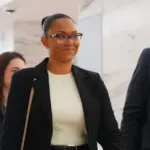
Chile occupies, circumstantially, a relevant place for Fujimorism and Keiko Fujimori, who on Tuesday assumed the Peruvian Presidency after 15 years of attempts and four candidacies. It was precisely in Santiago that her father, Alberto Fujimori, decided that the eldest of the clan should start a political career.
Read more We tested the latest Ray-Ban Meta, now with AI available in Chile
In November 2005, the former Peruvian ruler arrived on a private plane from Tokyo and entered Chile as a tourist. The Peruvian embassy, then led by José Antonio Meier, requested his immediate expulsion.
The chancellor of Ricardo Lagos’ government, Ignacio Walker, detailed to La Tercera that the Peruvian president, Alejandro Toledo, called him personally to request the administrative return of Fujimori. But that did not happen.
The case then went to the Supreme Court, which in 2007 approved Fujimori’s extradition, later sentenced to 25 years in prison for human rights violations. But by then, Fujimori’s stay in Chile had allowed him to get to know Chilean politics up close and strengthen ties with many of its leaders.
“I hold no sense of resentment,” Keiko said in 2011, when asked about the extradition process granted by the Chilean justice system to her father. “On the contrary, I remember many friends fondly,” she commented.
However, for Fernando Vivas, columnist of El Comercio, “Chile unfortunately does not bring the best memories for the Fujimori family or at least brings bittersweet memories, since the patriarch arrived there, who was detained. He spent periods imprisoned and periods under house arrest or free. But finally Chile, with much rigor and justice, granted extradition to Peru and, of course, the family visited him in Chile, the children visited him, Keiko visited him. It was in Chile when the father encouraged her to enter politics in his place. That would indeed have importance in her decision to run for congresswoman.”
“She led the Fuerza Popular bench for the next three terms and ran fully as President, having assumed her father’s legacy. So, I believe that Alberto’s decision to encourage his eldest daughter to do politics as his replacement, as having his legacy, was very important and that inspiration has ultimately led her to the Presidency, on her own merits,” Vivas told La Tercera.
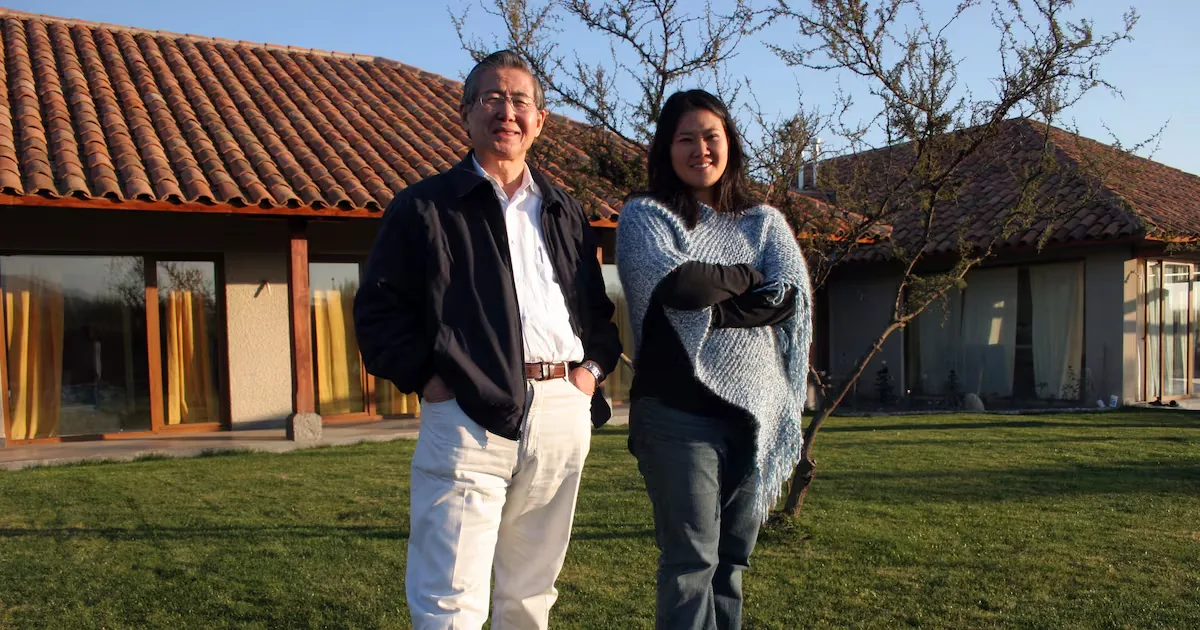
Keiko Sofía – who had assumed the role of first lady at just 19 years old – was pregnant and regularly traveled to Santiago to meet with her father, both in Los Dominicos and Chicureo. It was then that Alberto Fujimori revealed to her that he was going to run as a presidential candidate in the 2006 elections. Although that initiative did not prosper, the idea that Keiko would run as a congressional candidate for Metropolitan Lima bore fruit. Thus, she appeared as the first on her party’s list.
Keiko Fujimori, at 30 years old, debuted in the electoral arena in that year’s legislative elections, which she won with the highest individual vote of that process on the Alliance for the Future list. During Alan García’s government, to which she provided parliamentary support, the young legislator defended her father’s legacy, who after his extradition in 2007, was tried five times and sentenced to a total of 52 years in prison for multiple corruption and crimes against humanity offenses. Amid this turbulent scenario, Keiko built a new party, Fuerza 2011, with which she ran in the 2011 presidential elections.
“A new stage of Fujimorism – with Fujimori, but without him – was born in Chile, precisely, to add one more paradox to the historical tensions between the Pacific countries. Fujimori’s trip (to Chile) at the beginning of the 2006 electoral campaign pressured Fujimorists in several ways: his former collaborators, to politically articulate under the same political umbrella; his followers, to publicly recognize themselves as such; his children – especially Keiko – to assume greater responsibilities, including getting involved in politics. Therefore, it can be said that, at that juncture, Keiko found her dynastic destiny,” wrote Peruvian political scientist Carlos Meléndez in his book El Informe Chinochet: Historia Secreta de Alberto Fujimori en Chile.
In 2006, a dark episode also occurred in the history of the Fujimori family. Alberto’s younger children, Kenji and Sachi, gave testimony in the Supreme Court in Chile stating that their mother Susana Higuchi had psychological problems. All this happened amid the Chilean justice system’s review of the notebooks sent by the Peruvian State due to Alberto Fujimori’s extradition request.
In their testimonies, they denied the kidnapping and mistreatment accusations made by their mother, although they did attribute psychological problems to Susana Higuchi.
The time the now Peruvian president visited Santiago to see her father served to strengthen ties with various local figures. But even before, when she served as first lady, she related to then-President Eduardo Frei and his wife, Marta Larraechea.
Read more Review of the Xiaomi 17T Pro: power and Leica cameras tested at the heights of Valle Nevado
When Alberto Fujimori visited Santiago, he did so with his very young daughter Keiko, which aroused the affection of Marta Larraechea, who always accompanied her when they met at various summits. When Keiko won the Presidency this year, Frei called her by phone and was invited to the handover ceremony.
The current president has also strengthened political ties as founder of Fuerza Popular and for her role as second in command of the Union of Latin American Parties (UPLA) for the 2025-2027 period.
In this context, she met the former constituent candidate of National Renewal and executive vice president of UPLA, Andrea Ojeda, who was also invited to Keiko’s inauguration ceremony. “She, President Fujimori, has a lot of affection for Chile. She lived here in a house, has friends, uses Chilean words, and has great appreciation for Chile,” she told LaMetro FM radio.
About their relationship, she added, “Keiko and I have known each other for about seven or eight years, we have traveled together. We have a very good, very nice relationship.” Ojeda described her as “a disciplined person, with a very clear purpose, which is to lead her country.”
This coincides with the tone of the first formal contact with the Chilean government. In Lima, on the day of the handover, Keiko Fujimori and President José Antonio Kast expressed their “full willingness to consolidate high-level dialogue”, according to the Peruvian Foreign Ministry in a post on X.
According to Ojeda, Fujimori’s rise to the Presidency was part of a long-standing plan. With three failed presidential elections, the fourth would represent part of the strategy that, according to the RN leader, “was so well planned so long ago that she at this moment – of taking power – was quite calm, because the design had been planned a long time ago.”
In any case, the new president’s relations with Chilean politicians are not limited to the right. Former chancellor and ex-senator of the Socialist Party, José Miguel Insulza, told La Tercera that he has had a relationship with Keiko dating back almost three decades. Although he denied it was a close relationship and said it would be limited to protocol circumstances.
“I met her at the National Stadium in ’97, when she was first lady to her father, Alberto Fujimori, and I also happened to meet her at many meetings we had at that time and then I have seen her a few times since,” he mentioned.
This week, Insulza attended the Peruvian Congress to witness Keiko’s assumption and her arrival at the Casa de Pizarro. It was Fujimori who personally summoned Insulza, and then President Kast included him in the delegation that traveled to Lima.
“I believe she has a very good image of our country. I know several people who work with her and are interested in a very good relationship with Chile. So I am sure it will be very good,” he added.
The Chilean delegation brought together figures from different sectors, including – besides Insulza himself – the former Minister of Justice during President Piñera’s second term, Hernán Larraín; the mayor of Santiago, Mario Desbordes; and former president, Eduardo Frei Ruiz-Tagle and former first lady Marta Larraechea.
Another Chilean leader who has established good ties with the president is precisely the mayor of Santiago, Mario Desbordes. “We have a very close, very cordial, very nice relationship. We talk a lot by phone, WhatsApp. But from now on, of course, she is no longer my friend Keiko, she is President Fujimori. I am very careful with that, but the relationship remains very cordial,” he told La Tercera. In fact, the mayor announced that when the president visits Chile, he will go to the Santiago Municipality to receive the keys to the city.
Read more The death toll rises to nine and the injured to 28 from a Russian ballistic missile attack on Kiev