








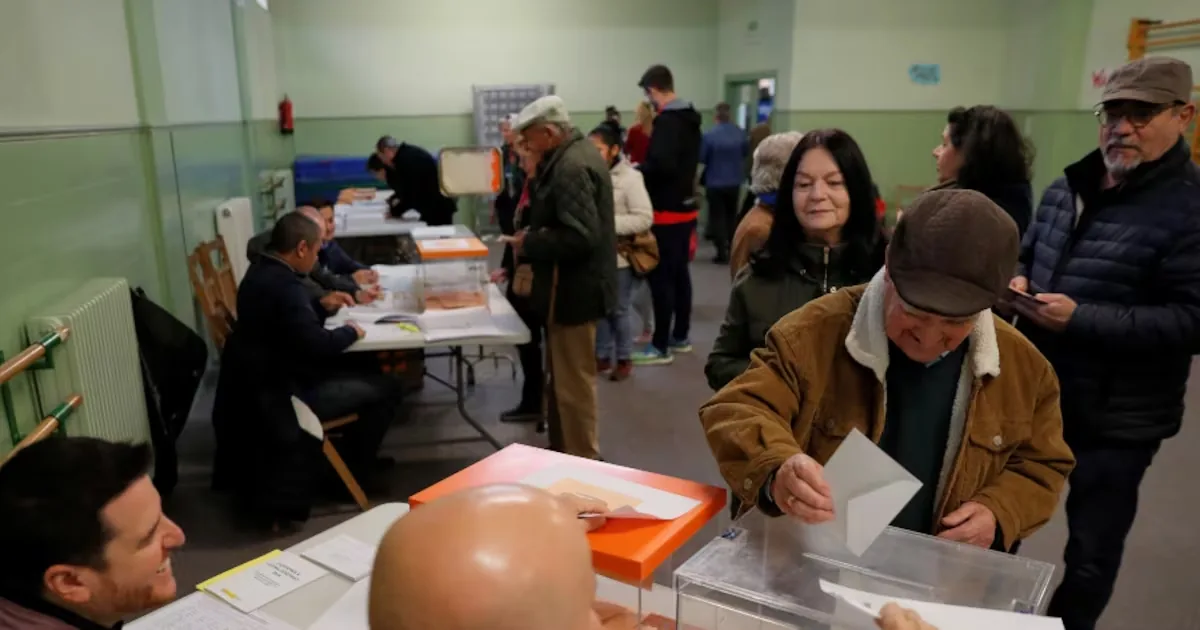
The Supreme Court of Spain last Tuesday suspended the voting rights of thousands of naturalized citizens under the Democratic Memory Law, popularly known as the “grandchildren’s law.”
Read more Russia announces the shooting down of nearly 400 drones launched by Ukraine
The decision halts the immediate registration of these voters in the electoral roll and reopens a political dispute that is already projected onto the 2027 general elections.
The regulation, approved by the Congress and the Senate in October 2022, allows those born outside the country who are children or grandchildren of exiles during the Civil War and the Franco dictatorship to apply for Spanish nationality.
Since its entry into force, it has benefited thousands of people in various countries, including several in Latin America.
In practice, the ruling of the high court stops the automatic inclusion of the newly naturalized in the Census of Absent Residents (CERA) and requires them to prove their status as relatives of Spanish exiles in order to vote.
In any case, the measure is precautionary and should not be considered final or definitive, as the Supreme Court still has to resolve the substance of the controversy.
The origin of the dispute lies in an appeal filed by the far-right parties Vox and Iustitia Europa against a July agreement by the Central Electoral Board (JEC), which had refused to rule on the electoral effects of the regulation. Both groups accused Pedro Sánchez’s socialist government of trying to inflate the electoral roll for its own benefit, which was denied by Moncloa.
In the ruling, made public on Thursday, the Supreme Court argued that the registration in the electoral roll of those naturalized under the Democratic Memory Law generates “a founded, real, and serious danger of seriously affecting the objectivity and transparency of the electoral process.”
That, according to the order, would cause “irreversible damage to the integrity and correctness” of the process, at a time when it affects an essential element for the rule of law such as the expression of popular will through suffrage, according to the newspaper El País.
The Contentious-Administrative Chamber of the highest Spanish judicial instance invoked the principle of “periculum in mora” that governs the adoption of precautionary measures, and considered that there is a risk of alteration of the census through an exceptional increase in registrations in the CERA.
The court accepted the figures from Iustitia Europa, which counted 408,262 new registrations in the CERA between the 2023 elections and July of this year. The decision was agreed upon by five of the six magistrates who debated the appeal.
The Public Prosecutor’s Office and the State Attorney opposed the measure and warned that it would restrict a fundamental right recognized in the Constitution for naturalized citizens. The court, however, clarified that the measure “will have a merely temporary character” and that only those who can prove their status as a child or grandchild of a Spaniard who suffered exile for political, ideological, religious, or sexual orientation and identity reasons retain the right to vote.
However, the criterion adopted by the Supreme Court contradicts the guidelines set by the Ministry of Justice in October 2022, which established that it was not necessary to prove that link for those who left Spain between July 18, 1936, and December 31, 1955, a period for which exile status was presumed.
In response, the Supreme Court warned that this broad interpretation caused “the progressive increase of the CERA” and does not conform to the content of the regulation it interprets.
The “grandchildren’s law” corresponds, strictly speaking, to a provision included in the Democratic Memory Law, approved in October 2022, as explained by the Spanish media El Periódico. The text contemplates three ways to access Spanish nationality.
The main one benefits those born outside Spain who are children or grandchildren of a Spaniard who had lost or renounced their nationality after suffering exile for political, ideological, religious, or sexual orientation and identity reasons, with a limit of second-degree kinship, without the possibility of going to a great-grandparent or great-great-grandparent.
Read more Iran announces the shooting down of a US Army Predator drone over waters of the Strait of Hormuz
The second way applies to children born abroad to Spanish women who lost their nationality by marrying foreigners before the Constitution came into force. The third corresponds to adult children of those who obtained nationality through the first “grandchildren’s law”, promoted by José Luis Rodríguez Zapatero in 2007.
The application period opened in October 2022 and, after a one-year extension granted by the government, closed in October 2025. During that period there were nearly 2.6 million applications, of which more than 100,000 have already been rejected.
Those who obtain nationality through this route acquire the status of Spaniard by origin, although in a subsequent manner and without retroactive effect, with the same rights as any other citizen, including the right to vote in general elections through the CERA.
The impact of the law on the electoral roll is considerable. By March of this year, more than 1.2 million files had been initiated, of which 545,000 were approved and 306,500 completed their registration in the consular registry, a prior step to enrollment in the electoral roll.
Currently, voting from abroad accounts for nearly 7% of the Spanish electoral roll. Thus, had there been no judicial intervention, projections indicated that up to 12 out of every 100 people registered in the electoral rolls would have voted from abroad by the end of the process.
While in 2021 the external census grew by 57,667 people, since the law came into force in October 2022, the number of new registrations increased by 461,858 voters. Only between January and August of this year, 82,790 new registrations were recorded, a pace that surpassed the growth of a whole previous year in eight months.
Furthermore, according to information from the newspaper El Mundo, the phenomenon was unevenly distributed across Spanish territory. The Community of Madrid led the increases with a 36.67% rise in external voting, followed by the Balearic Islands, Álava, and Girona.
However, those figures would reflect the lack of a link with much of the Madrid registrations, unlike regions such as Galicia or Asturias, where there were direct migratory routes to America during the Civil War and the Franco dictatorship.
In 2023, the Ministry of Inclusion, Social Security, and Migration had already acknowledged that external voting could “alter the last seat in up to nine provinces with differences of less than 2,000 votes,” a margin that allowed the Popular Party (PP) to take a deputy from the PSOE in Madrid after the CERA recount.
The Supreme Court’s agreed order triggered an immediate political confrontation in a debate that the PP leader, Alberto Núñez Feijóo, had already initiated by denouncing an “electoral engineering” by the government. President Pedro Sánchez accused the opposition of violating fundamental rights. “The Popular Party and the far right are cutting off the voting rights of thousands and thousands of Spanish citizens,” he said, and assured, according to the news agency EFE, that he aspired to citizens “all first-class, with the same rights.”
The president also asked the court to resolve quickly to prevent the suspension from turning into a legal limbo.
From Vox, parliamentary spokesperson Pepa Millán welcomed the ruling. She highlighted having achieved that the court “suspend the electoral effects of the so-called grandchildren’s law and the attempt at electoral manipulation for the next elections,” and stated that her party had managed “to stop Pedro Sánchez’s goal of perpetrating a coup in the next general elections through the adulteration of the census.”
For her part, the president of Madrid, Isabel Díaz Ayuso, of the PP, anticipated a future instruction from the Central Electoral Board and announced allegations “to ensure that the government does not manipulate the census” with external voting.
The president of the Supreme Court, Isabel Perelló, responded to the official criticism during the opening of the judicial year. “It is not acceptable that the public disqualification of judges becomes an instrument of pressure,” she said. The Supreme Court itself insisted that its decision is not final and that it still has to rule on the substance of the appeal filed by Vox and Iustitia Europa, in a process whose outcome could redefine the rules of external voting before the 2027 general elections.
Read more Trump outlines the possibility of “staying” in Iran and with its oil “like in Venezuela”