





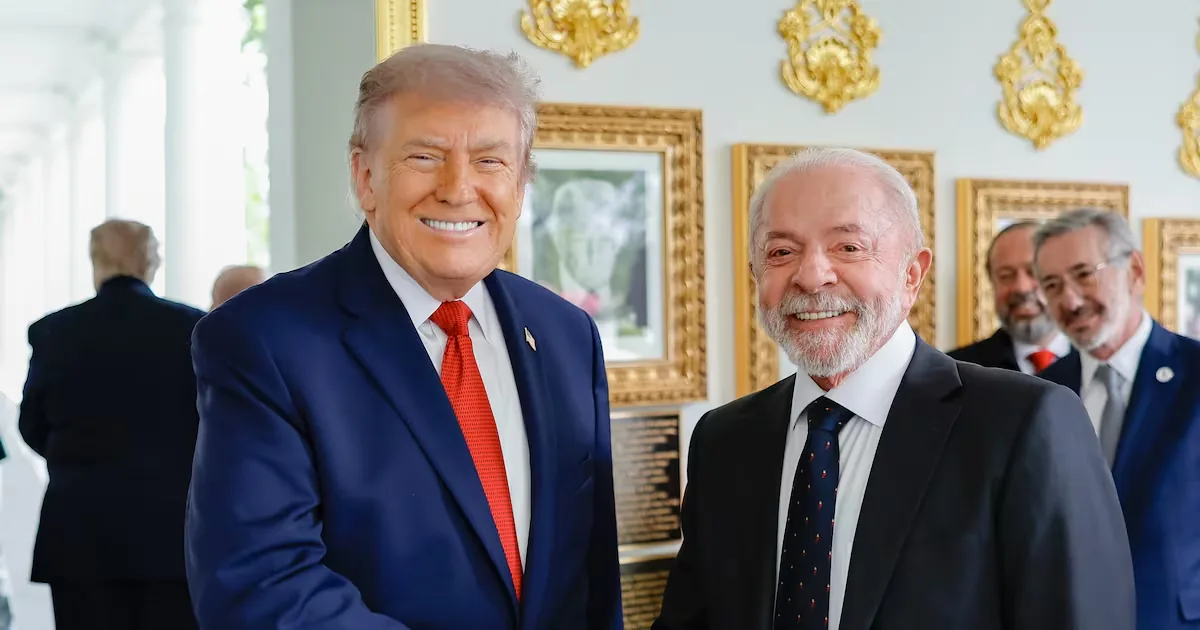
The United States government ordered this Wednesday the imposition of a 25% tariff on “most” Brazilian imports, attributing the trigger for this decision to the lack of “good faith” of Brazil’s president, Luiz Inácio Lula da Silva, when negotiating with Washington.
Read more Why the movie Behemoth! is the biggest challenge of Pedro Pascal’s career
“President (Donald) Trump has ordered the United States Trade Representative (USTR) (Jamieson Greer) to impose a 25% tariff on most Brazilian imports,” announced U.S. Secretary of State Marco Rubio on social media, stating that “there should be no doubt about the reason: President Lula and his government have not negotiated in good faith with the United States.”
Immediately after, the senior U.S. official asserted that the economic policies adopted by the head of the Planalto “are harmful both to Americans and Brazilians.”
“Over the past year, Lula has put his own ego ahead of reaching an agreement that benefits the Brazilian people, and these tariffs are the price to pay for that”, Rubio said.
This was also confirmed by the U.S. Trade Representative’s own office in a note defending the imposition of the aforementioned 25% tariff, arguing that “certain Brazilian measures related to digital trade and electronic payment services, unfair preferential tariffs, interference in the fight against corruption, intellectual property protection, ethanol market access, and illegal deforestation are unreasonable and harm or restrict trade for American farmers, workers, innovators, and exporters.”
Precisely, the first item listed was one of the key points of tension between the two countries, as Washington maintains that Brazil “has unfairly harmed” U.S. suppliers by favoring the Pix electronic payment service, promoted by Banco do Brasil, used daily by millions of Brazilians.
The same service that was recently registered by the Brazilian government as a “well-known trademark” with the National Institute of Industrial Property (INPI) to be protected if it markets more products or services than originally conceived.
In this context, Greer argued that, “whether punishing U.S. tech companies for refusing to censor political speech, backtracking on anti-corruption law enforcement, or allowing Brazilian farmers to exploit illegally cleared land to gain an advantage over U.S. farmers, Brazil’s unfair trade practices have prevented U.S. workers and producers from accessing this important market.”
In that sense, he pointed out the measure as “necessary” to “address these unfair trade practices and ensure that U.S. workers and businesses can compete on a level playing field”, while lamenting that “extensive negotiations with Brazil over the past year have not resolved these issues,” despite being “open to continuing” to do so.
Although the press release issued to formalize the tariff does not specify an effective date and assigns its application to “certain products,” the so-called notice of action published by Greer’s office on the tariff states that the additional tariff “applies to products imported for consumption or withdrawn from warehouse for consumption as of (…) July 22, 2026.”
Likewise, it lists a long list of sanctioned goods, including pharmaceutical products; civil aircraft and aircraft components; passenger and road transport vehicles; and “informational materials” such as films, printed publications, or works of art.
This announcement contrasts with steps taken earlier this July by both administrations, as Brasilia seemed to have intensified its negotiations with Washington to close an agreement to reduce or eliminate tariffs imposed by Trump originally decreed in retaliation for the trial for attempted coup d’état against former Brazilian president Jair Bolsonaro.
Read more What if instead of listening to the heartbeats, we listen to the women?
In response to the new imposed tariff, the Presidency of Brazil published a press release stating that “July 15, 2026, will be marked in the history of Brazil-U.S. relations as a regrettable milestone.”
“The Brazilian government repudiates the decision announced today by the U.S. government on the imposition of 25% tariffs on Brazilian products”, reads the text from the Secretariat of Social Communication of the Presidency shared on social media by Lula.
In rejecting these “unilateral” measures by Washington, Brasilia argued that “there is no justification,” since “the United States has accumulated a trade surplus in goods and services with Brazil worth 424.5 billion dollars over the past 15 years; in 2025, 76% of imports from the United States entered the country duty-free, and the average rate applied to U.S. products was only 3.1%.”
“Brazil does not recognize the legitimacy of investigations unsupported by multilateral trade rules”, it emphasized, maintaining that, despite this, they “never” abandoned negotiations and presented “evidence refuting each of the accusations of alleged unfair trade practices.”
Specifically, it claims to have demonstrated that “the accusations against Pix and the regulation of digital platforms are unfounded.” “Pix is an asset of our people and an international benchmark for public digital infrastructure,” the note asserts, adding that the Brazilian government will not give up “protecting” families and children “from the greed of a handful of techno-oligarchs.” “Freedom of expression is not a blank check for crime,” it adds.
The note also rejects deforestation accusations: “The whole world knows that since 2023, we have been determinedly combating environmental crimes and drastically reducing deforestation in all Brazilian biomes.”
In any case, the Brazilian executive promised that “it will continue to take measures to reduce the damage caused to the economy and the country’s income”.
“We will continue diversifying trade alliances and opening new markets for our products, as we did by signing MERCOSUR agreements with the European Union, the European Free Trade Association, and Singapore,” it pointed out.
At the same time, as a reaction, it declared that “it will immediately initiate procedures to activate the instruments provided for in the Reciprocity Law” to respond to the new tariff, and that “it will resume the issue within the framework of the World Trade Organization dispute settlement mechanism.”
“It is regrettable to note that the unfortunate outcome of the investigations (…) is part of a conspiracy hatched with the active collaboration of the Bolsonaro family. These are false patriots who orchestrated and publicly defended actions against our country, driven by electoral objectives,” it alleged, alluding to the actions of his sons after the trial and sentence of more than 27 years in prison against the former president for attempted coup d’état.
“You cannot love Brazil only when we win elections. Protecting our sovereignty is an obligation that transcends all parties and tendencies”, he stated, concluding that “the Brazilian government will not relent in its duty to preserve it.”
Read more French Parliament approves the right to assisted death for people with incurable diseases