








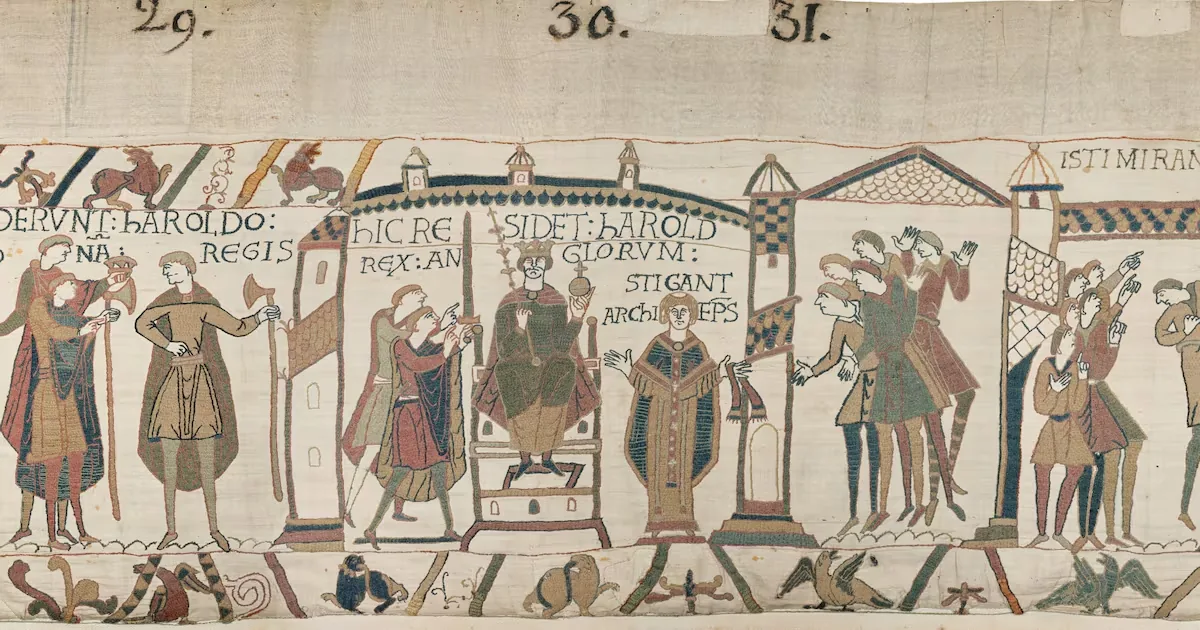
Treasure of the Late Middle Ages, yes. But also a binational relic, a living heritage treasure. Because the Bayeux Tapestry is both fabric and a graphic novel. Perhaps the best way left by those who lived in that era to tell the famous Battle of Hastings, in October 1066.
It happened that in the early hours of the morning on Friday, July 10, 2026, an armored truck slowly backed up to the loading dock of the British Museum. From inside, with extreme care, a metal box the size of a small car was unloaded. Inside traveled one of the most important treasures in European history: the Bayeux Tapestry. After almost a thousand years, the emblematic piece was returning to the land where it was probably created.
The transfer, described by witnesses as “like a movie,” was carried out in absolute secrecy. The tapestry left its usual home at the Bayeux Museum in Normandy the night before. Protected in a double container with climate control, impact and vibration proof, it crossed the English Channel on a vehicle train through the Eurotunnel. The total journey, about 560 kilometers and 11 hours, was under constant police escort.
Nicholas Cullinan, director of the British Museum, did not hide his emotion upon receiving the work: “It is the first time in almost 1,000 years that this very important piece of British — and also French — history is on these shores. It is incredibly exciting,” he said in statements collected by international media. Alongside him, the French ambassador to the United Kingdom, Hélène Tréheux-Duchêne, celebrated the moment as a symbol of renewed friendship.
The operation was not without controversy. French experts warned about the fragile condition of the piece, which has numerous tears, holes, and folds accumulated over centuries. To minimize risks, tests were carried out with full-scale replicas and the container maintains constant temperature (20°C) and humidity conditions.
The United Kingdom insured the work for up to 800 million pounds sterling (over 1 billion dollars), one of the highest policies for a cultural asset. In exchange, it will lend France important pieces from the Sutton Hoo treasure and other medieval artifacts. The total cost of the operation is around 20 million euros, borne by the British authorities.
French President Emmanuel Macron, who announced the loan during a state visit in 2025, celebrated it as “a tangible expression of our long-standing friendship” and an opportunity to “write the next chapter” of bilateral relations after Brexit. “The tapestry is an unfinished story. It is up to us to continue it,” he wrote in The Times.
The Bayeux Tapestry, then, is technically a wool embroidery on linen measuring 70 meters long (approx. 230 feet) by 0.5 meters high, not a simple tapestry but an extraordinary visual narrative of the Battle of Hastings and the Norman conquest of England in 1066.
Its 58 scenes, with 627 human figures, 737 animals, ships, castles, and everyday details, narrate how William, Duke of Normandy (William the Conqueror), defeated King Harold Godwinson, ending Anglo-Saxon rule.
Read more Why the movie Behemoth! is the biggest challenge of Pedro Pascal’s career
It is believed to have been commissioned by Bishop Odo of Bayeux, half-brother of William, and probably embroidered by English craftswomen, possibly nuns from Canterbury, around 1070-1080. After its creation in England, it crossed the Channel to Normandy, where it has remained almost uninterruptedly, except for brief periods in Paris. It is the first time it has left France in over 900 years and the first time it has returned to British soil since its creation.
UNESCO included it in the Memory of the World Register in 2007. For many historians, it is “the first comic in history” and an irreplaceable document for understanding the origins of the modern United Kingdom.
The narrative core of the tapestry is the Battle of Hastings, fought on October 14, 1066 near the present-day town of Battle, in East Sussex. The events that triggered this confrontation were due to a palace intrigue, following the death of the English king Edward the Confessor. This is explained by historian Jacques Heers in his famous History of the Middle Ages.
“At Edward’s death, England, already weakened by internal disorders, had to face the harsh competition between three claimants to the throne: Harold, favorable to the Danes, who soon had himself crowned king; Harald of Norway, who attacked the east coast; and William of Normandy, who claimed to have received solemn promises from Edward and Harold. The latter defeated the Norwegians and then headed south in search of the Norman army, then expanded by contingents from Flanders, Picardy, and Poitou.”
Thus, Heers comments, the mentioned battle took place. “On October 14, 1066, at Hastings, the battle was decided in favor of [the Normans]: Harold was killed. William had himself crowned king in London.” It should be added that the Normans — originally from Scandinavia — were established in France, where they assimilated with the local population and even swore loyalty to King Charles III of France and received from him what later became the Duchy of Normandy. But they always maintained some independence.
The tapestry not only documents these events but offers a unique view of medieval life: armor, Norman Viking ships, military tactics, and customs of the time.
The anticipation is enormous. Tickets for the first months of the exhibition, which opens on September 10, 2026, and will run until July 11, 2027, at the Sainsbury Exhibitions Gallery, sold out within hours. It is estimated that hundreds of thousands of visitors will come to the British Museum to see the work displayed in its full length.
After the exhibition, the tapestry will return to France for delicate restoration at its Bayeux museum, currently under renovation.
Read more What if instead of listening to the heartbeats, we listen to the women?