


In 2017, about a year after the death of his paternal grandmother, director Rafael Guendelman Hales (Santiago, 1987) found a series of tapes that had been stored in her house. Although he is a visual artist and filmmaker, his father had never told him about their existence, much less their content.
Read more Pride march in Berlin suspended after crash left several injured
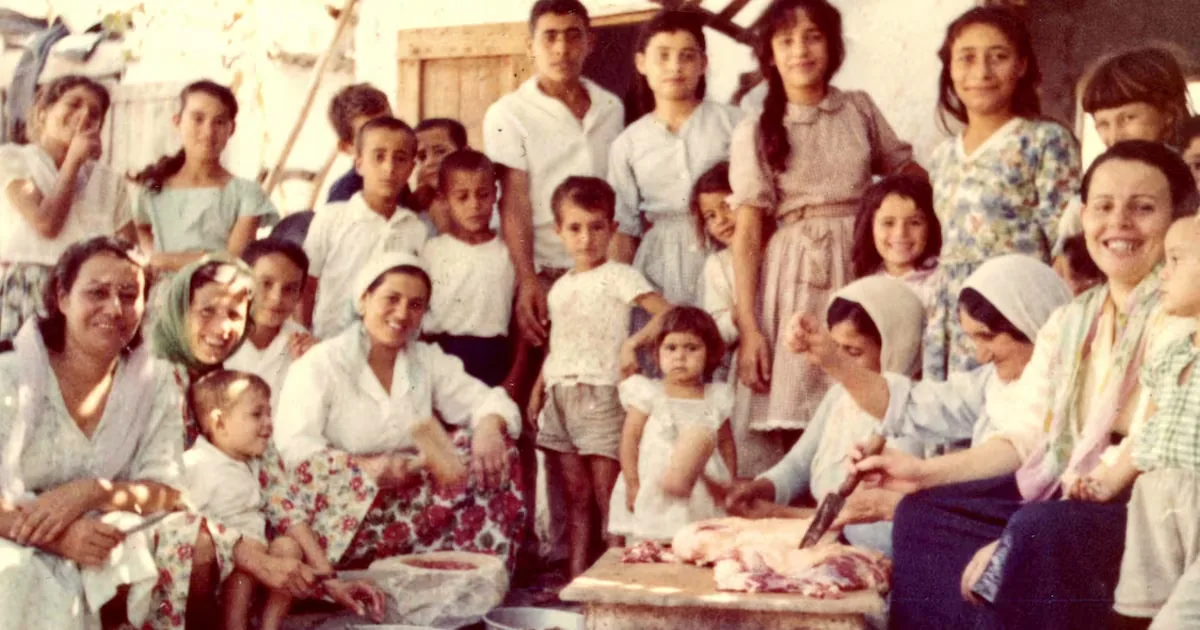
“It was a kind of hidden treasure in the cellar. I never imagined I would find something like that,” says the filmmaker, who is of Jewish and Palestinian descent. The images correspond to home recordings from the time his father traveled with his family to live in Israel in the 70s. An episode of his life about which he had rarely wanted to elaborate.
“In my house, they were always pro-Palestine. My dad got uncomfortable with the topic and never told me much. Finding this material was an excuse to ask him to talk about it. His mother had died, who holds great symbolic weight in every Jewish family, and now we could talk openly,” he states.
These father-son conversations form the beginning of Az Zeeb, Guendelman’s documentary which just had its world premiere at the Marseille International Film Festival (also known as FIDMarseille) and will debut in national cinemas during the first half of 2027. Without offering simple answers, the film narrates the opposing trajectories of a Jewish family emigrating to Israel from Chile and that of a Palestinian family expelled from the village of Az-Zeeb after the arrival of settlers.
That same year, 2017, shortly after finding the tapes in his grandmother’s house, the director traveled to Israel and took the opportunity to do some filming. He then created the video art Aliyá, yeridá and the editorial project Nosotros estudiamos hebreo, initiatives in which he reflected on his origins and which, he now assures, served as the basis for his first feature film as a filmmaker.
“I had always wanted to delve deeper into how Israel convinces people to go and populate Israel. I had never done it because it is always more complex to do it from the side of the perpetrator of violence,” says Guendelman, who acknowledges himself an admirer of Palestinian filmmaker Kamal Aljafari and Israeli director Avi Mograbi (“for me, he is like a kind of Israeli Ignacio Agüero,” he points out).
“Except for an Israeli propaganda archive, all are personal archives. The camera always has something erratic. It’s not a calm camera that shows you everything. It’s not a hegemonic gaze, but rather a partial one. My grandfather entered a place where there was a ruin and filmed something. I went to Palestine and filmed something that caught my attention: a march, a flower. In that sense, it is more like a diary,” he explains.
This characteristic is further crystallized because he decided to film in Super 8, the same format as the original recordings. After digitizing and color correcting the tapes that were in his grandmother’s possession, all the materials merge into a single fabric. “We did not try to homogenize the film, because it is composed of very diverse archives from very different years. There are errors and they are part of the film,” he warns.
-Do you remember at what age you became aware of this double history that runs through your family?
I think unconsciously always, but as I got older I became more critical. In college, I got more into the subject. Then, in 2012, when I was 24, I traveled to Palestine and lived there for a while. It’s a curious story: I took a funded trip for all Jewish youth under 26. I brought my camera and ended up staying seven months in Palestine, and didn’t take the flight back. That year was a great learning experience. I connected a lot with what was happening there and with the reality of both sides, so to speak.
Read more Cuba forecasts electricity cuts that will leave 67.5% of the island without power
-At the beginning of the documentary, your mother says that your family didn’t have a camera to film.
Yes, it’s an argument for using the archive images I found. It’s a kind of metaphor with which I propose that those who build history are those who have the images, those who have an archive and give them a narrative. In general, the winners are the ones who tell the story. Here, Israel has this documentary archive about the germ of Israel. On the other hand, Palestinian history has been destroyed and displaced, and there has been a loss of archives. I found it interesting to play with that contrast: on one side, there are many images and, on the other side, there are no images. Until at one point in the film, some images appear and something very powerful is triggered.
-How did you decide that almost the entire documentary would be in Super 8?
The material was very good, and I found it interesting to do something in the same format, perhaps to create a counterpoint, a kind of conversation between that archive and the archive I was building, between the more Zionist vision of my grandparents, who filmed certain things at the time, and my vision, who films other things when I go to that same territory. It seemed very coherent that it would be with the same materiality. At some point, you don’t know if it’s the 70s or 2025, if it’s Palestine, Israel, or Chile. I think there are many visual relationships between the two territories: hills, mountains, valleys, desert. Chile has the largest Palestinian community, and I’ve always thought it’s because they felt very comfortable.
-Do you think this story could have been told without the archive you found in your grandmother’s house?
I liked the tension produced by making a documentary with images that were not recorded to document something. It was taking images that were made to remember a family trip or similar moments, and giving them a twist to tell this story. The film is not composed of images made to document the history of the Israeli-Palestinian conflict. Instead of looking at the conflict head-on, it’s something more oblique. That was provided by the archive I found. The film is linear, but sometimes the images challenge you. You try to fit them into one thing and you don’t quite know if they are in line with what they are telling you or not. I think that’s the more artistic, plastic game with images.
-How did everything that happened from October 2023 in that territory influence the final form of the film?
I don’t want to spoil too much, but it did influence it. On the one hand, my father’s view of Israel changed very strongly. I believe that today there are no gray areas. Beyond political color, this is not human. It is unacceptable and must be denounced. In that sense, my father makes a kind of turn in the film, there is a trajectory that changes. In addition, we went to Palestine in 2024 to film scenes and the protests that occurred were incorporated. The challenge was how to integrate this without losing the point of view we already had. But we couldn’t ignore what was happening.
-What conversations has the documentary generated on both sides of your family?
It is very complex for my father to talk about the things he talks about. Publicly criticizing Israel is very complicated for a person born into a very Jewish family. There are mechanisms of coercion, there are mechanisms of threat. We have been threatened. I don’t know who from the Jewish community, but we have received letters. Family ties have been cut. The issue is very complex, especially on that side of the family. On the other hand, there are people who appear anonymously in the film, specifically a Palestinian uncle who went into exile and for security reasons could not give me his name. In that sense, the film has been very alive.
Read more Book review: from Fleur Jaeggy to Christopher Domínguez Michael
Az Zeeb
Chile, Qatar, 2026, Color, 86’
Direction and screenplay: Rafael Guendelman Hales
Editing: Ana Edwards, Rafael Guendelman, Sebastián Salfate
Music: Ian Jakab
Sound: Roberto Espinoza (Sonamos)
Production: Joaquín Echeverría (Brisa Films)