



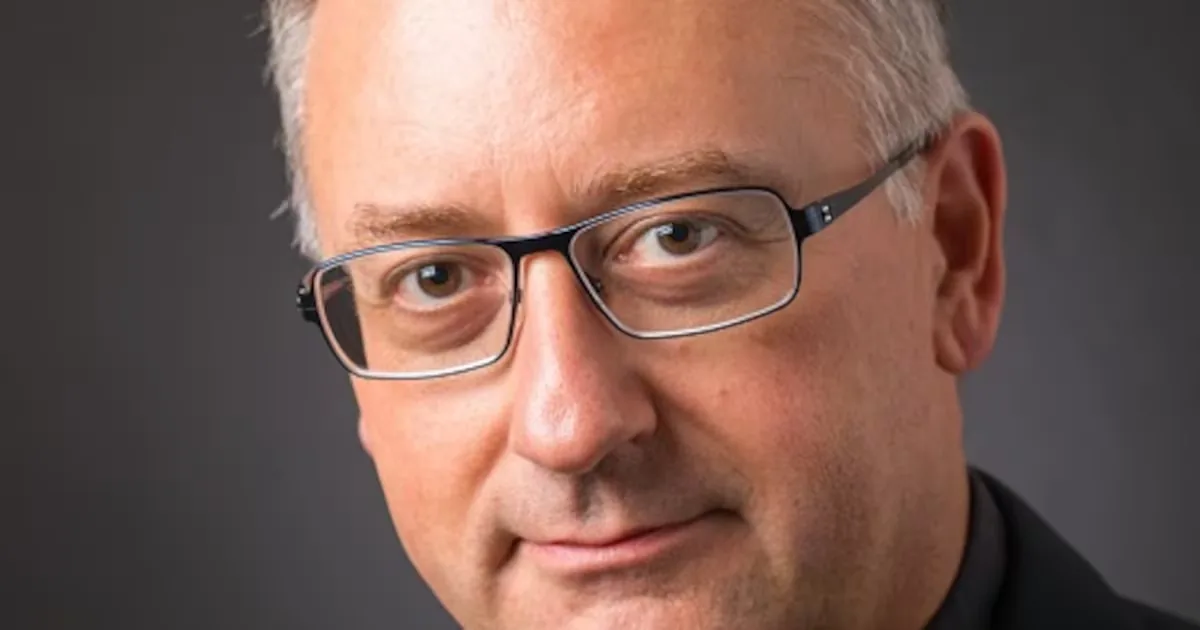
“I see him as a serene man, who listens more than he speaks,” says Antonio Spadaro when asked how he sees Pope Leo XIV a little over a year after his election. The former director of the Italian Jesuit magazine Civiltà Cattolica and current undersecretary of the Dicastery for Culture and Education is one of the most authoritative voices to speak about the Catholic Church and the Vatican. A man close to Pope Francis, he assures that the current pontiff is consolidating processes opened by his predecessor and says he distrusts the term “restoration” used by some after the election of Leo XIV. “That he has recovered the mozzetta or reopened Castel Gandolfo is part of his interpretation of the Petrine ministry, not an ideology.”
Read more Over 340,000 people evacuated and dozens of flights canceled after Typhoon Noul’s arrival in China
For Spadaro, who will participate in the International Church Communications Seminar, organized by the Catholic University, on July 27 and 28, the current pontificate follows the line of its predecessor on issues such as “synodality, peace as a non-negotiable line, the poor and migrants.” “It is a creative continuity,” he says, “not a photocopy.” And when comparing him to some of his predecessors, beyond Leo XIII, to whom Prevost himself has referred, the Jesuit priest assures that “by temperament” and by that “capacity to keep a Church in tension united without breaking, sometimes I think of Paul VI.” The current Pope, he assures, “is a helmsman in difficult times, who governs with the calm of one who prays.”
When he was elected, there was much talk about the role he could play as a counterweight to Donald Trump, especially since he is American. Do you think the cardinals took that into account when electing him, do you think he is seen today as the antithesis of Trump?
The cardinals did not elect an “anti-Trump,” they elected a pastor capable of fostering communion in a wounded Church and in a broken world. Reducing a conclave to a geopolitical maneuver means not understanding what happens in the Sistine Chapel. That said, Prevost’s biography is in itself a message: an American from Chicago with Peruvian nationality, twenty years of mission in Chiclayo, a Sicilian grandfather, Creole roots. It is the USA seen from the Global South. When he speaks English on American television, he enters homes with an authority that no foreign Pope had ever had. Has he become a counterweight? In fact, yes, but not by political choice, but by the weight of the Gospel. He doesn’t need to mention Trump, it is enough for him to talk about migrants, international law, the instrumental use of faith. It is not an opposition, it is a difference in nature. Power uses religion to consecrate itself, the Pope refuses to consecrate power. That’s all, and it’s a lot.
Throughout 2025, he maintained a more reserved, more silent attitude, but things changed since the consistory in January. Can it be said that his pontificate truly began this year?
I would rather say that the phase changed there. The first period was not one of silence: it was one of listening. Leo inherited a Jubilee inaugurated by Francis, a year that was not “his” and which he served with discretion, until closing the Holy Door on January 6. On January 7 and 8, he convened the extraordinary consistory: first he listened to the Church, then he began to address the world. There is an Augustinian logic in this: first interiority, then the word. And there is also a logic of government. A few days later, on January 9, in his speech to the diplomatic corps, he denounced the replacement of the diplomacy of dialogue with a “diplomacy of force.” That is the true international policy program of the pontificate. Those who described him as a cautious Pope have had to retract, after the international crises and the confrontation with Washington. But he has not changed: what has changed is the moment.
Since his inauguration, it became clear that the issue of new technologies would be fundamental for Leo XIV, which was evident with his first encyclical. You had already anticipated before the conclave that this would be the challenge for the next pope. Why do you consider AI to be a fundamental issue for the Pope and for the Catholic Church today?
Because we are not talking about just another technology. Artificial intelligence is not a tool that is used, it is an environment in which one lives. It redefines work, knowledge, relationships, war, the relationship with truth. The Pope told the cardinals when explaining the choice of name: just as Leo XIII responded with Rerum novarum to the first industrial revolution, today the Church must respond to another revolution, which affects human dignity, justice, and work. The “new things” of our time are algorithms.
And I add, the question of AI is the contemporary form of the anthropological question. Who is man when everything seems measurable, predictable, optimizable? It is not a topic for engineers: it is a topic for anyone who cares about the human. The Church intervenes not as an expert in technique, but as an expert in humanity, with two thousand years of reflection on the person. That is why, on May 15, exactly 135 years after Rerum novarum, Leo signed Magnifica humanitas: the first encyclical in history dedicated to the digital revolution. And it is worth remembering that Prevost studied mathematics: he knows the biases, the statistical mechanisms on which AI is built. He does not speak from what he has heard.
The Pope also speaks in Magnifica humanitas about the power of the owners of large technology companies, which today exceeds that of national states. Do you believe that “Big Tech” is becoming a kind of world government, a superpower that threatens local systems and liberal democracy?
The real theme of the encyclical is not how to use AI well, but who controls it. It is a reflection on power. And the text says it clearly: today, disproportionate power over people’s lives is concentrated in a few subjects. Technology is not neutral: it takes on the face of those who conceive it, finance it, regulate it, and use it. I would not speak of “world government,” large technology companies do not govern, they do something more subtle: they own the infrastructure with which governments themselves must operate. They control data, computing power, the channels of public discourse. It is a de facto sovereignty without democratic legitimacy and without territory. For this reason, the encyclical takes up two classic principles of social doctrine and applies them to the digital sphere: subsidiarity, which today has been inverted – it is no longer the State that crushes intermediate bodies, but platforms that empty States and communities of content – and the universal destination of goods, extended to data and knowledge. Digital goods arise from everyone’s life: they cannot belong only to a few. International governance of AI is needed, just as was done with nuclear energy. The Pope is not naive: he knows it is difficult. But he also knows that giving up claiming it means surrendering.
Do you think that “Big Tech” and the Catholic Church can be seen today as two opposing worldviews, two contrasting conceptions of the human being and technology, something similar to “Silicon Valley versus the Vatican,” simplifying the concept?
The simplification “Silicon Valley versus the Vatican” is effective from a journalistic point of view, but erroneous, because the Church is not against technology and Silicon Valley is not a monolith. That said, there is indeed a conflict between anthropologies, and it would be hypocritical to deny it. On the one hand, there is a vision according to which man is a project to be overcome, the limit is a defect to be corrected, and death, a technical problem – think of certain transhumanist currents, or the political theology of someone like Peter Thiel. It is a gnosis in digital version, and it is no coincidence that it uses openly theological language: salvation, immortality, apocalypse. On the other hand, there is the biblical vision: man is a creature, the limit is the form of his dignity, fragility is the place of love. The point is that the game is not played between two institutions, but within each of us, every time we accept or refuse to be reduced to a profile.
The Pope does not mention Trump in the encyclical, but there are some passages that seem directed at the White House; do you think the Pope is aware of this and has assumed the role of counterweight to the disruptive and polarizing discourse coming from the United States Government?
An encyclical is not an opinion piece: it endures for decades, not just one legislature. That is why it does not mention Trump, just as Rerum novarum did not mention specific industrialists. But, of course, whoever reads the pages on the concentration of technological power, on the manipulation of public truth, on the alliance between computing power and nationalism, on the instrumental use of religion, recognizes the scenario in which we live, and that scenario includes Washington. The Pope is perfectly aware of this, he is not naive, and he has training as a canonist and mathematician, two disciplines that teach precision.
But beware, “counterweight” is a category of mechanics, and the Pope does not play on that chessboard. For years I have distinguished between the logic of the chessboard – where each piece exists to eliminate the other – and the logic of the fabric, where the different threads are held together. Trump plays chess; Leo weaves. If the result is that his voice acts as a counterweight to the polarizing discourse of the White House, that is an effect of fidelity to the Gospel, not to a political project. And, in fact, the White House fears him precisely for that: you cannot negotiate with someone who does not play your game.
Much has been said about Pope Leo XIV’s references to Leo XIII regarding the encyclical Rerum Novarum, but some have also recalled another text by Leo XIII that offers a different reading, the text in which he warns of “Americanism” as a risk for the 19th-century Church. Do you share that analysis and what parallels can be drawn today with that text?
It is a sharp interpretation, and I share it with a precision. The text is Testem benevolentiae of 1899, the letter to Cardinal Gibbons in which Leo XIII warned against what he called “Americanism”: the temptation to adapt the Gospel to the spirit of the American age, the activism that despises contemplation, the idea that the Church must adapt to modern civilization to succeed. Ultimately, the primacy of performance over grace.
The parallels with today are striking. 21st-century Americanism has two faces: Christian nationalism, which recruits God for the power of the nation, and technological messianism, which promises salvation through optimization. They are the same heresy in two versions: faith reduced to a civil religion of force and success. And therein lies the magnificent paradox: the best antidote to Americanism is an American Pope. Leo XIV knows that culture from within and precisely for that reason can tell them, in English and on their own ground, that the Gospel is not a strategic resource. An Italian or Argentine Pope could have been dismissed as “someone alien to us”; Prevost, no. The choice of the name Leo must then be interpreted in its entirety: Rerum novarum for the social question of AI, but also, implicitly, Testem benevolentiae for the spiritual question of America.