







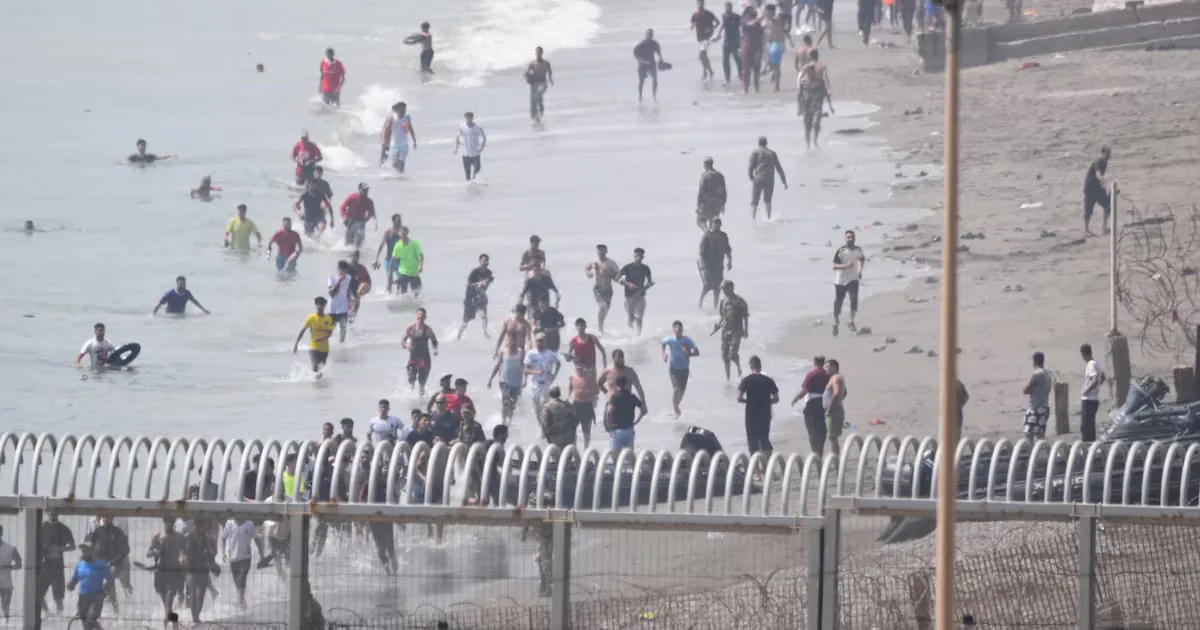
The Spanish government was forced this Thursday to deploy additional troops and police officers in its enclave of Ceuta, in North Africa, after thousands of people swam and entered the small territory from neighboring Morocco within hours. The Spanish Prime Minister, Pedro Sánchez, will travel this Friday to the autonomous city amid the crisis triggered by the influx of migrants.
Read more Russian missile destroys drone factory of a US company in Kiev
Videos recorded on Thursday at Tarajal beach showed crowds of people walking around the breakwaters and running along the beach and roads. Most appeared to be young men, but there were also families with women and children, detailed The Guardian newspaper.
After nine hours of migrant influx, about 20,000 people had crossed the Ceuta border on foot without facing opposition from Moroccan security forces, police sources cited by the Spanish newspaper El Mundo confirmed, marking the biggest migration crisis since 2021, the newspaper indicated.
According to El Mundo, the images coming from Ceuta recall those experienced in the spring of 2021, when Morocco sent more than 8,000 immigrants to cross the borders with Spain, in response to the transfer of the Polisario Front leader, Brahim Ghali, to a hospital in Logroño with the approval of the Spanish Government.
This time, numerous people continued entering Ceuta from Morocco uncontrollably as night fell on Thursday, according to Europa Press. This, despite the fact that, in the mid-afternoon, the Spanish Ministry of the Interior announced it had agreed with Morocco to return “as soon as possible” “all” migrants who had entered Ceuta illegally. Meanwhile, military forces were deployed at the border alongside the Civil Guard and also to ensure security throughout the autonomous city. At the end of the day, Spain closed the Melilla border crossing with Morocco, the Government delegation in the autonomous city reported.
Morocco attributed the massive entry of migrants at the Ceuta border to “criminal organizations.” Achraf Maimouni, a member of the Moroccan Association for Human Rights, described the situation as “exceptional.” He said the Tarajal border opened “under unusual circumstances” on Thursday morning and people crossed.
The increase in entry attempts coincides with a rise in the number of deaths on the maritime route to Ceuta. The units in charge of border control recovered the lifeless bodies of 16 people from the water in the last 24 hours. So far this year, 44 foreigners have been found dead in Ceuta waters while attempting to swim across from Morocco. Last year, the number of people found dead was 46.
Faced with this scenario, the President of the Autonomous City, Juan Vivas, requested the central government to activate the “national emergency” plan to address the situation. Likewise, all members of the Ceuta Assembly’s Board of Spokespersons, including the PSOE, demanded the closure of the border and the deployment of the Army, as well as the declaration of a national emergency.
But the Executive led by socialist Pedro Sánchez argued that they cannot declare a national interest emergency because the state civil protection regulations do not consider migratory flows as a risk of the National Civil Protection System nor establish special plans, basic guidelines, or specific civil protection instruments for their management. “Therefore, the activation of this mechanism, as requested by the President of the Ceuta Government, is not possible,” sources from the Executive cited by El Mundo stated.
Pedro Sánchez is scheduled to visit Ceuta this Friday, accompanied by the Minister of the Interior, Fernando Grande-Marlaska, to address the migration crisis unleashed in the autonomous city with the uncontrolled entry of thousands of people from Morocco.
From Brussels, they expressed concern about the influx of migrants. The Interior Commissioner, Austrian Magnus Brunner, called Minister Grande-Marlaska to offer assistance with the resources available to the EU. Brunner also said he communicated with Moroccan authorities to “prevent these dangerous crossings.” “Protecting the Union’s external borders is a crucial part of our efforts to combat illegal migration,” Brunner wrote on social media.
More extreme, the government of Italy’s Prime Minister, Giorgia Meloni, said it was considering suspending the Schengen agreement with Spain due to the migration crisis in Ceuta, sources from the Prime Minister’s office reported on Thursday.
Meloni explained that she had spoken with the Interior Minister, Matteo Piantedosi. “Italy will not stand idly by. We are convening the competent bodies and, once those meetings conclude, we are prepared to intervene even with extraordinary measures to defend the borders and the security of citizens, such as suspending the Schengen area with Spain,” she stated.
According to the newspaper La Vanguardia, the Italian Government’s proposal to suspend the Schengen area with Spain over the Ceuta crisis caused a diplomatic clash between Rome and Madrid. The Italian Foreign Minister, Antonio Tajani, accused Pedro Sánchez’s Government of favoring irregular immigration with the extraordinary regularization of hundreds of thousands of immigrants.
The response from his Spanish counterpart, José Manuel Albares, was immediate and unusually harsh: “This message is unworthy of the Foreign Minister of a partner and friendly country, from whom we expect European solidarity and not partisan demagoguery.” Albares added that “today’s events are related to a court ruling, nothing to do with what the tweet says” and announced the summoning of the Italian ambassador in Madrid for this Friday.
The Spanish opposition immediately took advantage of the crisis in Ceuta to direct their criticism against Sánchez’s administration. “The situation in Ceuta is desperate. The Government cannot look the other way in its duties because we are facing a national security crisis,” denounced the leader of the Popular Party (PP), Alberto Núñez Feijóo, on social media.
“Ceuta is suffering an unprecedented influx. It started on Monday and continues to worsen. The government’s version of a prompt solution is being contradicted by reality. Tens of thousands of people keep arriving. All of Europe is seeing it. The whole world is seeing it,” Feijóo continued, who assured that “it is estimated they could exceed 40,000 people.” “That is half the population of the autonomous city, impossible to manage without extraordinary mechanisms,” he indicated. And he added: “Spain needs a Government that leads and serves our country and all Spaniards. A Government that defends national sovereignty.”
Meanwhile, Santiago Abascal, leader of the far-right Vox party, linked what is happening in the autonomous city with the immigrant regularization process approved this year by a decree of the Council of Ministers. In his view, Pedro Sánchez acts “like an enemy of the Spanish people.”
“It is an INVASION. And Pedro Sánchez is its main promoter and responsible for all its consequences. Period,” Abascal wrote on social media. “Sánchez is a traitor, a corrupt, and an indecent person. He acts as the enemy of the Spanish people. The national emergency can only be resolved by throwing him out and putting him on trial,” he reiterated.
Read more The number of bodies recovered from the sea in Ceuta in the last 24 hours rises to 10