








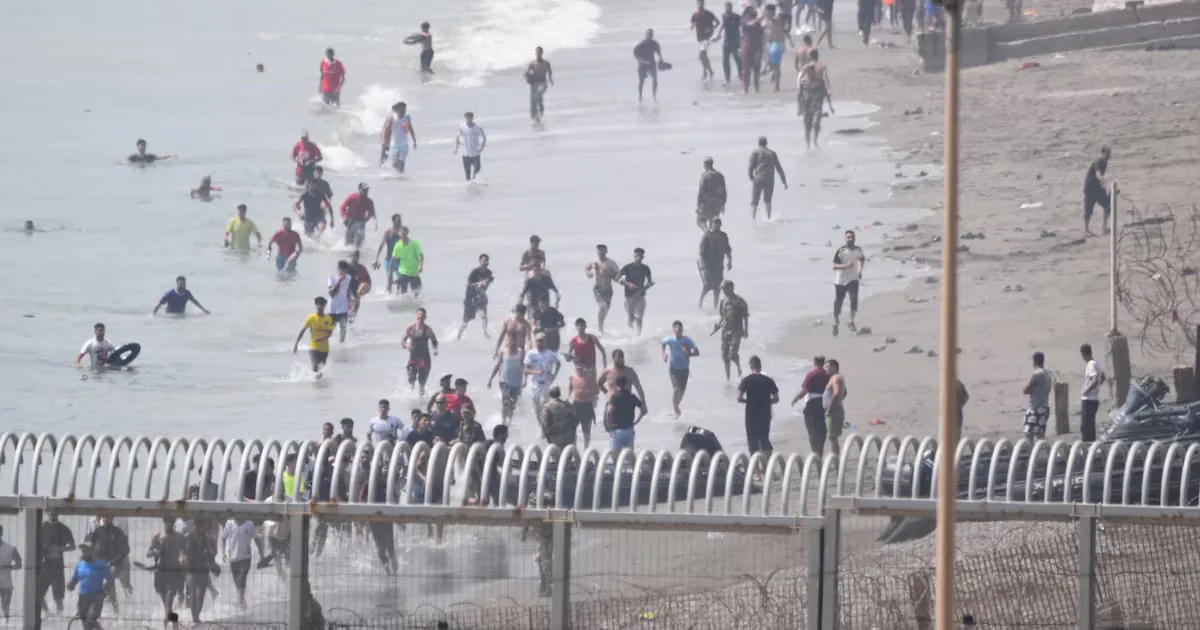
To understand what is happening in Ceuta, you have to look at the map of this autonomous city located between Africa and Europe.
Read more Anemia: the symptoms that many women normalize
Reports from Spanish media talk about the irregular entry of over 60 thousand migrants in 24 hours, on Thursday, July 30, and dozens of people dead in their attempt to cross from Morocco.
Ceuta is a Spanish autonomous city located on a peninsula, on the north coast of Africa, at the eastern end of the Strait of Gibraltar, separated from the rest of Spanish territory by the waters that converge from the Mediterranean Sea and the Atlantic Ocean.
Its area is 18.5 square meters and it has about 85 thousand inhabitants.
The peninsula, on its western part, borders Morocco. An eight-kilometer border from north to south separates Ceuta from the African country.
There is sea at each end of the border.
The migrants climbed border fences or tried to reach the coast by swimming from the El Tarajal border jetty, to the south.
A few weeks ago, the Supreme Court of Spain issued a ruling on the returns of migrants that would have precipitated what happened in the last days of July.
The ruling determined that migration legislation does not allow “hot returns” of people intercepted trying to cross by swimming, interpreting that the regulation governing “express rejection” on land is not applicable in these cases, considering that there is no physical border.
A crafty interpretation of that ruling would have encouraged the mass crossing.
This Saturday, an inflatable barrier and containment buoys began to be installed in the area of the Tarajal jetty that separates Ceuta from Morocco.
The Spanish Ministry of the Interior explained that this sought “to comply with the ruling issued by the Supreme Court on July 8, which established that the tenth additional provision of the Immigration Law, which enables rejection at the border of those who try irregularly in that autonomous city or in Melilla, cannot be applied in the case of those who access by swimming, as there are no physical containment elements that prevent their access to national territory.”
The installation of the barrier would change the scenario.
On Thursday, the day the crisis broke out, the Spanish Ministry of the Interior issued a statement referring to the situation, highlighting “the exemplary collaboration” with Morocco in all areas, including migration matters.
The department headed by Fernando Grande-Marlaska considers “that human trafficking networks are instrumentalizing a judicial ruling to encourage the flow of undocumented migrants, mostly young people.”
Read more Car bomb attack leaves eight police officers injured in Colombia
The Minister of the Interior maintains permanent contact with his Moroccan counterpart, Abdelouafi Laftit, and both countries agreed “to strengthen coordination and efforts to address these flows and have committed to reviewing and implementing measures for the delivery, as soon as possible, of all people who have entered Ceuta illegally.”
“The response of the National Government is late and insufficient,” said the president of the Autonomous City of Ceuta, Juan Vivas, from the opposition Popular Party.
The current president of the Government of Spain is Pedro Sánchez, leader of the Spanish Socialist Workers’ Party (PSOE).
Ceuta asked Sánchez’s government to close the border, declare a national emergency, strengthen the State Security Forces, and deploy the Army to guarantee the inviolability of the territory at its border with Morocco.
Sánchez committed to the deployment of a physical containment barrier in the sea and to expedite the repatriation files of migrants who arrived irregularly.
On the other hand, he faced criticism from other European Union countries, such as Italy, detailing some figures associated with irregular entries.
“Solidarity and empathy are optional. Respect for European treaties and data is not. Number of irregular entries between 2021 and 2026 according to Frontex: through Italy 478,600, through the Western Balkans 340,600, through Greece 259,800, through Spain 234,760, through the eastern border 48,000. It is not time to divide. It is time to continue building a strong and united EU,” said the Spanish leader on X.
The United Nations Children’s Fund (Unicef) called to guarantee the rights of boys and girls, pointing out that the repatriations of minors cannot be collective and are subject to “strong legal guarantees” provided by legislation.
According to official figures, during the first weeks of July, the entry of 505 minors was recorded, mostly from Morocco, although there were also cases from other countries such as Sudan, Guinea, Senegal, and Syria.