





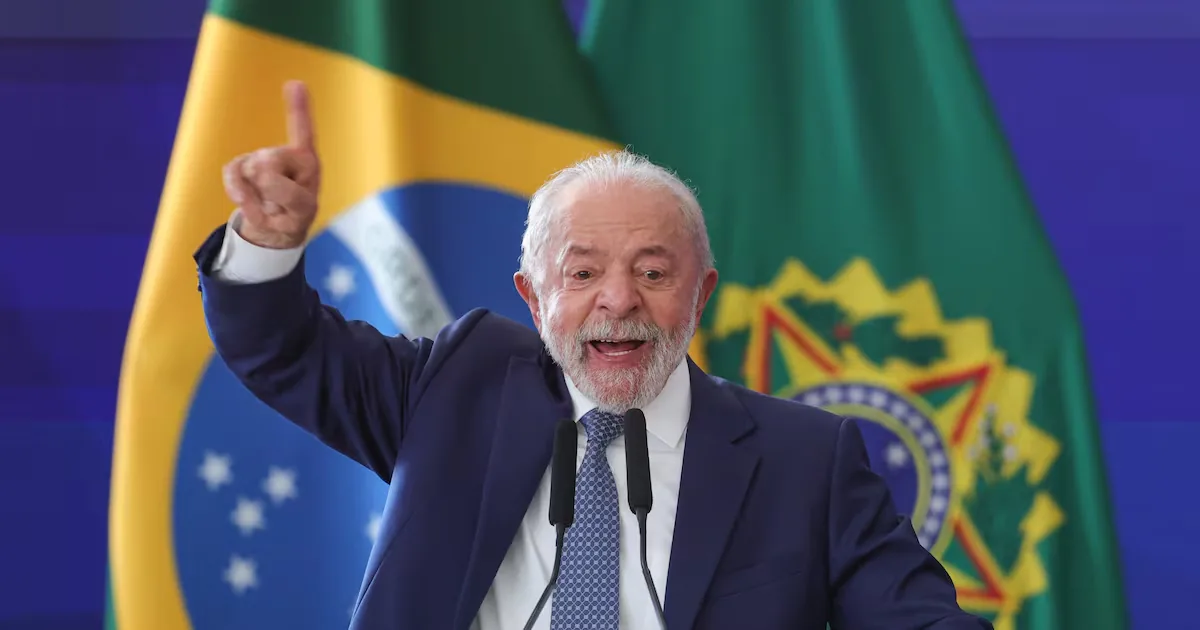
The presidential race in Brazil now officially has its main pro-government figure in competition. The Workers’ Party (PT) proclaimed this Sunday the candidacy of Luiz Inácio Lula da Silva, who will seek a fourth non-consecutive term in October and promised to increase defense investment to protect the country’s sovereignty.
Read more Explosive attack in Moscow may have been aimed at the head of the Russian Aerospace Forces
During the convention held in São Paulo, the president stated that he wants to prepare Brazil to prevent a foreign intervention that would allow the capture of the head of state.
“I want to be prepared so that no one invades this country to take the president away, as they have invaded. I want to be prepared for peace, not for war,” declared Lula during his speech.
The phrase was interpreted as an allusion to the operation deployed by the United States last January 3, when special forces captured the then Venezuelan president, Nicolás Maduro, and his wife in Caracas.
The president asked the leftist militants to stop considering defense as a secondary matter and assured that a possible fourth government of his will take military strengthening more seriously.
“I want to be prepared so that no one dares to take us for fools. Is that clear? That is why it is important to know that we need to invest in defense,” he said.
Lula pointed out that countries like Germany, England, and Japan are strengthening their military industries and suggested that Brazil should follow the same direction to protect its population, its borders, and its strategic resources.
He also questioned that a country with the territorial extension of Brazil does not have a drone factory of its own and linked that deficit to the difficulties in monitoring its borders. “How is it possible that a country the size of Brazil does not have a drone factory?” he asked. “There are too many people invading our territory, and this will end.”
In addition to strengthening the defense industry, the president promised to protect the country’s strategic minerals and warned that no foreign power will be able to access those resources without respecting Brazilian sovereignty.
At 80 years old, Lula will face his seventh presidential campaign. The leader governed Brazil between 2003 and 2010, returned to power in 2023, and now seeks to extend his administration until 2030.
During his intervention, he compared his electoral trajectory with Pelé’s career and the football World Cups. “Pelé, the great football star of the 20th century, considered the athlete of the century, only played in four World Cups. What they don’t know is that this World Cup of mine is the seventh,” he stated.
Read more Air accident in Greece: two helicopters collide during forest fire fighting
The PT again presented Vice President Geraldo Alckmin as running mate. The convention also brought together representatives from PSB, PSOL, PDT, PCdoB, Green Party, and Rede, showing unity of the progressive bloc ahead of the first round.
The event was marked by a strategy oriented towards women. Before Lula’s speech, the organization projected videos about policies on access to daycare, health, microcredits, and prevention of gender violence.
The president questioned that no woman had initially spoken at the event and asked the first lady, Janja da Silva, to address the attendees.
“My Government and the Workers’ Party must have the courage to say loud and clear: it doesn’t matter to lose votes. The guy will have to choose: either mistreat women or vote for me. If he mistreats women, he has no reason to vote for me,” he declared.
The candidate also defended the powers of the Presidency against the advance of Congress and assured that he cannot allow the head of state to continue losing power to the Legislature. As an example, he mentioned control over the creation of universities and appointments of members of the Supreme Federal Court.
The president’s main opponent will be Senator Flávio Bolsonaro, son of former president Jair Bolsonaro, whose candidacy was formalized by the Liberal Party.
The latest Datafolha poll places Lula with 48% of preferences against 43% for Flávio Bolsonaro in a possible runoff. The study interviewed 2,004 people and has a margin of error of two percentage points.
In the first round, the current president reaches 40%, while the senator obtains 32%. The electoral scenario is also marked by the public support given to Flávio Bolsonaro by foreign leaders such as Javier Milei and Benjamin Netanyahu.
Lula enters the campaign defending the reduction of unemployment and poverty during his administration but will face questions about the economic slowdown, high interest rates, fiscal deficit, and the increase in public debt. He will also have to respond to the political impact of two investigations for alleged influence peddling against his eldest son, Fábio Luís Lula da Silva.
Read more Who is Alfonso Fernández Magallón, the leader of the Los Reyes Cartel arrested in Mexico?