





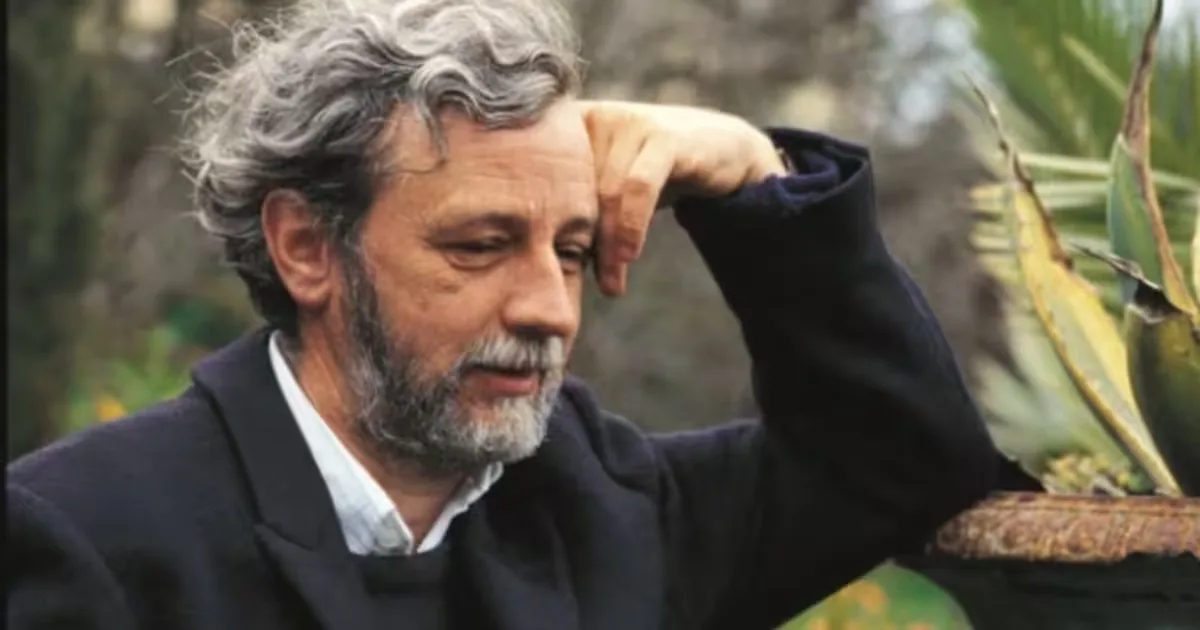
Art was everything to Adolfo Couve Rioseco (1940). The closest thing to a divine calling. He probably felt like a bearded enlightened man preaching the gospel of beautiful things. “My renunciation of art is total. I have no interesting personal life. The only thing I am passionate about is the religious path, and it was given to me through beauty. Art for me is one of the many paths to reach God, a path of conversion, a path towards the Light,” he said in a 1980 interview. “I gave up everything. I have invested all my time in my work and in reality I have not cared about myself. I don’t have a pleasant place to live, I am going from one place to another all the time.”
Read more Lula launches candidacy for a fourth term in Brazil: promises to strengthen defense
A trained painter, with studies at the School of Fine Arts of the University of Chile and a scholarship at the prestigious academies l’Ecole des Beaux Arts in Paris and The Arts Student League in New York, Couve had a first stage focused on visual arts. His motives were rather classical: landscapes, portraits, still lifes, and human figures. He was even a professor of Art History and Aesthetics at the Faculty of Arts of the University of Chile. But painting was not enough for him. Like Enrique Lihn, he crossed the street and decided to venture into literature.
“I did it when I realized that language was alien to men, that it was a borrowed thing. It happened while I was reading The Waste Land, by Eliot. It sounded sacred to me. I realized it was wonderful to build inner landscapes. I saw that I drew better with the word than with the brush. I realized that the verb, the word, was more for me. I wrote several books. I had more innate facilities for painting, but I knew I had to follow this path. It is very dangerous to make use of natural talent. Man must choose what hurts him the most,” he added in the cited interview.
In 1965 he debuted with the poetry book Alamiro, but in 1971 he raised the stakes and decided to dedicate himself solely to writing. In 1983 he resumed painting, but without leaving literature aside. He published a series of novels and saw success with the volumes Balneario (1993) and The Comedy of Art (1995). There he made a name for himself within Chilean literature.
“As a painter I have been quite lazy, irregular, I have facilities, but I have not dedicated myself much and I have not risked myself as I did in The Comedy of Art. You cannot be two things, it is very difficult because they are different attitudes. Painting helped me write and literature helped me paint. I paint my charcoals, my things, I keep them but I don’t show them, they are well done, they are essential, they please me, but what I go out to fight with are these books. With painting I would do much better, I would be happy and go out to do landscapes,” he said in a talk with Cristián Warnken, in The Beauty of Thinking.
The Comedy of Art meant burning the ships. It was the moment when Couve received the attention of the media and critics. It tells the story of an extravagant couple formed by Alonso Camondo, a down-and-out forty-year-old painter, and Marieta, his model; the bizarre love triangle is completed by a photographer named Sandro. In a tone that alternates comedy and unease, the novel explores the decanted, the better past times, but above all, a view of the art world. This, in a free, torrential ramble. He wrote it “without paying so much attention to form,” as he said to the newspaper La Época, in October 1995. The story is set in the coastal city of Cartagena, where Couve had settled.
“Here I risked everything, because otherwise I would have continued making the novels I was making, rigorous ones. I risked it and won; I could have lost – he said to La Época -. Beauty is a badly dressed woman, who doesn’t wash much. And here I was given all that beauty in a very full form. Here there is nothing pretty or polished, nothing that shines, nothing that is poetic prose, none of those things that go against beauty. Here there is roughness, hardness, pain, there is true joy, a search for truth. There are elements of knowledge, which are true beauty.”
31 years later, The Comedy of Art will return in a new edition from the Fondo de Cultura Económica scheduled for September. “It is a central work within his narrative. Also one of his novels that had the greatest reach in its time, in terms of readers. And from a formal perspective, for Couve himself, as he once said, it was a break with the writing style he had been practicing. After visiting the landscapes of childhood, the writer investigates the scope of art, returns, as always, to the province and writes a work that puts his own writing in tension,” comments his editor Roberto Santander to Culto.
Why is this novel still considered one of his fundamental works? Santander explains: “It’s as if his already outstanding previous work was a preparation for this novel, a landing where he exposes his intimacy and the power of fiction to reflect certain truths. This novel uses parody as only a seasoned writer can, one who handles the word like few.”
Santander adds that the grace of rereading Couve is that the reader faces a writing that resembles nothing else. “Couve’s narrative voice is of a unique and very personal style. Perhaps it could be said that rescuing Couve and putting him back into circulation is the way new generations approach these writers considered marginal within the canon, writers with a unique and unparalleled work, of great authenticity, which is how the great writers of Chilean narrative are. Different voices, that seem to have no parallel, that arise from who knows where but that sentence universal novels.”
For Santander, Couve’s dimension as a visual artist somehow intersects with his narrative in The Comedy of Art. “Within his narrative work it is complex to measure, since the scope is multiple and much has been written about it, but within The Comedy of Art specifically there is a clear and forceful tension about the role of art, craft, and life. In his work, references to painters, paintings, styles are commonly found. Painting, understood as a craft, for Couve was, if we want to see it that way, a stage.”
Read more Explosive attack in Moscow may have been aimed at the head of the Russian Aerospace Forces
However, no matter how much recognition he received for The Comedy of Art, Couve carried the procession inside. He dragged a depression that in 1998 made him stop teaching and isolate himself. He committed suicide on March 11, 1998, at 57 years old. Shortly before, he had finished a manuscript. His last novel.
It was called When I Think About My Lack of a Head, and is a kind of continuation of The Comedy of Art. Published posthumously in 2000, here we again find Camondo, whom the gods have punished with the loss of his head, so he sets out to find it. Written in fragments, Camondo questions the meaning of life, although it has a farewell air and a rather disillusioned view of the art world.
“Adolfo Couve comes alive on paper,” titled the note in La Tercera on March 12, 2000. “The clockmaker’s precision that the late author displayed in his previous writings now fragments into a dreamlike and extreme world in When I Think About My Lack of a Head,” and reported the news. “Fragmented, dreamlike, irreverent, Couve’s posthumous letters reflect a spirit tormented by a world that has no possible accommodation. His main character has lost nothing less than his head, as Couve would later lose it in the desperate act of hanging himself on March 11, 1998: ‘It was a scorching summer, seven hundred thousand tourists filled the beaches; instead of sand there were heads, so many heads! Where had Marieta left my wax head? In some museum or underground? Have you seen my head?, I felt like shouting in the market, the bus shelter, the terrace, the docks of the port; investigating in the brothels: maybe some old bitch had me in bed, the body armed with a pillow’… it says in the book.”
Today, When I Think About My Lack of a Head has been reissued by Ediciones UDP and is already available in national bookstores. Its keys are commented on by the editor, Felipe Gana: “There is an extraliterary fact that runs through the whole novel, it is a posthumous and final work, when Adolfo Couve decided to end his days he had already finished and made publishable When I Think About My Lack of a Head, and so it can be understood as a farewell. Many essays and chronicles comment on this. A writing in this way, so on the edge, is one of the keys to reading it. Another is his disillusioned view of the art world, Camondo’s biography (both here and in The Comedy of Art) is a perfect example of his perspective.”
“I see it as a more alienated writing, as Felipe Joannon says in the prologue: ‘It lets go of all moorings, we face an unbridled story…’, thus, each of its parts can be read as a novel in itself, and these cross genres, according to different critics: gothic, adventure, road, etc. It is a novel that reflects on the art world, the life of the artist, and the crises of creators. Also on the possibilities and limits of writing and the novel.”
For Gana, the fact that the novel is set both in Cartagena and in the countryside says a lot. “The location of this novel, between Cartagena and Cuncumén, seems spectacular to me. The marginalized characters, the circus, the desperate women, the decapitated Camondo traveling the rural roads between the sea and the coastal mountain range and its extraordinary ending provide the allegorical and ideal setting of a work and a life that closes with this novel.”
Why is Couve still so relevant? Felipe Gana answers: “This novel, and also those he wrote about his childhood, still have incredible relevance. In this one, in particular, the genres, the themes, the technique, have a lot to do with what is being written now. This is reflected in the kaleidoscopic and fragmentary nature of his writing; in the marginal spaces and the use of the circus as a setting and character; but perhaps its most current feature is the use of horror and the gothic, so in vogue in today’s Latin American novel.”
On his side, Santander adds: “I think that in Couve there is an awareness of the role of the writer, but from the craft, from the art of narrating. And, above all, the rescue of fiction and what he called universal themes. To a certain extent I would say that in Couve there is more of a bet on fiction – that everything fits there -, and in a way that seems to me to operate more as a warning to today’s writing than as a dialogue. It is hard for me, thinking quickly, to find continuators of Couve’s work. There doesn’t have to be any, but it is important to read him to find traces of a writing that did not deny the capacity of fiction to recreate other possible worlds without losing the ability to confront existence.”
“Both novels or both comedies, if we want, can be articulated as a process of continuity, but they also withstand reading on their own. Reading both works broadens the meaning, without a doubt, and allows a panoramic reading. I would not consider them as front and back, but rather as an extended panorama of a story that has unsuspected scope.”
Read more Air accident in Greece: two helicopters collide during forest fire fighting