



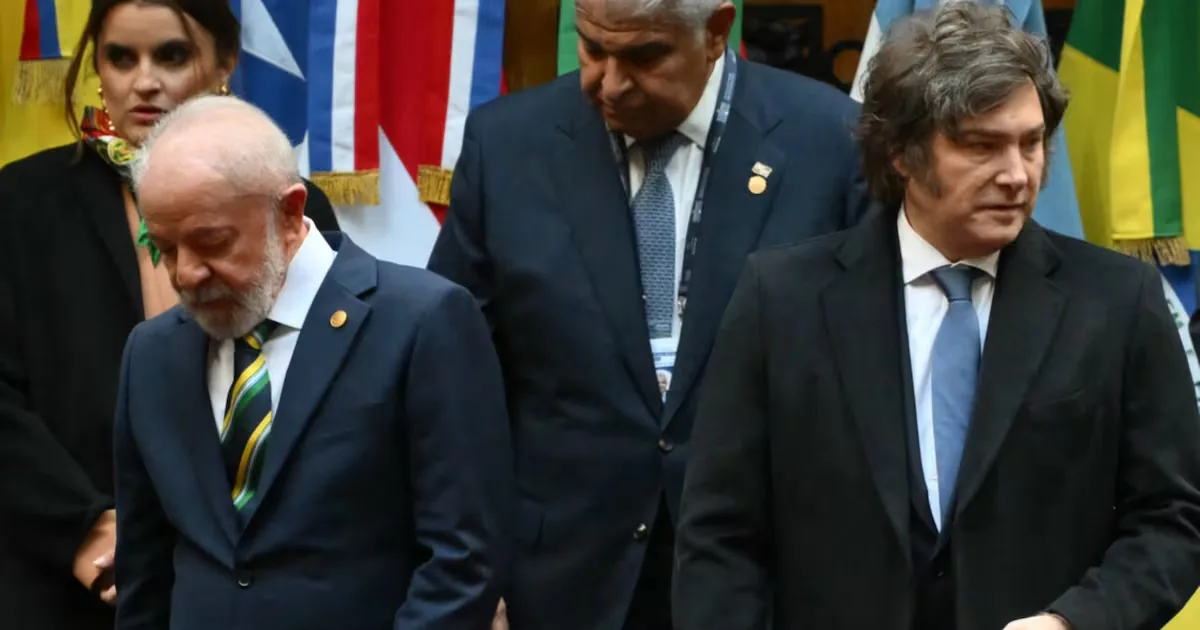
The tension between Brazil and Argentina has escalated in recent days, causing an unprecedented crisis in the more than two hundred years of relations between the two countries. Shortly after Brasilia decided to reduce the bilateral relationship to the level of chargé d’affaires, Javier Milei’s government clarified that it will not apologize to the government of Luis Inácio Lula da Silva for the insults he has directed at him, such as calling him an “ex-convict,” a “thief,” and a “corrupt person.”
“There have been expressions from both sides that reveal these political and ideological differences. Argentina decided not to bring them into the diplomatic sphere; unfortunately, Brazil has every right to decide what it has decided. We regret it because we understand that there is another way to preserve relations between our countries,” said Argentine Foreign Minister Pablo Quirno on Wednesday.
The decision by Itamaraty (Brazil’s Ministry of Foreign Affairs) came on the same day the Trump administration announced the revocation of the visa of the Brazilian ambassador to the United States, Maria Luiza Viotti, which made it impossible for the diplomat to perform her duties normally.
In this context, the newspaper Clarín noted that the Argentine ambassador to Brazil, Daniel Raimondi, will return to Buenos Aires in the coming days, initially on “vacation.” And the Argentine embassy in Brasilia will thus be under the charge of the chargé d’affaires, career minister María Emilia Cortés.
On Tuesday night, Brazilian Foreign Minister Mauro Vieira handed Argentine ambassador Raimondi a formal protest over Milei’s insults to Lula, including a decision to downgrade, for the first time in decades, its relationship with Argentina to the level of chargé d’affaires. He also postponed indefinitely the return of ambassador Julio Bitelli to Buenos Aires. He also requested Raimondi’s departure from Brasilia, something that was only confirmed today.
Vieira stated on Wednesday that the measure will remain “until the conditions that caused that decision cease” and that “satisfactory explanations” are required from the Argentine government. “Education and respect are fundamental; without them, there is no dialogue,” said the Brazilian foreign minister on the program Modo Fontevecchia.
These measures originate from Milei’s repeated insults to Lula da Silva. It all began on July 25 during an event in Sao Paulo where the libertarian was present to support the presidential candidacy of right-winger Flavio Bolsonaro. On that occasion, the Argentine leader not only did not meet with his counterpart but called Lula “corrupt” or “prisoner” while on stage.
Brazil responded by recalling its ambassador to Argentina, Julio Bitelli. Foreign Minister Mauro Vieira criticized Milei’s attitude as “extremely serious and unacceptable,” but Lula remained relatively on the sidelines.
But it did not stop there; a week later he said: “When I respond with truths, does Lula feel attacked? He is a fraudster and a thief. He is a convict.” “If there is someone who politically interferes in the region, it is Lula, completely contaminating it with the filthy ideas of socialism,” he added.
In this context, the one who broke protocol of Brazilian diplomacy was Economy Minister Dario Durigan, who called Milei a “clown” in an interview and rebutted his catastrophic arguments about leftist policies, noting that Brazil has better economic indicators.
The Spanish newspaper El País recalled that the bad relationship between the two began even before Milei arrived at the Casa Rosada. During the 2023 Argentine presidential campaign, the Brazilian leader warned, during a visit to the United States, that democracy was “at risk” in Argentina. Although he did not mention Milei, the then-candidate interpreted those statements as a direct reference to him, at a time when he was competing for the lead in the polls. Tension increased when advisors who had worked on Lula’s successful campaign joined Sergio Massa’s electoral team, his opponent, for the runoff. Milei read that participation as a political intervention by the Brazilian president in the Argentine election, reinforcing the idea that Brazil was openly aligning with his rival and that Lula himself was consolidating his long history of political affinity with Kirchnerism.
At the inauguration of the Argentine leader in December 2024, former president Jair Bolsonaro was invited to the Casa Rosada with all honors. Lula, offended, stayed at the Planalto Palace. Months later, the Argentine made his first trip to Brazil, and far from meeting with Lula, he participated in a far-right convention where he insulted him again.
Patricia Bullrich, leader in the Senate of Milei’s party, La Libertad Avanza, mentioned Lula’s visit in July last year to Cristina Kirchner, the former Argentine president under house arrest. “Argentina did not respond with a diplomatic gesture, as the interests of states prevail over the political activities of governments in power. Unfortunately, it seems that Brazil is choosing a different path,” she wrote on her social media account.
At Wednesday’s press conference, Argentine Foreign Minister Quirno did not directly mention an apology, something Lula had suggested in 2024, referring to Milei’s attacks during his victorious presidential campaign the previous year. At that time, the Argentine responded that there were more important things than “the inflated ego of some leftist.”
Quirno also mentioned the tension between Brazil and Paraguay that was triggered after Lula declared, during a visit to a defense company in the interior of Sao Paulo on July 24, that “Paraguay once decided to invade Brazil,” referring to the 19th-century war.
The statement sparked a crisis between the two countries. However, after delivering a note of repudiation to the Brazilian ambassador in Paraguay, Paraguayan Vice President Pedro Alliana said he did not want to prolong the matter on the eve of the elections. “The last thing we want is for them to think we intend to interfere in the elections,” he said.
Quirno also expressed his hope that Brazil will join the conservative wave sweeping South America and confirmed the organization of a summit of right-wing leaders from the region in Buenos Aires. “The region is changing its ideological course. We celebrate this and hope the same happens in Brazil,” he said.
Referring to the event in the Argentine capital, he attributed the rise of the right in the region to President Javier Milei. “This leadership is what has allowed us to have today a group of 12 countries aligned with these ideas and that constantly support each other. This will probably result in an invitation from President Milei for a meeting in Buenos Aires as soon as their schedules allow,” he continued.
The differences between Lula and Milei, El País indicated, are evident both ideologically and economically, and are most marked in Mercosur. “The two countries are the pillars of the group and each looks in a different direction: for Lula, it must be strengthened because it is the only way for South America to have a voice in the world. For Milei, it is a heavy burden that prevents him from negotiating freely. Still, and although these differences have slowed the group down, they have not prevented the signing of the free trade agreement with the European Union, a milestone after two decades of negotiations,” the newspaper said.
“Trade exchange also does not seem to have suffered: last year bilateral trade reached 31.2 billion dollars, the highest value in 13 years. Brazil is the main destination of Argentine exports, and Argentina buys a good part of Brazil’s industrial products. Last year, Brazilian exports to the neighboring country grew by more than 30%, mainly thanks to the automotive industry. Divorce here is unthinkable: a car manufactured on the outskirts of São Paulo can have an engine from Córdoba. The interdependence is total,” it added.