

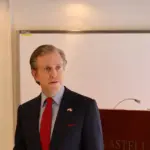




For Michael Reid, British writer and journalist, the main difficulty in importing Nayib Bukele’s security approach to Colombia – an idea to which the country’s new president, Abelardo de la Espriella, has alluded – is that it responds to different problems. While El Salvador is a small country with “a specific problem of armed youth gangs,” Colombia is a large country, with complex geography and “powerful illegal armed groups,” he says.
Read more The left wing of the Democratic Party gains ground ahead of the midterm elections
In conversation with La Tercera, the former editor of The Economist’s “America” section discusses the inauguration of Colombia’s new president. He also explains Keiko Fujimori’s challenges in her arrival to the Presidency of Peru – such as the impact of El Niño -, the confrontation between the United States and China in Latin America, and the October elections in Brazil.
What are Abelardo de la Espriella’s main challenges as president of Colombia?
There are several and significant. First, because his victory was by a small margin, and Gustavo Petro, very irresponsibly, has not recognized the defeat of his candidate and has promised street opposition to the new administration. Second, because Petro’s legacy is very negative both in security and in the economy. The country’s security has deteriorated in recent years. It is true that this started before Petro, but the deterioration has continued with him and the illegal armed groups have strengthened: their members are more numerous and they operate in a wider territory. The government has begun to lose the monopoly of air power which, in a country with Colombia’s geography, is vital. Several groups are using drones. And the fleet of operational helicopters has decreased due to maintenance problems. It is difficult for the government to respond to two emergencies at once, in different parts of the country. So, it seems to me that Abelardo de la Espriella’s proposals, copied from Nayib Bukele of El Salvador, do not respond to the country’s objective problems. He will need a much more sophisticated strategy on multiple fronts. Another challenge is the economy. Petro is leaving an overheated economy, with a significant fiscal deficit and inflation. A fiscal adjustment will be needed which, under the political circumstances I described, will not be easy.
Do you think De la Espriella will try to be like Bukele?
That was the projection during the campaign. The signals he has sent, in terms of the composition of his cabinet, are mixed. In the campaign he said he represented the “never,” against the “always,” but he has resorted to quite a few “always” to form his government; people who have been in previous administrations who, in several cases, are a positive sign in the sense that they are experienced and capable. But Bukele’s security proposal, which is his iconic proposal and what many in Latin America say they want to copy, is difficult to transfer to Colombia. El Salvador is a small country that had a very specific problem of armed youth gangs. Colombia is a very large country, with very complicated geography, with a series of powerful illegal armed groups. The State has to regain control of the territory. What is important is intelligence work and strengthening security forces.
Regarding Peru and Keiko Fujimori, what are her prospects of completing her term?
I think she will complete it for sure. Well, one never knows, but it is quite likely she will complete it, because she has a strong position in Congress. Peru has returned to a bicameral system. And the power to remove the president lies in the Senate, where she has enough support to block a vacancy motion. It seems to me that the issue does not go that way. As in Colombia, the issue is in the streets. She won by an even narrower margin than De la Espriella. And anti-Fujimorism in Peru remains very significant. Over time, she will surely face protests. Especially in the southern cities. But there is also an immediate issue, which also applies to Colombia, which is El Niño. Everything indicates it will be very severe and will start soon. In Peru, that leads to floods and road problems. Unfortunately, although on paper works were commissioned to face the phenomenon, little was done in practice. The government has announced immediate measures. Much will depend on how efficient they are. El Niño normally increases inflation in Peru and will have an economic impact in the first year of her term. In Colombia it also has an impact, but mainly on inflation, which will make things difficult for De la Espriella. El Niño normally brings drought to Colombia. And the country depends heavily on hydroelectricity. If river levels drop, electricity generation drops, so they must resort to more expensive alternatives.
And, politically speaking, what do you think will be Fujimori’s main challenge?
I think it will be coordinating the street. She has a relatively solid position in Congress. It is ironic, because Fujimorism, in the last five years, has used Congress to weaken the Executive. Now they will have to reverse that. It helps that the economic position is relatively favorable. With mineral prices, copper, gold, exports, so high. But it is a challenge to unblock large mining investment projects. And it will be a challenge to increase the economic growth rate over five years and improve transport infrastructure, which is very deficient in Peru. That is one of her priorities.
Regarding the influence of the United States and China in Latin America, how do you evaluate the confrontation between the two powers in the region?
The so-called Trump corollary has several aspects. The first is a military approach against drug trafficking and organized crime. We have seen it in actions against cartels in Mexico and the sinking of boats in the ocean, which are probably illegal. We also saw it in the operation against Nicolás Maduro in Venezuela. Right-wing governments in Latin America have supported the Trump administration’s initiative in this regard, through the “Shield of the Americas.” A second aspect is electoral interventions. It was important in Argentina, in the offer of economic aid, which was important in Milei winning last year’s midterm election. It was also important in Honduras, where it helped the conservative candidate who won. So far, its intervention to support the Bolsonaro family in Brazil, with tariffs and threats, has not worked. That has strengthened Lula in the polls. In Colombia or Peru, I don’t think those interventions were decisive, where internal factors explain the electoral outcome. The third aspect is pressuring governments to reduce Chinese influence. We saw it in Panama with Chinese ports. We saw it in Chile with the withdrawal of visas to officials from Boric’s government over the submarine cable project. Now, I think there could be some pressure on Fujimori’s government regarding the Chancay port, a Chinese investment. For Latin America, the trade relationship with China is crucial. It is unlikely that this will change. And there is no interest in the region for it to change abruptly. Chinese investment is striking because it is in key sectors, such as mining or electrical systems. However, it is not as large in foreign direct investment as a whole. So, I think there will be some operation there. But we will see. So far, I don’t see very large conflicts.
And, in this context, how do you think regional governments should be managed?
The tariffs imposed on Latin American exports, which in most cases are 10%, but in Brazil are higher, are negative for Latin American economies. The effect of this is that several governments are, rightly, seeking to diversify their economic and trade links. Brazil will do so. The trade agreement between the European Union and Mercosur, which will come into effect provisionally, is also important. In Mexico’s case, it is very difficult to diversify, but it will try. We will probably see Claudia Sheinbaum in Madrid for the Ibero-American Summit, which is a sign of her desire to strengthen ties with Europe. There is an incentive to do so.
What is your outlook on the October elections in Brazil?
I think it will be closer than the polls currently indicate. Lula has a narrow advantage, but an advantage. Although things can change between now and October, I think it is a shame for Brazil that, once again, it will probably be an election between Lula and a Bolsonaro. Brazil needs political renewal. It is possible that the right-wing candidate will not be a Bolsonaro, but it is not very likely. It will be a close election like last time. Hopefully it will happen peacefully and democracy will be strengthened.
Read more De la Espriella takes possession of his new cabinet to launch his government program