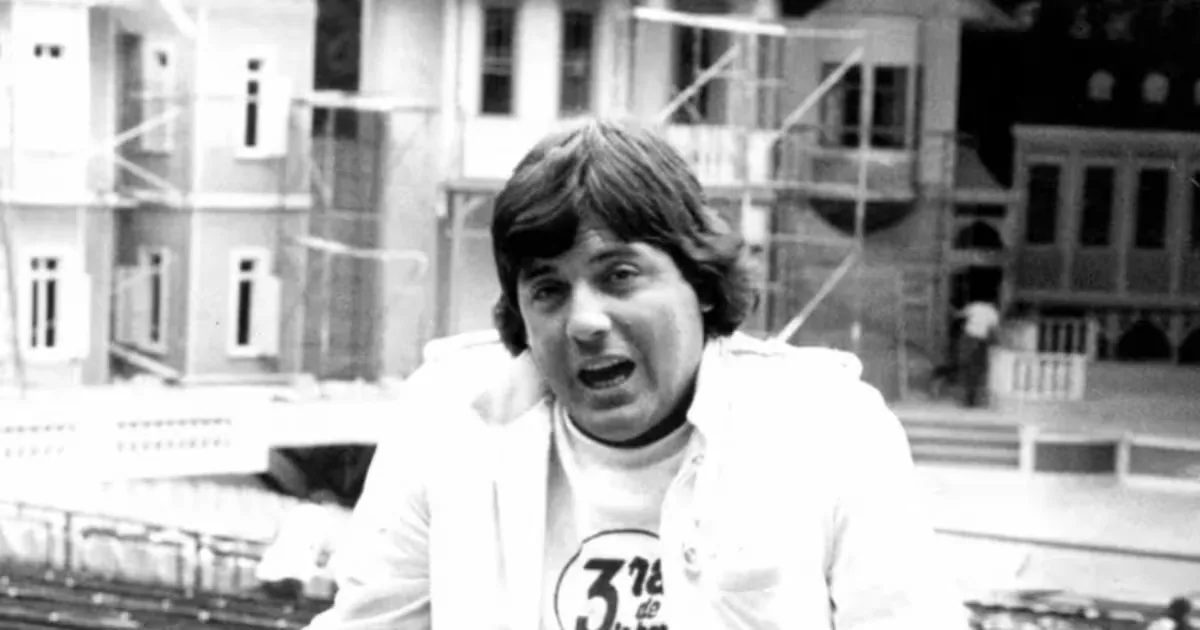







The last exhibition that the artist and architect Juan Pablo Langlois Vicuña held during his lifetime was at the Il Posto gallery. In 2018, Segundo Viaje Sentimental was presented, his swan song before his passing in 2019. Since then, various works by him have continued to be part of exhibitions and research developed by the institution.
Read more Autonomous war: AI-guided drones kill three people in Ukraine
Today, in addition to a gallery, Il Posto has a rich documentation center—one of the most important in the world of Chilean art—that in 2025 incorporated into its collection a large set of artist books: photographs, sketches, manuscripts, and others. This material is what is currently exhibited in the exhibition From Object to Mystery. Juan Pablo Langlois Inside and Outside the Museum, an exhibition curated by the Argentine researcher and curator Santiago Villanueva that brings together works, documents, and archival material of the artist.
The exhibition gathers both works belonging to the Il Posto Collection as well as loans and documentary reproductions from other institutions, including the Nemesio Antúnez Foundation, due to the records of his interventions outside the Museum of Fine Arts, then directed precisely by Antúnez. In fact, Langlois is considered one of the pioneers of installations in Chile.
“There was a desire on our part to exhibit the documents of the installation called Diario de Vida Recortado, which had been presented only for a few days on the Museum’s facade in 1990, before it was removed due to neighborhood complaints. On our part, we realized that this installation, among the artist’s best-known interventions, was one of the least publicized, even in the more specialized world of visual arts studies in our country,” says Antonio Echeverría, executive director of Il Posto, to Culto.
“The biggest challenge was the scale of the archive, the impossibility of covering it entirely, and the diversity of materials it presents,” comments the curator, Santiago Villanueva. “On the other hand, from the beginning it was an archival exhibition project, so another challenge was to think about the exhibition design and the tension between showing the archive in its diversity and at the same time accounting for each of the projects by highlighting the different moments from projection and conceptualization to realization and the different paths and itineraries of each one.”
Echeverría adds a general view of Langlois’s archive: “The Juan Pablo Langlois collection is composed of materials of very diverse nature. A very relevant part corresponds to his production of artist books throughout his career, which allow us to understand the methods with which he approached both the works he created and those that remained unfinished projects. But alongside them, his archive also consists of fragments that often directly border works, and in other cases, more personal objects from his life that go beyond the artistic.”
“Its cataloging is an ongoing project, but we hope that access to this source will already be a task for those developing research around these artistic periods in our country, and that students and new generations of researchers will also encounter Langlois’s universe and the countless ways to approach his production,” he specifies.
“I believe two pillars in his work are self-reflection and insistence,” adds Santiago Villanueva. “Langlois returns to the same themes, or emphasizes related issues, always finding different ways to respond to the context and its possibilities, but maintaining materialities, such as newspaper paper, which gives shape and structure to the thought of many of his works.”
Read more Raphaël Glucksman announces his candidacy and shakes up the election campaign in France
“The archive maintains a relationship between disorder and systematization, it has structure and at the same time constantly breaks out of it and generates a space of doubt where not everything fits the initial logic of the project. And more than a recording space, these are the materials that form the works, which were part of the planning and realization; they do not account for the work but are the work itself,” adds the curator.
Likewise, as part of the exhibition program, Il Posto will open the seventh call for its Research Grant, dedicated this time to the work of Juan Pablo Langlois. Developed for the first time in collaboration with the National Museum of Fine Arts, the call will fund research projects focused on the interventions and exhibitions that the artist carried out at that institution. In this way, the selected researchers will have access both to the Juan Pablo Langlois Collection at Il Posto—currently in the process of cataloging—and to the Angélica Pérez Germain Documentation Center of the National Museum of Fine Arts.
“Since we started the grant in 2023, we have had 11 researchers who have developed their projects at Il Posto, around different themes and artists, both national and from the region. On this occasion, and due to the particular presence of the Museum figure and Juan Pablo Langlois, it was essential to add an external perspective to the institution. This alliance, which we hope will continue over time, will be reflected again in October, when the national artist Enrique Ramírez will be exhibited at the Museum, who will also be exhibiting in our archive room at the Research and Documentation Center,” says Echeverría.
If a 25-year-old visitor enters the exhibition without knowing Juan Pablo Langlois, what do you hope they discover? Echeverría responds: “I think it is one of the most important questions we can ask ourselves today. We know that Langlois is an ‘artist of artists.’ He is a very important reference within an internal circuit. But we must understand that reinforcing that does not mean giving up the task of making his work more public and widely known. Langlois was an artist who occupied many places, very different from each other.”
“He is an artist who worked all his life as a public employee of a government aeronautical agency, for example, and yet was able to sustain an artistic work with such depth and dedication. He is an artist who trained as an architect at the School of Architecture of the Catholic University of Valparaíso in the late 50s and early 60s, where he possibly learned from his professors an understanding of architecture that was related to the poetic, the environment, and an ethic of life. He developed a body of work as an artist outside the best-known groups of the Chilean art scene of the second half of the last century. Observing his life and work, we find very bold and radical ways of understanding the city, sexuality, the environment, waste, poetry, and many other issues and disciplines. Whoever encounters Juan Pablo Langlois for the first time will probably realize that his concerns, more than fifty years ago, are quite similar to those of a young person today.”
The exhibition From Object to Mystery. Juan Pablo Langlois Inside and Outside the Museum is on display from August 2026 to January 2027. The Il Posto exhibition room is located at Espoz 3150, -1, Vitacura. Hours from 12 to 14:30.
Read more A scenic journey through the layers of the earth, the body, and memory at the GAM