



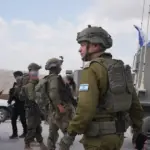



Palestinians continue to face difficulties accessing basic healthcare amid restrictions, insecurity, and violence. In a context marked by the intensification of attacks by settlers and Israeli armed forces throughout the West Bank, the ability of organizations like Médecins Sans Frontières to respond to the needs of Palestinians is severely hindered.
Read more First cassette of La Ley revived in an unreleased concert at GAM
In this regard, the group reports a crisis of physical and mental health among the population of Hebron, a town 30 kilometers from Jerusalem in the West Bank. There, amid repeated attacks, displacements, and movement restrictions, the human situation becomes increasingly complicated.
Ismail Ibrahim, an MSF patient from the outskirts of Yatta in the Hebron province, says he has been assaulted three times in recent months. “Settlers sprayed pepper spray in my face while I was working in an olive grove that my family had been cultivating for years,” he explained.
“They let their animals graze among the olive trees, damaging the land, destroying and breaking the trees. When the police arrived, they told us we could not speak to the settlers. The situation worsens every day,” Ibrahim insists.
At least 77 Palestinians have lost their lives and another 1,775 have been injured at the hands of Israeli forces and settlers just this year in the West Bank, according to OCHA, the United Nations Office for the Coordination of Humanitarian Affairs. This figure already exceeds that of the entire year 2025.
Since March, between 17% and 38% of MSF psychological consultations have been due to intentional acts of violence, compared to a percentage that did not exceed 13% at the beginning of the year. Between January and July, MSF teams conducted more than 1,930 individual mental health consultations and carried out 436 group therapy sessions.
During the same period, MSF teams in Hebron received nearly 170 alerts of incidents such as home demolitions, injuries, and attacks on the water and sanitation system. The teams carried out 27 rapid response interventions that may include mental health support or the donation of essential items, such as mattresses and bedding.
Read more How Hydroelectric Tunnels Became a Refuge for Trapped Workers in Nepal
Movement restrictions imposed in the West Bank have complicated MSF’s work. “We have observed a growing demand for our medical services because the population faces difficult economic conditions and cannot afford private healthcare,” explains Dr. Mohammad Haroub, MSF deputy medical referent in Hebron.
“Every day, we don’t even know if we will be able to reach the clinic. The context is constantly changing,” says Elisa Tamimi, MSF humanitarian affairs officer in Hebron. “Sometimes, entire areas are closed for a day, two days, or even a week. This has a profound impact on the lives of community residents. Many have lost their jobs and cannot find work.”
The shortage of healthcare personnel worsens the problem, leading to a collapsed health system. After its offensive in Gaza, Israel withheld billions of dollars in tax revenues destined for the Palestinian Authority. This has severely affected the payment of healthcare workers’ salaries, caused medical staff to work fewer hours, and in some cases, led clinics to be completely closed.
“The limited availability of health services, the lack of healthcare personnel, and the shortage of medicines in the Ministry of Health have been an additional burden,” adds Haroub. “Some patients tell us they have been without medication for several days.”
Even reaching a healthcare point becomes a problem for Palestinians in the West Bank. “Life has become a heavy burden due to settler attacks. I live in constant fear. My family barely sleeps. They fear the settlers might come,” says Aisha (name changed for privacy), a woman from a village near Yatta who went to an MSF clinic in Khallet Al Mai, located just a few kilometers away, but whose journey was considerably lengthened due to insecurity and detours.
Her mother-in-law suffers from diabetes and hypertension, but, she says, “not all medications are available” where the family lives. Aisha reiterates that they do not ask for much: “I hope life can return to how it was before the war and that we can live with dignity. I want people to be able to go out on the street without fear, to have access to healthcare, education, and basic needs.”
Read more Robert De Niro: “With Martin Scorsese we see each other when we need to”