



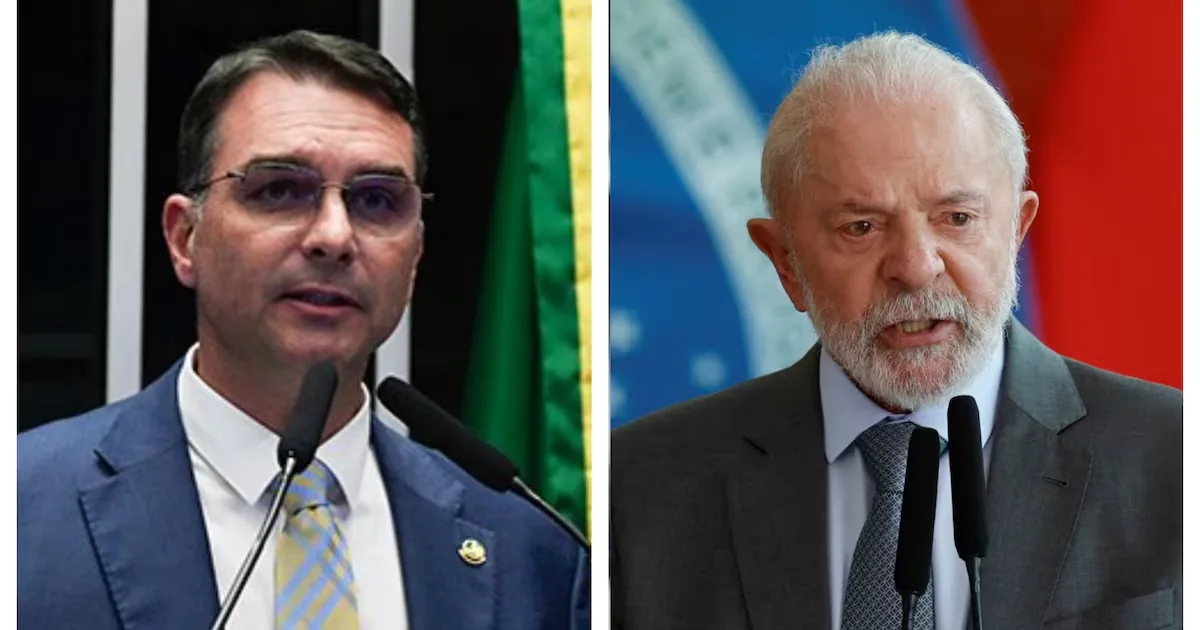
The 2026 Brazilian presidential race has corruption as one of its central axes. The two candidates leading the polls, President Luiz Inácio Lula da Silva and Senator Flávio Bolsonaro, face judicial cases that serve as ammunition for attacks from their rivals just over a month before the presidential elections on October 4.
The common link is Daniel Vorcaro, former president of Banco Master, intervened by the Central Bank, now liquidated. Both Lula and Flávio had to explain their ties to the ex-banker after recordings, documents, and meetings linking them to him became known, according to CNN Brasil.
Added to this are investigations against Fábio Luís Lula da Silva, the president’s eldest son and known as “Lulinha”, for an alleged scheme of improper deductions from pensions of the National Institute of Social Security (INSS).
Also, – according to Folha de S.Paulo – in the electoral prelude appears the jurisdictional dispute between the Federal Police, the Supreme Federal Court (STF), and the Superior Electoral Court (TSE), which could determine the course of the process.
To date, President Lula’s lead over Bolsonaro has narrowed ahead of the elections, while the leftist leader faces the repercussions of corruption accusations against Lulinha. Lula leads Bolsonaro with 47.1% against 42.6% in case of a second round, according to an AtlasIntel poll for Bloomberg News published this Monday.
In the previous poll, conducted in July, Lula led Bolsonaro, the eldest son of former President Jair Bolsonaro, by approximately 6 points. Last week, Lula had a 1-point lead in a BTG Pactual/Nexus poll and a 4-point lead in a Datafolha poll from August 21.
Flávio Bolsonaro was the first to be forced to give explanations regarding the Master Case. Audios revealed in May by The Intercept Brasil showed the senator asking Vorcaro for funds, supposedly to finance the film Dark Horse, centered on the political career of his father, former President Jair Bolsonaro. The former head of Banco Master allegedly transferred 61 million reais to the production.
The senator maintained that these were private commercial transactions and denied irregularities. In an interview with CNN Brasil, after the audios became known, he promised to justify the film’s expenses, a promise that has not been fulfilled to date.
A document that became known in June, attached to the police investigation of the case, details that the film cost 75 million reais, 54 million spent abroad and 20.9 million in Brazil. However, there are no receipts or invoices to support these figures. The opposition uses this gap to pressure Flávio ahead of the elections.
Lula, for his part, met with Vorcaro in December 2024, in an unofficial meeting which was also attended by Gabriel Galípolo, then nominated as president of the Central Bank. In that meeting, Vorcaro allegedly detailed to Lula the operational situation of his bank. But the president downplayed the meeting. In an interview with the UOL portal, he said he had already met with other businessmen and that Vorcaro attended through the management of then Finance Minister, Guido Mantega.
The splinters of the Master case also splash the Workers’ Party (PT) of Lula through Jacques Wagner, former leader of the government in the Senate. The Federal Police maintain that there is evidence that the senator received economic benefits from bank executives in exchange for his parliamentary management on matters of interest to the entity, including the negotiation of an apartment valued at 2.5 million reais.
The other open front for Lula – as well as for his rival – also involves the family. Lulinha faces three Federal Police investigations for alleged influence peddling and corruption linked to contracts with federal government companies, including his relationship with lobbyist Roberta Luchsinger.
Read more First cassette of La Ley revived in an unreleased concert at GAM
The defense of the president’s son denies any irregularity. Luchsinger, in turn, is accused of collaborating with lobbyist Antônio Carlos Camilo Antunes – or “Careca do INSS” – in the pension fraud, who is pointed out as the main intermediary of the pension administrators’ embezzlement scheme.
According to the Federal Police, companies linked to Antunes received more than 53 million reais from improper deductions applied to retirees and pensioners. Lula has insisted that he trusts his son’s innocence, although he has stated that the Federal Police must investigate him.
Outside the candidates’ control, decisions by the Federal Police and ministers of the STF and TSE could influence the final outcome of the campaign, which first swung in favor of the PT and more recently towards Flávio.
Much of the uncertainty falls on STF Minister André Mendonça, chosen by Jair Bolsonaro, described as “fiercely evangelical,” and who enjoys the sympathy of the right and the distrust of the left.
Mendonça is the rapporteur of the Master case and two of the three investigations against Lulinha. The third is in the hands of Flávio Dino, considered close to the PT.
The Federal Police, under the command of Director General Andrei Rodrigues, faces distrust from the right. The Liberal Party (PL) of the Bolsonaros denounces selective leaks in the Master case by the police. Flávio Bolsonaro even rejected the escort that the corporation offered him as a presidential candidate and opted for the security of the Senate Police.
The defense of Lulinha, on the opposite extreme, also accuses selective leaks and demands the government correct what it calls a “maneuver to damage the PT campaign”.
Added to this dispute is the jurisdictional conflict between the TSE, chaired by Kassio Nunes Marques, and the STF, particularly the sector aligned with Alexandre de Moraes, over the judgment of deepfake videos made with artificial intelligence.
Kassio, who was nominated by Jair Bolsonaro, is questioned inside the court for supporting Flávio regarding the legality of a deepfake of the former president shown at the PL convention. Moraes, for his part, suggested that the case could lead to Flávio’s disqualification, which TSE members interpreted as interference.
For the PL, Moraes is the most influential figure in the electoral process. He was the one who legally pursued the right-wing former president for the attempted coup d’état in 2022. The minister ordered Jair Bolsonaro’s imprisonment and prohibited visits from his son. After that decision, in July, the senator accused Moraes of interfering in the election by preventing him from seeing his father, a complaint he had already anticipated in April, when he warned in the Senate plenary that the minister would seek to unbalance the elections from the STF, as – according to his accusation – he did at the head of the TSE in 2022.
Read more How Hydroelectric Tunnels Became a Refuge for Trapped Workers in Nepal