

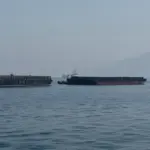



The United States Armed Forces destroyed this Tuesday five Iranian tankers in waters near the Strait of Hormuz and the Gulf of Oman, in a new military action that was responded to by Tehran with the launch of missiles towards U.S. facilities in Jordan.
The U.S. operation was confirmed by Central Command (Centcom), which detailed that the attacks occurred after the Islamic Revolutionary Guard Corps of Iran (IRGC) attempted to attack a U.S. warship with ballistic missiles on two occasions during the previous two days.
According to Washington, the ship managed to evade both attacks and continued its operations in regional waters. No U.S. military personnel were reported injured in those episodes.
The U.S. military command identified the five destroyed vessels as Kaviz, Charminar, Horizon 1, and Riesco, attacked in the Gulf of Oman, and Derya, hit near Kharg Island, one of Iran’s main oil export points.
Additionally, it emphasized that the five ships were linked to an oil transport network that, according to Washington, generates resources for the Revolutionary Guard and its associated organizations in the Middle East. Before the attacks, U.S. forces ordered the crews to abandon the vessels.
The episode adds to a similar operation carried out on Saturday, when the North American nation reported the destruction of three other Iranian tankers after the Revolutionary Guard attempted to attack a U.S. aircraft carrier and a destroyer.
After the attacks on the tankers, Iran launched missiles towards Jordanian territory, where facilities used by U.S. forces are located.
The Revolutionary Guard claimed to have attacked a U.S. military facility located in the Al Azraq area, in eastern Jordan. Centcom, consulted about the episode, initially stated that it had no information to provide about the attack.
However, the Jordanian government confirmed that its territory was hit by a wave of missiles coming from Iran.
The Jordanian Armed Forces reported that their air defense systems faced 20 ballistic missiles launched towards the country. Of that total, 18 were intercepted and destroyed, while two others fell in unpopulated areas.
According to the initial assessment by authorities, no fatal victims were recorded as a result of the attack. Specialized teams were sent to the places where debris and fragments fell to secure the areas and determine the nature of the elements found.
The exchange of attacks is framed within the dispute between the United States and Iran over control and maritime traffic in the Strait of Hormuz, one of the main global routes for the transport of oil and gas.
Tehran has announced new restrictions for vessels attempting to cross the strait and has threatened to respond against ships linked to countries that, according to its government, collaborate with the United States.
The Revolutionary Guard warned this Tuesday the crews of tankers located near ports of Kuwait and Bahrain to abandon the vessels, arguing that both countries host U.S. forces and that their facilities are used in operations against Iran.
Meanwhile, the United States maintains restrictions on Iranian ports as part of the economic pressure exerted by the Donald Trump administration. The goal is to limit Tehran’s capacity to export oil and obtain income to finance its military operations.
The situation has also impacted energy markets. According to the AP agency, the price of Brent crude briefly rose to US$99.46 per barrel during the day, amid concerns about supply disruptions and navigation in the region.
In addition to the military response, a new round of U.S. sanctions against the Iranian aviation sector was added this Tuesday.
The Trump administration announced measures against more than twenty commercial and private airlines, as well as foreign providers of services related to cargo transport, as part of efforts to limit Iran’s economic ties with other countries.
U.S. Secretary of State, Marco Rubio, stated during a visit to Colombia that Washington will respond to Iranian attacks against its forces.
“Iran continues trying to attack U.S. naval ships. And for every time they do or try, they will lose oil tankers,” he emphasized.
Read more Joe Biden assures that treatment for his prostate cancer «worked as expected»