




“Wouldn’t it be wonderful if Canada were the 28th Member State of the European Union instead of the 51st State of the United States?” asked Finnish President Alexander Stubb this northern summer.
Read more What does the Supreme Court’s rejection of Trump’s plans to restrict mail-in voting imply?
The question was posed jokingly, highlights the British broadcaster BBC. The U.S. President, Donald Trump—currently engaged in an escalating tariff dispute with Ottawa—has expressed on several occasions his desire to turn Canada into the 51st State of the U.S., which has caused deep discomfort among many Canadians.
Finland is one of the 27 EU Member States and a close ally of Canada, as both share their status as Arctic nations. Beyond the jokes, President Stubb perfectly captured the moment that EU-Canada relations are going through, increasingly close. “Canada has a more European mindset than most Europeans!” is a response often heard in Brussels lately with a smile.
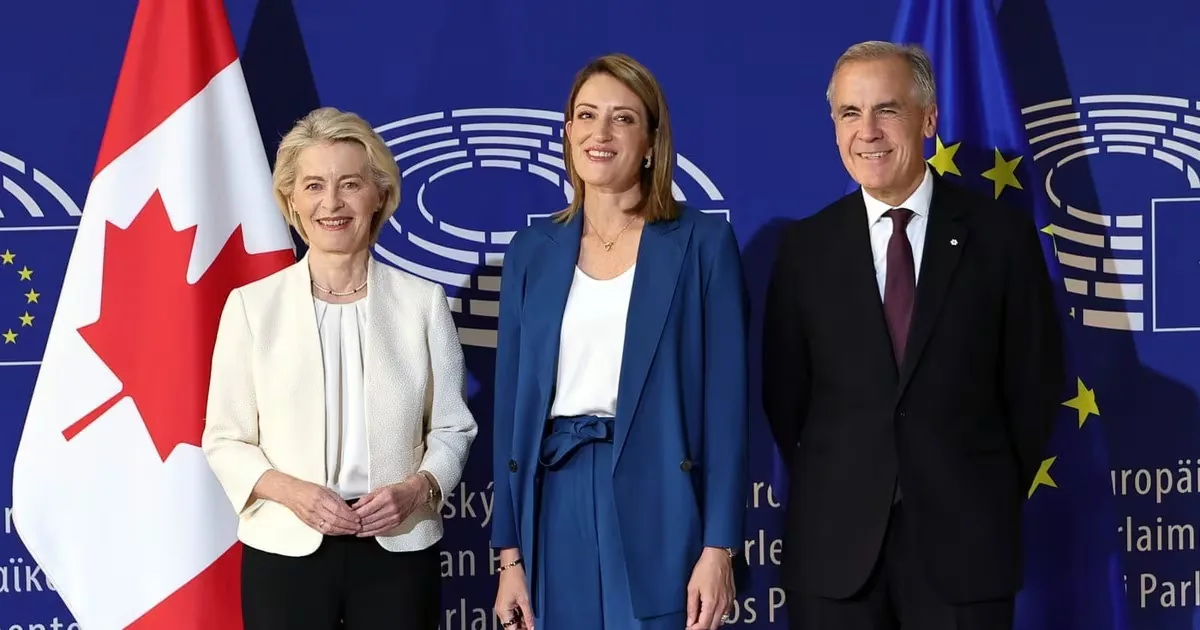
On Sunday, Canadian Prime Minister Mark Carney told the press that Canada seeks to establish a “unique alliance” with the EU.
And Carney’s wishes seemed to materialize this Wednesday, after the President of the European Commission, Ursula von der Leyen, proposed opening the door for Canada to become “the first associated member” of the European Union, as part of a new phase in bilateral relations to strengthen their economic, technological, industrial, and defense ties.
In the presence of Carney, the head of the EU executive proposed taking this step during her State of the Union speech before the plenary of the European Parliament gathered in Strasbourg, which welcomed the Canadian premier with applause and where he will deliver a speech in the Eurochamber this Thursday.
“Dear Mark, I have said that we must urgently rethink our alliances. That is why I would like to work with you to open the door for Canada to become the first associated member of the European Union. We share an ocean, the same values, and the same way of seeing the world. And now we will also build our common future,” asserted the German, amid an ovation and applause for Carney among those present in the plenary.
Von der Leyen framed her proposal in the need to “urgently reimagine” the EU’s alliances in the face of the “fracture” of the international rules-based system, arguing that Europe must build new coalitions with partners who share its values to strengthen its resilience and democracies.
“In this new world, we must urgently rethink our alliances and build global coalitions to strengthen our resilience and our democracies. And here too, only Europe, because of its size and power, can take the initiative. That is why I have invited the Prime Minister of Canada, Mark Carney, here today,” she added, describing his presence as “a symbol of the enduring friendship” between the two peoples.
After highlighting the “cultural, historical, and personal ties” between the EU and Canada, as well as emphasizing that both see “the world through the same eyes,” from Artificial Intelligence to climate change, from the Arctic to geopolitics, Von der Leyen proposed moving from the current Comprehensive Economic and Trade Agreement (CETA) signed in 2016 to an “Alliance for the Future” to create “a common space of prosperity and economic security,” after noting that trade in goods between the two partners has increased by 75% in less than a decade.
The EU president announced that this new alliance will include the creation of a technological partnership and greater integration of European and Canadian defense industries, as well as making the Arctic “a flagship joint project.”
Above all, she emphasized that “this is not an alliance against anyone, but in favor of our common strength,” summarizing that Brussels’ goal is to take the relationship with Canada “to the highest possible level.”
Although Von der Leyen stressed that the partnership “was not directed against anyone else,” given that Canada maintains a trade dispute with the United States even more intense than the EU’s, this plan would place the EU leader and Europe “in clear confrontation with the White House,” highlighted the European edition of Politico magazine.
But, according to the President of the European Commission, solidarity among EU Member States was the only possible solution in the face of “an openly hostile world,” she stated. “Our path is clear: to build an independent Europe that has the capacity to act.”
“This is a Europe that supports each other,” she said, referring to two concrete examples: Ukraine and Greenland, neither of which is part of the EU. She did not mention by name the antagonists of both: Russia and the United States. “Europe is there for Europeans,” she said. “And in the cold fragility of today’s world, only Europe can provide true sovereignty to Europeans.”
The 27-nation bloc faces a war on its borders due to the Russian invasion of Ukraine. In trade and other areas, it also faces strong rivalry from Donald Trump’s United States and an increasingly assertive China, Reuters reports.
The EU also faces significant internal obstacles, such as the growing rise of a Eurosceptic far right, evident in Germany’s regional elections, which have weakened Chancellor Friedrich Merz. Meanwhile, opinion polls place Marine Le Pen as the strongest candidate for next year’s presidential elections in France.
“The state of our Union is stronger than ever. The state of our Union may also seem more precarious than ever,” said Von der Leyen, now in her second five-year term leading the EU’s executive branch.
For the BBC, the EU’s offer to Canada has a clear reason: the current occupant of the White House. “The trigger for this new and passionate romance, lived in full view, is Donald Trump. Just a few days ago, the U.S. president posted on his Truth Social platform a map of North America—which included Canada and Greenland, a territory belonging to Denmark (an EU country)—all superimposed with the U.S. flag,” wrote Katya Adler, Europe editor for the British broadcaster.
“It’s not just Europe that is moving away from the United States. Leaders of U.S. partners in Asia and the Middle East are quietly doing the same,” Jon Finer, former Deputy National Security Advisor during President Biden’s term, told The New York Times. “The ostentatious corruption, trade conflicts, military adventurism, and erratic regulation of artificial intelligence characteristic of the second Trump administration have led to a new juncture in international affairs: a grand strategy of almost global reach whereby countries distance themselves from the world’s most powerful nation.”
Trade negotiations between the United States and Canada failed at the end of last month. European countries, affected by their own tariffs imposed by Trump, have privately watched the development of this dispute with a mix of interest and—for many—admiration, the outlet states.
While the EU, led by the European Commission, merely accepted Trump’s new widespread tariffs without resistance, Carney has openly stood up to the U.S. president, quickly imposing retaliatory tariffs on the United States.
Philipp Lausberg, analyst at the European Policy Centre, explains that “Canada is offering Europe a lesson on how to deal with Trump: economic dependence does not have to translate into political submission.” Lausberg highlights that “Carney responded to Washington’s latest tariff offensive by suspending trade negotiations and promising a reciprocal response, dollar for dollar. It is a striking decision for a country that sends about 70% of its exports to the United States. However, Carney’s calculation is that giving in again and again to ever-increasing demands ends up creating an even greater vulnerability.”
In a widely followed speech at the World Economic Forum in Davos in January, Carney urged middle powers to work together to increase their influence in an era of great power rivalry. “When we only negotiate bilaterally with a hegemon, we negotiate from weakness. We accept what is offered,” said the Canadian premier.
“This is not sovereignty,” he stated. “It is a dramatization of sovereignty while accepting subordination.”
Carney’s speech in Davos provoked a personal reprimand from Trump, and Von der Leyen’s approach to the U.S. neighbor “could heat up tensions again,” warned The Associated Press.
According to the BBC, “when courting the EU, Canada seems, in the eyes of some, even more interested than one of the bloc’s closest neighbors.”
“At this moment, Canada seems more interested than the United Kingdom in tightening its ties with Brussels to the maximum, even without being a Member State,” says Mark Leonard, director of the think tank European Council on Foreign Relations. “It is remarkable.”
A Canadian official familiar with the talks told The Associated Press last week that Ottawa was exploring ties with the EU that could stop just short of membership. The official said Canada would seek an agreement allowing its citizens to live and work in Europe without visas as part of a broader strategic partnership.
Barry Andrews, chair of the European Parliament’s Development Committee, called Canada “a perfect ally for Europe” and said closer ties could bring particular benefits to Ireland, noting that more than 10% of Canadians claim Irish ancestry.
Canada became this year the first non-European country to join the EU’s €150 billion defense SAFE program, giving Canadian companies access to joint procurement as Europe seeks to increase its defense readiness.
Anand Sundar, researcher at the European Council on Foreign Relations, points out that “European defense projects should open up to countries outside the EU and the European Economic Area. The Canadian Armed Forces bring considerable experience and knowledge in Arctic warfare, an area of growing interest for Europe given the increasing threats from both Russia and the United States.”
Iratxe García Pérez, chair of the Socialists and Democrats group in the European Parliament, praised Carney for showing “great courage in standing up to Donald Trump” and said allies were needed to defend “sovereignty, solidarity, and international law.”
A Nanos opinion poll conducted in April suggests that more than four out of five Canadians support closer ties with the EU. Nearly three out of five support Canada effectively joining the bloc, although Article 49 of the EU Constitution seems to make this impossible, the BBC reports.
As for trade, the EU is already Canada’s second-largest trading partner, although far behind the United States, which buys nearly 70% of Canadian exports. “The Canadian government is committed to trade diversification, aiming to double trade with countries other than the United States in the next 10 years; in this regard, intensifying the relationship with the European Union will be key to achieving that goal,” Mark Camilleri, president of the Canada-EU Trade and Investment Association (CEUTIA), told the BBC.
“However, completely decoupling from the United States would seem unrealistic, both for Canada and the EU. The United States is the EU’s largest trading partner overall, if goods and services are considered together,” Katya Adler recalls.
The figures are categorical. Canada and the United States maintain the world’s largest bilateral trade relationship, valued at nearly 900 billion U.S. dollars last year. This figure eclipses the 130 billion dollars of total bilateral trade between the EU and Canada during the same period. The vast majority of Canadian exports are destined for the United States.
“Thus, Ottawa could sign new trade agreements, but replacing the customers and supply chains built around the huge U.S. market would be a daunting task,” commented the BBC’s Europe editor.