








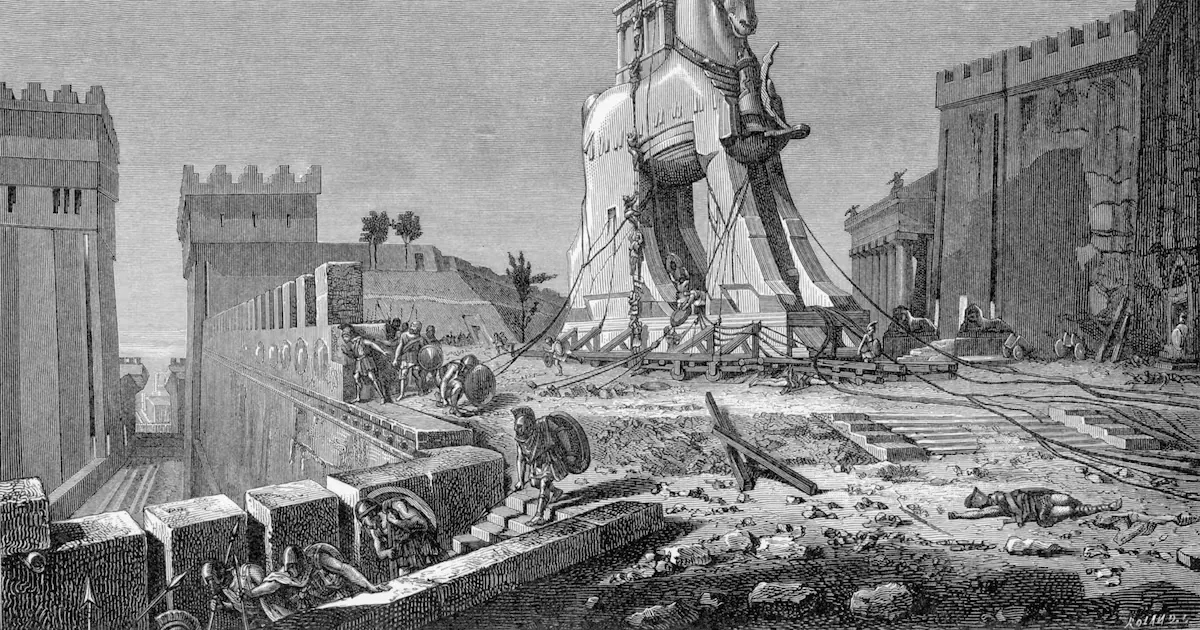
“Sing, O goddess, the anger of Peleus’ son Achilles; deadly anger that caused countless woes to the Achaeans and sent many valiant souls of heroes down to Hades.” These are the opening lines of The Iliad, the epic work of Homer based on the Trojan War. A text that, along with The Odyssey, are pieces considered canonical in the Greek world and Western culture.
Read more Madrid Court returns passport to Pedro Sánchez’s wife but maintains trial with popular jury
For centuries, that mythical war that took place on the walls of Troy involving heroes of the caliber of Agamemnon, Hector, Odysseus (also the protagonist of The Odyssey), Diomedes, Ajax, Aeneas, the old king Priam, Achilles, among others, sailed between reality and myth.
For the Greeks of the classical era, the era of democracy and the Persian Wars, those stories were completely real. This is explained to Culto by Professor Ioannis Xydopoulos, specialist in Ancient Greek History at Aristotle University of Thessaloniki.
“For the Greeks of the classical period, the Trojan War was generally considered a historical event marking the heroic age that preceded theirs,” he comments. “Although its details varied according to literary traditions, there is little evidence that educated Greeks fundamentally questioned its historicity. The war served as a fundamental cultural narrative, providing examples of heroism, morality, and political identity, while linking contemporary Greek communities with a shared myth.”
On the other hand, Doctor of History Edmund Stewart, associate professor of Ancient Greek History at the University of Nottingham, adds: “The Trojan War was the most important epic and story the Greeks possessed. This is largely due to the supremacy of Homer, who from the classical era was considered a genius of fundamental importance for Greek culture and poetry.”
Historian Sebastián Salinas, Director of the Center for Greek, Byzantine, and Neo-Hellenic Studies “Fotios Malleros” at the University of Chile, specifies a detail. The Greek world was not a single unit; therefore, the story of that conflict functioned as a bond. “The Trojan War was one of the few elements of common origin that everyone recognized. In a certain way, the story of Troy can be seen as the first emergence of an idea of Hellas, of Greece as such, in contrast to those who were part of another culture and language, whom the Greeks called ‘barbarians’.”
Did the Trojan War really happen? The settlement discovered by the German Heinrich Schliemann on the hill of Hisarlik, in present-day Turkey, was a step toward establishing a historical basis for the myth. “The current academic consensus is that the tradition of the Trojan War probably has a historical core, but does not constitute a reliable account of a single historical event. Archaeological evidence confirms that Troy (at Hisarlik) was an important city of the Late Bronze Age that suffered destruction at the end of the 13th or beginning of the 12th century BC, while Hittite texts referring to Wilusa (widely identified with Troy) and Ahhiyawa (generally identified with the Mycenaean Greeks) indicate political and military tensions in the region,” explains Professor Xydopoulos.
That is, Troy does appear as a flourishing city of the Bronze Age, contemporary with the Mycenaean civilization in present-day mainland Greece. “Troy was apparently culturally different, as everything seems to indicate it was more related to the Hittites, a people who formed a great kingdom in the territory of present-day Turkey,” explains Salinas. “That is, the evidence seems to show that Troy did not have much of the Mycenaean world (what was experienced in the territory of Greece at the time), but rather a more eastern culture, although also of Indo-European origin like the Hellenes.”
But the events of The Iliad themselves would correspond more to myth. “There is no evidence of a ten-year pan-Greek siege, of the historicity of the Homeric heroes nor of events like the Trojan Horse,” assures Professor Xydopoulos. “Therefore, most historians consider Homer’s The Iliad as an epic poem that preserves memories of one or more real conflicts of the Late Bronze Age, substantially transformed by centuries of oral tradition and literary development.”
On his side, Professor Stewart also emphasizes that both The Iliad and The Odyssey should rather be read as the result of a series of traditions accumulated over time. The stories also tend to coincide in time with the collapse of the Mycenaean era, giving way to the so-called Greek Dark Age (approx. 1200–800 BC).
“It is likely that the poems reflect a real war or a series of wars in the Bronze Age period, that is, before 1200 BC. The Iliad and Odyssey, poems composed by the one the Greeks called Homer, were, however, composed much later, after or around 750 BC. They were composed by a poet (or poets) trained in the tradition of poetry and oral performance, but probably used the new technology of writing to produce their work. This means that the poet relied on oral traditions that were already ancient in his time, although we must also accept that there is likely much new invention and reworking of older traditions in his work.”
Stewart points to the traceability of certain details present in the works. “There are some clear elements in his poetry that are vestiges of the Bronze Age and that coincide with the archaeology of the time of the Trojan War (for example, boar’s tusk helmets, long shields, etc.). The archaeological record of Troy also attests to several sackings of the city, which generally aligns with ancient tradition. Around 1200, the order established by the Mycenaeans in the Aegean collapsed (a phenomenon linked to broader regional instability) and the palaces of sites like Pylos and Mycenae were also burned.”
In other words, if a war occurred in the area during the Late Bronze Age, it fits into a context of high conflict in the Mediterranean. “Throughout the eastern Mediterranean, approximately from 1250 to 1150, there was a widespread crisis in many aspects, affecting almost all populations living there,” says Sebastián Salinas. “The Hittite Empire in Anatolia fell in these years, but the Mycenaean palaces in mainland Greece were also destroyed, there is evidence of strong invasions and destruction in Crete and Cyprus, several cities in the Near East experienced the same fate (notably Ugarit, where it seems people fled in emergency taking only what they wore), etc.”
Situated on the Hisarlik hill, Troy dominated the Dardanelles strait connecting the Aegean Sea with the Sea of Marmara. It was then a strategic location. Therefore, if a large-scale war occurred in the Late Bronze Age are there documentary references to the Trojan War in other parts of the Mediterranean world?
Read more Protests in Ukraine following the resignation of the popular Defense Minister
Professor Ioannis Xydopoulos responds: “No contemporary Mediterranean source explicitly records the Trojan War as described in the Homeric epics. The main external evidence consists of 13th-century BC Hittite texts referring to Wilusa and Ahhiyawa, which attest to political and military conflicts in western Anatolia,” he explains. “In contrast, Mycenaean tablets in Linear B, Egyptian inscriptions, and other Near Eastern records contain no clear reference to a Trojan War. Consequently, while contemporary documentary evidence supports the existence of regional conflicts involving Troy, the Homeric tradition itself is not corroborated by independent contemporary written sources.”
On his side, Professor Edmund Stewart complements with the perspective of the cultures of the time towards the Greeks of that era, then active navigators. “In documents from Near Eastern kingdoms (such as the Assyrians and Egyptians) there are numerous references to the Greeks (or Ionians, as non-Greeks called them). Since ancient times, the Greeks traded and raided throughout the Mediterranean, and also served as mercenaries (as Odysseus claims in Egypt, according to his account to Eumaeus and Penelope).”
In any case, Professor Salinas points out that the myth was so strong it originated a series of related stories toward other cultures. “We all know the story that Achilles died from an arrow that hit his heel, but that does not appear in either The Iliad or The Odyssey,” he explains. “Where did it come from? From these oral stories that showed the strength of the conflict narrative. So strong that later Rome also decided to create a mythical origin, inventing that they were somehow descendants of Aeneas, someone who had participated in the war. But the story also had so much weight and prestige that when in the Middle Ages The History of the Kings of Britain was written, it was also said that the monarchy of Britain descended from a great-grandson of Aeneas, thus also having a Trojan origin.”
If The Iliad narrates events in the last year of the Achaeans’ siege of Troy, The Odyssey – with a new film version directed by Christopher Nolan – would be something like a sequel. Also attributed to Homer, it tells the story of Odysseus’ return home, one of the heroes famous for his cunning.
His return will not be easy, complicated by a series of circumstances and involves various adventures, encountering fabulous beings; there appear the cyclops Polyphemus, the giant Laestrygonians, the monsters Scylla and Charybdis, the famous sirens, among others.
Regarding when it was composed, Professor Xydopoulos elaborates: “There is no certainty about the date or manner of composition of The Odyssey. Most scholars place it at the end of the 8th or beginning of the 7th century BC, making it slightly later than The Iliad, although both dates are approximate. It is believed the poem arose from a long oral tradition before being written down.”
On his side, Professor Stewart points to the composition of the work during a transitional period, when the Greek world began to recover a new writing system after the collapse of the Bronze Age. “We cannot be completely sure, but we know it must be after the rediscovery of writing and the adoption of a new alphabet (based on Phoenician) in the 8th century. It could be later, and a 7th-century date is even possible.”
Most likely, that oral tradition was enriched over time until reaching the best-known narrative. “A possible date for the end of the Trojan War according to the ancient Greeks was 1184 BC. Homer is usually dated to the 8th century BC,” says Sebastián Salinas. “Most specialists seem to agree that a more standardized version, based on the oral transmission that was fundamental, appeared only between the 6th but especially in the 5th century BC. And the oldest written version found is close to the 2nd century BC. So, we see that much water has passed under the bridge; the poem must have been nourished over the centuries by various influences, and there are other studies looking at what could or could not have been interspersed.”
Professor Salinas adds an interesting detail that reveals much about the origin of the text. “The Homeric language is Ionic Greek, that is, of the Greeks who lived on the western coasts of Anatolia, present-day Turkey. Perhaps that proximity to older written cultures with more mythology, like the Mesopotamians, could explain some parallels or why the apparent writing of The Odyssey arose there and not elsewhere in ancient Greece.”
An interesting aspect of the story is the way The Odyssey spread in the Greek world until becoming a canonical text. “During the Archaic and Classical periods, it spread mainly through performances by professional reciters (rhapsodoi), eventually becoming a canonical text in Greek education,” says Professor Xydopoulos. “In the Classical period, The Odyssey was widely known throughout the Greek world and constituted one of the fundamental works of Greek literature and culture.”
Professor Stewart traces the work of these rhapsodes, itinerant artists already identified since the 6th century BC. “They traveled between festivals and recited epic poems. Around this time, a group based on the island of Chios began calling themselves the Homeridae (that is, the descendants of Homer). They promoted Homer and his works, and probably also inserted some of their own poems into the Homeric corpus. By the end of the 6th century, The Iliad and The Odyssey seem to have been canonized as the greatest epic poems the Greeks possessed, probably largely thanks to the work of the Homeridae.”
Thus, Homer’s works gained popularity in the Greek world. “By around 520 or 510 BC, the tyrants Pisistratids of Athens decided that only these works could be performed at the Panathenaea,” points out Professor Stewart. “By the early 5th century, scenes clearly identifiable as derived from The Iliad and The Odyssey became more common in art (whereas before this date artists had focused on other episodes of the Trojan cycle). Also in the 5th century, the production and sale of written texts became widespread, so these not only supported poets and performers but were collected and read in the homes of the educated elite and also used as teaching material by teachers. In the Classical period, The Iliad and The Odyssey were the main school texts for young people beginning their education with a writing or music teacher.”
Read more Flávio Bolsonaro accuses Lula of US tariffs on Brazil: “We are on a plane without a pilot”