







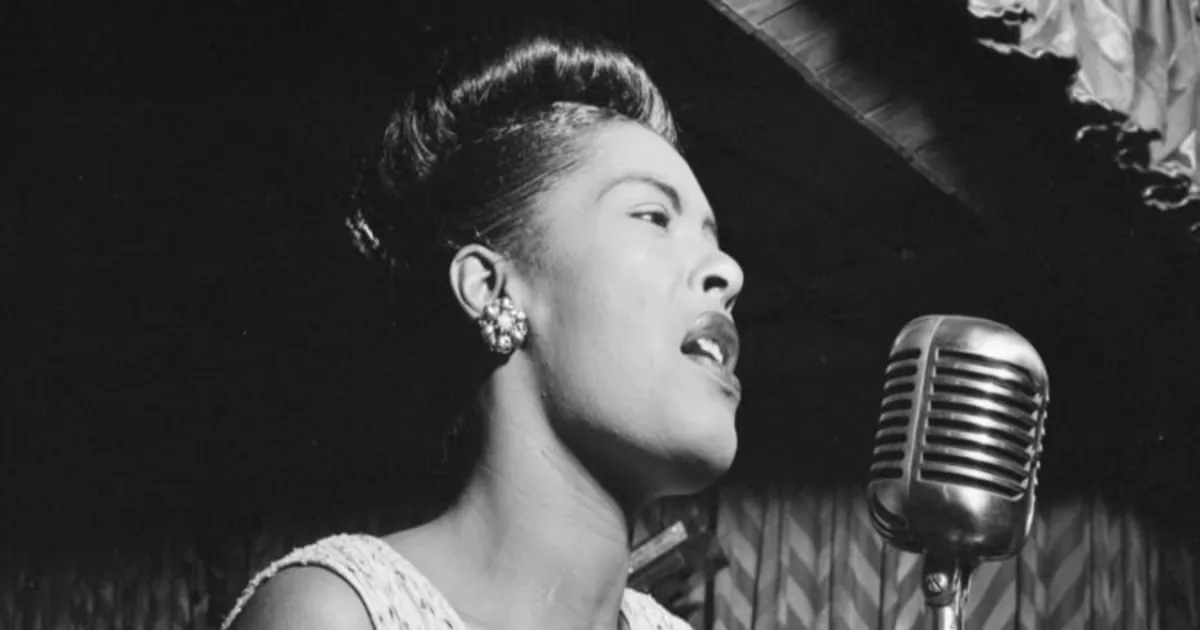
On July 17, 1959, at the Metropolitan Hospital in New York, a police officer guarded the door of a room. On the other side, a woman was dying from severe heart complications. Far from the sound of jazz, the applause that once filled the halls, and without the gardenias in her hair that became her trademark, Billie Holiday faded away at 44 years old.
Read more What is behind Trump’s speech in which he accused China of «interfering» in the 2020 elections
With her death also ended the chiaroscuro of a whirlwind life, marked by poverty, racism, stormy relationships, and addictions, but also by an unrepeatable voice, capable of elevating any song with phrasing that moved between elegance and a deep emotional charge.
According to the site American Songwriter, the singer born in Philadelphia “used the most turbulent experiences of her life to create timeless jazz recordings.”
However, to understand how one of the most influential voices in jazz history ended her days under police surveillance, alone and bedridden in a hospital bed, it is necessary to go back to the beginning of her story.
On April 7, 1915, she was born in Baltimore under the name Eleonora Fagan. She was the daughter of two teenagers: Sarah “Sadie” Fagan, only 13 years old, and Clarence Halliday, 15.
Her childhood was marked by hardships. Her father abandoned her and, when she was only 11 years old, she survived an attempted rape. It was also at that time that music first appeared in her life. While working running errands in a brothel, she first heard Louis Armstrong and Bessie Smith, two artists who would end up shaping her singing style.
In 1928 she moved with her mother to New York. Their arrival coincided with the years of the Great Depression, which left her family without income and forced the teenager to look for any available job.
Her first intention was to become a dancer. She auditioned at a nightclub but failed to impress with her steps. Then they asked if she could sing. She said yes and got the job. For this new stage, she took the name of her favorite actress, Billie Dove, and adapted her father’s surname. Thus, Billie Holiday was born.
In the early 1930s, while performing in Harlem clubs, she caught the attention of clarinetist Benny Goodman, who invited her to participate in a recording session. That was the first of many collaborations that followed with pianist Teddy Wilson and saxophonist Lester Young, who gave her the nickname that would accompany her forever: Lady Day.
By 1939, at just 23 years old, she was one of the main figures of New York’s Café Society. By then she was already wearing white gardenias in her hair and had developed the interpretive style that made her a legend.
It was there that she premiered Strange Fruit, a song based on a poem that denounced racial lynchings in the United States. The performance made her an internationally recognized artist but also put her in the authorities’ sights at a time when racism and segregation prevailed. Holiday began to be under surveillance.
Read more Iran enters Trump’s electoral controversy blaming Israel for perverting United States politics
Her confrontation with the U.S. authorities intensified over the following years. While her fame grew beyond the borders of jazz, so did her problems with drugs and alcohol.
In 1947 she was arrested for the first time for narcotics possession. After the conviction, she voluntarily entered a rehabilitation center to try to overcome her heroin addiction.
Although she returned to the stage with a massive concert at Carnegie Hall, the conviction cost her the loss of her license to perform in New York nightclubs. Since then, she could only perform sporadically in theaters and concert halls.
In her autobiography, Holiday acknowledged that she began using hard drugs during her marriage to trombonist Jimmy Monroe. Later, she had a relationship marked by violence with trumpeter Joe Guy, also linked to drug trafficking.
By the 1950s, addictions, along with a deteriorated health condition caused by them, began to affect her voice. In 1959 she already suffered from cirrhosis, had lost about nine kilos, and showed obvious physical deterioration.
According to The New York Times, in June of that year she was arrested again for illegal possession of narcotics while hospitalized at Metropolitan Hospital due to her delicate condition. She remained under police custody for weeks until shortly before her death.
On July 15 she received the last rites. Two days later, during the early hours of July 17, 1959, Billie Holiday died from pulmonary edema and heart failure derived from cirrhosis caused by years of substance abuse.
The writer Gilbert Millstein, close to the singer, recalled that moment: “In the bed where she had been arrested for illegal possession of narcotics just over a month earlier, while lying mortally ill; in the room from which a police guard had been removed —by court order— just a few hours before her death.”
Despite Lady Day’s tragic end, her music transcended time. Today she is considered one of the most influential figures in jazz history, an artist who challenged the limits of her era and turned the wounds of her life into a voice that transformed the genre forever.
Read more Conservatism and the return of the old obsession with controlling the female body