



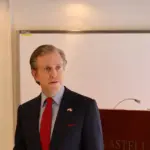




Emanuela Fronza teaches International and European Criminal Law, International and Comparative Criminal Law, and International Criminal Justice in the Department of Political Science at the University of Bologna, Italy.
Read more Guachaca Summit 2026: the best of Chilean gastronomy
Her latest book, Chaos. International Justice Under Attack (Laterza, 2025), deals with the definition of international crimes. She also published a book on historical denialism and the limits of freedom of expression (Memory and Punishment. Historical Denialism, Free Speech and the Limits of Criminal Law, Springer, 2018).
Invited by Diego Portales University to give the keynote lecture “Genocide, Symbolism and Denialism” this Tuesday, as part of the UDP Francisco Muñoz Conde Chair, Fronza analyzes in the following interview with La Tercera the challenges of the international rule of law, the offensive by the United States against the International Criminal Court (ICC), and the pressures faced by countries in the region to abandon this international court of justice governed by the Rome Statute.
Her latest book, published in 2025, has a suggestive title: “Chaos. International Justice Under Attack”. What is your diagnosis of the international rule of law? Is the stability of the global justice system at risk?
We are currently living through a phase very different from previous ones, a change of era. Since the origin of the system for the protection of human rights and the prosecution of the most serious violations—the ‘Nuremberg pact’—two irreconcilable logics coexist: on the one hand, the construction of an international (universal) justice; on the other, Realpolitik, which sees the great powers as actors who act according to state reason and the logic of force.
For decades, international justice has undergone significant evolution (from a set of international conventions to the creation of ad hoc tribunals, finally culminating in a permanent International Criminal Court). Despite the commission of very serious human rights violations and despite many countries not supporting or openly rejecting this system (consider that countries like the U.S., Russia, China, Israel, and India have never joined the ICC system), there was a system of rules and institutions that established the prevalence of law over force. In the current state, we are in a different phase, in which this entire structure is being questioned.
In recent years, the ICC has begun to fully exercise its universal vocation—also prosecuting leaders of great powers, such as with arrest warrants against Vladimir Putin and Benjamin Netanyahu—and, paradoxically, from that moment the ICC has been under attack. That is the qualitative leap that worries me and that I want to point out: it is no longer just about violating rules and attacking institutions, but openly denying the very universe of values that those rules express. That indeed puts the stability of the system and, above all, the international rule of law in general at risk. But I do not believe we are doomed to that regression. The growing role of middle powers, in a scenario no longer limited to bipolarism, leaves open the possibility that this necessary utopia—the one of a universal international justice—is not defeated.
What do you think of the offensive by Donald Trump’s government against the International Criminal Court? Will it be able to dismantle the ICC “brick by brick,” as Secretary of State Marco Rubio has suggested?
It is curious that he uses that metaphor, because I close the book I wrote with Marcello Flores, “CHAOS,” with the same image, but in the opposite sense: I write that, faced with attack and regression, “we have the duty and joy to react and keep building, brick by brick.” So, if I may, I return the metaphor: the question is not whether the Court can be dismantled brick by brick—obviously, with sanctions against judges, diplomatic pressure, and the weight of the U.S. not being a party to the Statute, much erosion can occur—but whether, on the other side, there is enough will from states worldwide to keep building and supporting the Court. Sanctions against ICC judges and prosecutors are not an isolated fact: they are part of state reason, which today is claimed so manifestly that a few years ago it would have been unthinkable.
Kenneth Roth, former executive director of Human Rights Watch, wrote that Trump “wants the world to be a safe place for American and Israeli war criminals.” Do you agree with that statement?
I share the underlying diagnosis, although I would nuance the emphasis. U.S. sanctions came precisely after the Court decided to investigate crimes committed by U.S. soldiers in Afghanistan and issued arrest warrants against Netanyahu and Yoav Gallant (former Israeli Defense Minister), while the U.S. celebrated the independence of the same Court when it issued the arrest warrant against Putin. That asymmetry is objectively verifiable: it is not a political opinion, it is a pattern of conduct. However, I would avoid reducing it to a personal intention to “protect war criminals”: I believe the phenomenon is more structural. It is the return of state reason as the only key to understanding international relations; a return that is not exclusive to one government or country, although today the U.S. expresses it with particular frankness.
Besides the United States, do you see other international actors conspiring against the international rule of law?
Unfortunately, the law of international crimes is the testing ground for a more general trend of attacks on rules, limits, and that “Nuremberg pact” I have already mentioned. On one hand, there are powers openly hostile to the human rights protection system. On the other hand—and this worries me the most—there is a widespread trend toward “de-internationalization” in countries that are part of the Rome Statute and that, when directly or indirectly involved, change their attitude: France, Germany, and Italy have declared they will not execute the warrant against Netanyahu invoking his immunity; Hungary directly withdrew from the Statute; and in Italy, I document the Almasri case, a Libyan citizen who was detained in Italy following an ICC arrest warrant, then released by an Italian court on a procedural technicality, while images of his festive reception in Tripoli clearly showed the real interests at stake, linked to migration agreements between Italy and Libya. There are several paths to weaken the system: one can refuse to cooperate or also leave the system, as Burundi and the Philippines did, or as several states are beginning to do (Niger, Burkina Faso, Mali, Chad, Venezuela) and others heading in the same direction (perhaps Colombia).
Read more The French right pays tribute to the “statesman” Edouard Balladur, who passed away at 97 years old
Mechanisms such as the EU Blocking Statute have been proposed to counter sanctions against the ICC. Are they going in the right direction?
In general terms, any diplomatic or legal mechanism that protects those working for the Court from external reprisals goes in the right direction because it addresses exactly the problem that seems central to me: the Court was born structurally fragile, without the adhesion of the main powers, and that fragility has been aggravated, not reduced, as it began to fully exercise its universal vocation of justice that identifies limits and rules for all.
Instruments like that seek to compensate for that power asymmetry. However, the blocking statute is an instrument conceived for other reasons and, even if the European Union responded in a politically united way—as desirable—it might not work to safeguard the independence of the International Criminal Court. That said, no countermeasure mechanism replaces the essential: the sustained political will of the states that do believe in the system. Legal tools help but do not replace that fundamental political decision.
Is there any degree of self-criticism about the global justice system itself given the lack of results in some emblematic cases?
The most persistent criticism for decades has been that of double standards: during the first 14 years of the Court’s operation, all investigations were directed exclusively against African countries (the first case outside Africa was Georgia, only in 2016). It is true that many of those African cases came by voluntary self-referral from the states themselves, but it is also legitimate to ask how much of that “will” was genuine and how much was induced by the prosecution itself in search of what I call, citing the criticisms I document in the book, “easy victories.”
The U.S. pressures its Latin American allies to abandon the ICC. What should be the response of governments in the region?
My fundamental position is clear: joining the Rome Statute was never a loss of sovereignty but an expansion of the legal spaces of sovereignty itself, because it requires cases to be judged by the national jurisdiction itself instead of ceding that space to the Court by default. Leaving the system due to external pressure would invert exactly that logic: it would give up that shared sovereignty for nothing.
Moreover, Latin America’s own history shows that the region has been, on more than one occasion, an active protagonist in building the system for prosecuting international crimes and a “laboratory” to identify and resolve many complex issues, not just a passive recipient of its decisions. My answer, then, would be that governments in the region should resist that pressure precisely by appealing to that same history and their role: international justice is not an instrument imposed from outside; it is largely a tool that Latin America helped build and evolve, and to which it has turned—and continues to turn, as shown by its current jurisprudence on crimes against humanity and universal jurisdiction—to resist impunity dynamics.
Currently, it is not only the survival of the International Criminal Court at stake. What is happening reveals an allergy to any control and limit other than that which the executive power imposes on itself. It is an attack on the idea of impartiality of international and national justice: equal and independent justice for all, which does not depend on great powers or intermediate countries. An international justice that must walk on the legs of states but is an entity distinct from states. And precisely this autonomy, this impartiality, is what states tend not to accept at all, rather seeking to reorder the world according to their own interests. It should be noted that this is not unique to the international criminal justice system: it is also observed, for example, in the regional human rights system, where there have been several cases of countries not complying with rulings of the European Court of Human Rights.
If justice does not even have guaranteed automatic enforcement by states in defining the most serious crimes because they consider they can negotiate the application of international law at any time; and if this happens even regarding the deepest and foundational principles of the international legal order and violations that wound all humanity, we have a very serious problem: the entire structure of law collapses.
The risk is that governments will again decide the application or non-application of laws at their whim. If it is up to the government to decide whether the law applies or not as if it were a mere instrument at its disposal, there is a risk of complete erosion of the rule of law in favor of an order suspendable by political authority. This would mean the death of law, both domestic and international. Does only the war instrument matter? Does only the use of force that apparently tears apart any law matter? We must reaffirm the legal instrument, fragile but necessary if we want to avoid a collapse of civilization. It is a battle that belongs to all of us and should lead us to avoid opposing or keeping Europe and America separate.
Read more Haakon VIII takes the oath in the Norwegian Parliament as the new monarch