





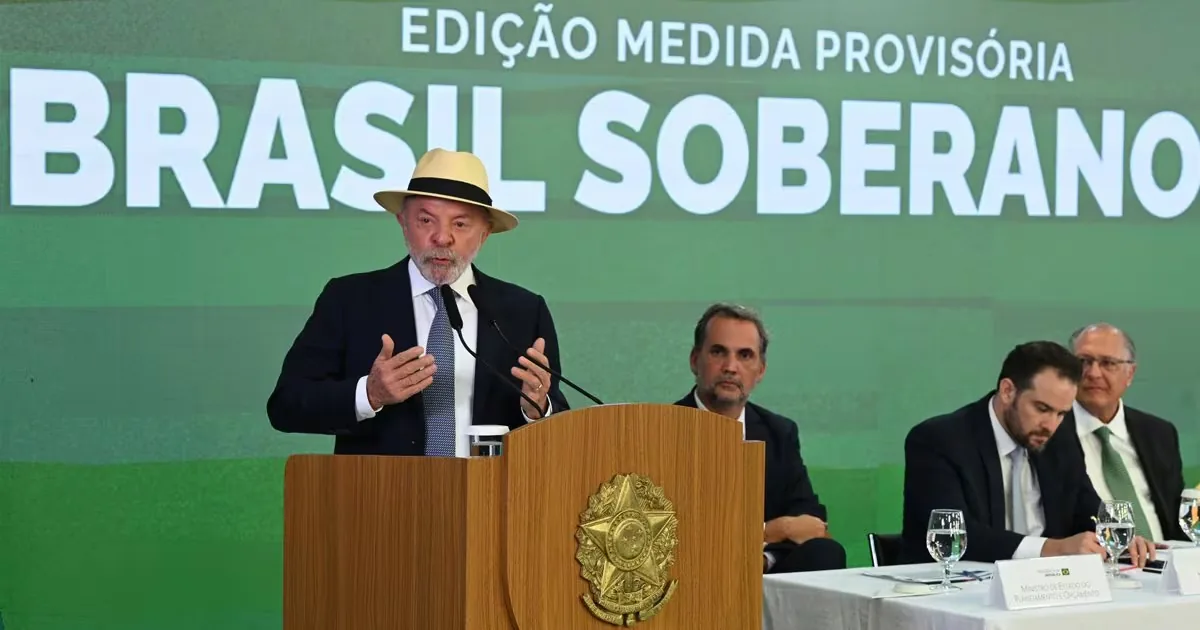
The president of Brazil, Luiz Inácio Lula da Silva, this Thursday rejected the imposition of tariffs on 60 countries by the United States, accusing the Donald Trump Administration of manipulating a fundamental issue for Human Rights and the struggle of workers.
This comes after the justification given by Washington, just hours before the previously imposed temporary global tariff of 10% expires, to punish those economies that have not banned goods produced with forced labor.
“In the absence of an internal legal basis to support its protectionist trade policy, the Office of the United States Trade Representative (USTR) -Jamieson Greer- has chosen to manipulate a fundamental issue for Human Rights and the struggle of workers worldwide, accusing 59 countries and the European Union of unfair practices”, the Brazilian president declared on social media.
Lula stated that his administration “rejects the decision of the United States government to impose 12.5% tariffs on Brazilian products”, affirming that “throughout the investigation (of the USTR on Brazil) the Ministry of Labor provided explanations and extensive documentation on Brazilian legislation and the actions of our customs authorities to curb imports of goods produced with forced labor”.
“We have criminalized not only subjection to forced labor, but also exhausting working hours, degrading working conditions, and restrictions on freedom of movement. We demand accountability from companies and individuals, applying severe fines, and maintain a ‘Black List’ of employers,” he remarked on the measures taken from Brasília in this area.
Furthermore, he highlighted that “Brazil has been recognized for decades by the International Labor Organization (ILO) for its firm commitment to the fight against forced labor”, recalling that “Brazil has ratified the four ILO instruments related to forced labor”, while “the United States has only ratified one”.
“We are signatories to 66 active ILO conventions. Meanwhile, the United States, which claims the right to judge us and impose sanctions on us, has only ratified 10 of these conventions,” argued the head of the Planalto.
He immediately pointed out that “the free trade agreements signed by Brazil and Mercosur, including those signed with Chile, the European Union, and the European Free Trade Association, contain commitments to eliminate forced and compulsory labor and to effectively enforce these prohibitions”.
Therefore, “given the completely arbitrary and unjustified nature of the tariffs announced against Brazil, we will immediately initiate procedures to activate the instruments provided for in the Reciprocity Law, unanimously approved by the National Congress, and will take the matter to the dispute settlement mechanism of the World Trade Organization (WTO)”.
Lula’s reaction comes after the Trump Administration announced the imposition of tariffs on 60 countries, framing the measure as a punishment for those economies that have not banned goods produced with forced labor, although it replaces the temporary global tariff of 10% imposed by the White House for 150 days, which expired this midnight in the U.S.
In Brazil’s case, the Trump and Lula governments already engaged in a war of words last week after Greer, the U.S. Trade Representative, announced the imposition of a 25% tariff on “most” Brazilian imports, citing Brasília’s lack of “good faith” in negotiating with Washington as the trigger for this decision.
On that occasion, one of the main reasons put forward by the U.S. was the protection by Brazilian authorities of the Pix electronic payment service, promoted by the Bank of Brazil, which, according to the White House, “has unfairly harmed” American providers.
It also included criticism for “punishing American technology companies for refusing to censor political speech,” in a veiled allusion to the fine imposed on the social network X, owned by South African magnate Elon Musk, after it failed to comply with the order to delete profiles of individuals investigated for publishing messages considered anti-democratic.
Read more Team sleep with pets or everyone in their own bed?