

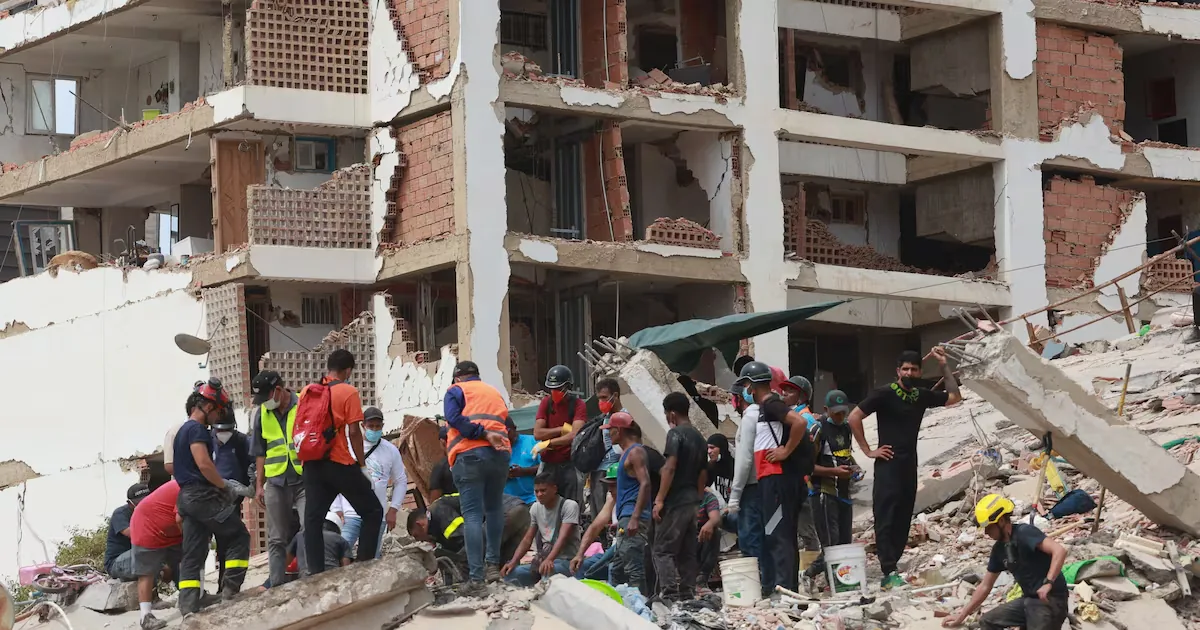
Mariuth Arenas knows where her nephew is. She learned it from the security guard of Residencias Solmarino Garden 2, in Playa Grande, La Guaira, rescued alive from the rubble: before the earthquake, he was talking in the parking lot with a man cleaning his car. The description and the vehicle match. José David Vera Arenas was there when the building collapsed on June 24.
Read more Team sleep with pets or everyone in their own bed?
His wife and two children were upstairs, in the apartment. They were found dead last weekend. He has not been found yet.
“Where we think he might have been is very close now. I believe that by working one day, we can rescue the body, to give him a Christian burial alongside his wife and children,” Arenas tells France 24.
But on July 20, at four in the afternoon, the machinery removing the rubble was withdrawn. In her social media posts, Arenas mentioned an engineering order; a day later, she wrote that it was taken away “without any justification.” No one offered them an alternative.
Since then, it’s three people facing the ruin: her, José David’s 73-year-old father, and his brother, who fractured an arm removing rubble and refuses to go to the doctor until the body is recovered. “We can’t do it alone. There are only three of us, that’s all,” she summarizes.
On Facebook, Arenas wrote it for all families like hers: “We cannot leave our relatives forgotten. We will not abandon them under the ruins.”
One month after the double earthquake of magnitude 7.2 and 7.5 that devastated northern Venezuela on June 24, the official toll records at least 5,278 dead, 16,740 injured, and 17,907 homeless people, in addition to 856 affected buildings and 190 collapsed. La Guaira, the coastal state considered the earthquake’s ground zero, concentrates the devastation.
This Tuesday, July 21, the National Service of Medicine and Forensic Sciences (Senamecf) and the Ministry of Interior called on the relatives of the victims for a voluntary collection of DNA samples, to identify bodies remaining in morgues through genetic profile comparison and provide, according to the official statement, “certainty and peace to families.”
The call comes as unidentified victims have already been buried in open graves in a municipal cemetery in La Guaira, according to witnesses cited by the EFE agency in early July.
What authorities have not reported in 30 days is how many people are still missing. Official references are unclear: Jorge Rodríguez, president of the National Assembly (parliament), stated that some 30,000 people were in La Guaira and that about 19,800 escaped or were rescued, which would leave about 10,000 unaccounted for in that state alone. The UN reported in June that it had received unconfirmed figures of up to 50,000 missing.
Gloriyen Aris doesn’t even have what Mariuth Arenas has. Her cousin, Sacha Chagua, went down to La Guaira with a friend on June 24, a holiday for the anniversary of Carabobo, a national celebration, to spend the day at the beach. She spoke with her mother until after two in the afternoon. Then, the earthquake, and nothing.
“No one knew where she was. She was in La Guaira, but we didn’t know which building or with whom,” Aris tells France 24.
The family did what she describes as “intelligence work”, traversing an extensive and devastated coast, until Sacha’s car appeared next to a building that was folded “like an accordion”: residents of the upper floors managed to get out; those below are still inside. The family presumes she is too. The vehicle appeared stripped, with a broken window and a stolen purse; from the building, even the security camera recorders were taken.
Read more Trump says he is “close” to making a decision on the “biggest attack” against Iran to date
Aris estimates that 12 people remain trapped in that building. And she tells something else: three or four buildings away, there is another, completely collapsed, where more than 50 people who no one claims would have died, because their relatives are not in Venezuela or no longer exist. In a country that saw millions emigrate in the last decade, there are dead that no record captures because there is no one to look for them.
“Having a missing person is complicated, because you don’t even know if they are alive or dead,” says Aris. “You have hope that they are alive, but as the days pass, that hope fades a little. At least to find the body to bury it.”
Sacha was reported on all search platforms that emerged after the tragedy. The largest of them, Desaparecidos Terremoto Venezuela (Missing Earthquake Venezuela), was born the same night of the earthquake: programmer Jorge Bastidas set it up with a group of volunteers after seeing people searching for their relatives through live broadcasts on social media.
“Five hours after the earthquake occurred, we already had the platform active,” he tells France 24. “We reached up to 100 reports per minute.”
In the first 24 hours, they received some 30,000 reports; in total, more than 82,000, of which almost half were duplicates that a team of volunteers cleans up case by case. Today, the platform maintains some 29,500 active cases of people without contact. Another citizen registry, Venezuela Reporta, counts more than 41,000.
In a month, no authority contacted them. “We have had no contact from official authorities,” said Bastidas. Nor for the DNA identification process that has just begun.
For the UN Office for the Coordination of Humanitarian Affairs (OCHA), the volume of citizen registrations does not imply that all those people are under the rubble, but it does reflect the dimension of the disaster families face, according to its deputy spokesperson, Jens Laerke.
In Caraballeda and Tanaguarenas, where several OPP towers of the social housing program, launched in the early 2010s, collapsed, the search was left in the hands of neighbors from the first days. They call themselves “Los Topos” (The Moles): they dig tunnels up to 18 meters to reach their loved ones, taking turns because there is a lack of air in the tunnels. At first, they pulled out survivors; later, only bodies.
“We have gotten used to eating with the smell, sleeping with them beneath us, pulling them out,” one of them, who found his aunt’s body and stayed to help, living in a tent next to the rubble, tells France 24. “It’s the story of thousands, not just our story.”
Families pooled money among neighbors to rent machinery, and at the pace of these collections, dozens of bodies were recovered. The Government, meanwhile, promised to deliver 4,000 homes between July and December, in a country that, according to official estimates, needs 25,000 and where thousands of victims sleep in camps set up in stadiums, squares, and sidewalks.
In Playa Grande, Mariuth Arenas hopes that a machine capable of operating on the unstable structure of Solmarino Garden 2 will return. In Caracas, Gloriyen Aris prays and checks the records. They await different things: one knows where her relative is and cannot reach them; the other does not know where to look. But a month after the earthquake, they ask for exactly the same thing, the only thing left to ask for: to be able to bury them.