







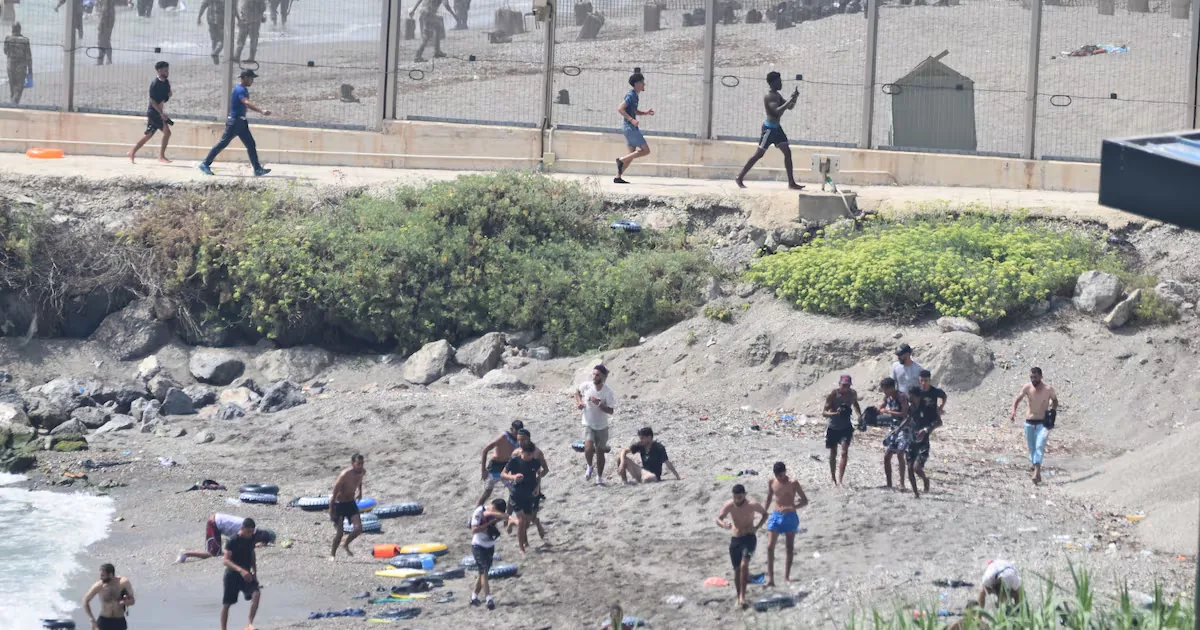
One day after the migratory avalanche in Ceuta, the Spanish autonomous city located on the north coast of Africa, the president of the government, the socialist Pedro Sánchez, arrived this Friday at the enclave bordering Morocco to assess the impact of the crisis.
Sánchez denounced “an attack on the integrity of Spain,” which he linked to human trafficking mafias, after instrumentalizing the recent Supreme Court ruling that prohibits hot returns of irregular immigrants who arrive by swimming, thus generating a pull effect. His statements, in which he exonerated Morocco of any responsibility, come at a time when Ceuta faces an unprecedented migratory crisis after, according to the latest official data, nearly 60,000 people crossed the border in just 24 hours.
Below are some key points to understand the origin and impact of the Ceuta migratory crisis:
Despite the numerous presence of Army and Civil Guard forces at the border crossing on the Spanish side, 49,000 people had already entered by sea and land in the last 24 hours, according to figures from the Spanish Ministry of the Interior.
However, the president of Ceuta, Juan Jesús Vivas, estimated that 60,000 migrants have entered the autonomous city from Morocco due to the migratory crisis unleashed this Thursday. “It is impossible to handle this situation,” he said at a press conference after meeting with the Spanish government president, Pedro Sánchez.
The Spanish government raised the number of immigrants who have returned to Morocco from Ceuta to 48,300 by 3:30 p.m. this Friday.
On Thursday, for practically the whole day, the flow of entries to Ceuta was continuous, but this Friday a good part of the migrants who crossed the border by swimming or skirting the El Tarajal breakwater began the way back. At noon, Pedro Sánchez’s government estimated 25,000 had returned, at a rate of 150 people per minute, and just a few hours later raised the number to 37,500.
This figure far exceeds that recorded in the previous migratory crisis in the autonomous city, in May 2021, when it was estimated that more than 10,000 migrants bypassed border controls.
The number of entries now handled represents practically 70% of the 83,600 inhabitants of this small territory of 18.5 km².
The Government Delegation in Ceuta confirmed this Friday afternoon an updated count of 57 bodies found since the start of the massive entry of immigrants from Morocco to the autonomous city. The new findings add to the 30 deaths found until Wednesday this year. Now there are 87, according to data handled by Europa Press, immigrants found on the Ceuta coasts who drowned trying to cross from Morocco.
During the entire year 2025, 46 migrant deaths were recorded on the coasts of Ceuta trying to enter irregularly, a figure that has already been surpassed due to the recent migratory crisis.
According to experts consulted by the AFP agency, there are several possible explanations.
One would be the Spanish Supreme Court ruling of July 8, which ruled that so-called “hot returns” (immediately returning a migrant who crosses the border irregularly without opening an administrative expulsion procedure) do not apply in the case of arrivals by sea.
But Pedro Sánchez opened this Friday to reform the immigration law to ensure that “border repatriations are carried out in the most efficient way possible.”
In any case, the Spanish socialist leader said that the “mafias that traffic in human beings” had made an “interested reading” of the Supreme Court decision.
According to the ruling, this “express return” can only be applied to people who surpass “the established border containment elements, such as fences,” but not to those who do so by sea, as many of the people who arrived in Ceuta in recent days did.
“Without a doubt, the July 8 ruling (…) has played a role. But that does not explain the level of mobilization, which is very high,” points out journalist Ignacio Cembrero, a specialist in Maghreb politics in its relationship with Spain.
The massive arrival could have been encouraged by the regularization of migrants recently announced by Sánchez’s socialist government or by the prospect of an upcoming government change less favorable to migrant reception, hypotheses difficult to confirm, according to analysts.
Analysts also point out that recurrent migratory crises and the supposed laxity of Moroccan security forces to “open the doors” would be a diplomatic pressure weapon. Morocco claims sovereignty over Ceuta and Melilla since its independence in 1956, but Spain has flatly rejected any negotiation over the two cities.
According to Cembrero, “Moroccan authorities have seen an opportunity to force Spain to negotiate the future of those cities.”
Faced with this “unacceptable” territorial claim, Carlos Echeverría, director of the Ceuta and Melilla Observatory, calls to “Europeanize” the issue. “We must get the European Union, as a member state, to take retaliatory measures,” he assures.
“Morocco has taken advantage of a window of opportunity within its hybrid war strategy, once again using migratory pressure on Ceuta as a political blackmail instrument,” says Jupol, the majority union of the Spanish National Police, in a message published on social media.
Just 10 days ago, Pedro Sánchez traveled to Algiers, opening a new page in bilateral relations after the 2022 Sahara shift that greatly upset the Algerian government, but any “gesture” with Algeria, warn some experts on the Ceuta crisis, will be “punished” by Morocco.
About Sánchez’s trip to Algeria on July 20, Juan Luis Manfredi, professor of International Studies and researcher at the Center for European Studies of the University of Castilla La Mancha, is clear that “for Morocco, our rapprochement to Algeria is unacceptable.”
But the Spanish Ministry of Foreign Affairs has dissociated the migratory crisis in Ceuta from Pedro Sánchez’s recent trip to Algeria and has defended that the relationship with Morocco is “excellent.”
“The relationship with Morocco is excellent and is not affected at all by good relations with Algeria,” sources from the department led by José Manuel Albares told Europa Press, also pointing out that coordination on migration, as well as on “other issues,” is “very intense.”
Fulfilling the warning made the day before, on Friday afternoon, Italy announced that it suspends the EU Schengen free movement agreement with Spain. Italy has no land border with Spain, but the measure will affect people traveling by plane or boat between the two countries. The Italian Ministry of the Interior indicates in a statement that it had also agreed with Paris to strengthen controls along the Franco-Italian land border.
This Friday, Finland’s Interior Minister, Mari Rantanen, expressed her support for the measure proposed by the Italian government and called on other European governments to do the same: “Spain has completely failed to protect the external border of the Schengen area from illegal immigration. This cannot continue. All European countries must support Meloni’s proposal. Those countries that do not fulfill their obligation to protect the external border cannot be members of Schengen,” she said.
She was also supported by Denmark’s Prime Minister, Mette Frederiksen, who this Friday expressed that the European Union must analyze all options in the face of the massive arrival of migrants from Morocco to Ceuta, including suspending Spain’s participation in the Schengen Treaty. “It is clear that the EU must immediately take all necessary steps and consider all possibilities, including suspending Schengen cooperation,” Frederiksen said in a statement sent to the Danish agency Ritzau.
Austrian Chancellor Christian Stocker described the events in Ceuta as a “clear warning sign,” stating that such conditions “have no place” in the EU, urging Madrid to fulfill its responsibilities by ensuring that “not a single illegal immigrant sets foot on continental European territory.”
From France, Interior Minister Laurent Nuñez announced the reinforcement of controls at the border with Spain and confirmed that he maintains contact with the Spanish government due to the magnitude of the crisis. “Given the situation observed in the enclave of Ceuta, since last night I have given instructions to promptly reinforce controls at the Spanish border. In addition, I have activated the Rapid Intervention Border Force to carry out thorough checks,” Nuñez posted on his X account.
Swedish Prime Minister Ulf Kristersson also spoke out, stating that Spanish authorities must “regain control of the situation” in Ceuta and warned that the Swedish government is prepared to act if the migratory crisis worsens.
But, according to the Spanish site Vozpópuli, European Commission President Ursula von der Leyen sent one of the strongest messages from Brussels since the outbreak of the migratory crisis in Ceuta this Friday: “We cannot allow anyone to come to our Union without respecting our rules.”
The U.S. State Department issued a message of condemnation, solidarity, and warning this Friday for what has happened in Ceuta and Melilla in the last 36 hours.
“The United States stands with the people of Spain, and all Europeans, against this blatant violation of their sovereignty and human rights,” begins the tweet from the department led by Marco Rubio.
However, immediately after, the tone changes completely. “This unacceptable incident is the direct result of the Spanish government’s deliberate efforts to facilitate and promote massive illegal migration to Europe. We are considering actions to protect Americans in the country and abroad from this threat, and we are ready to assist other European allies considering similar options,” the post concludes.
President Donald Trump took advantage of the crisis in Ceuta to send a message to American voters. The Republican leader lamented the “terrible” migratory crisis that the Spanish autonomous city has been going through in recent hours and predicted that the same will happen in the United States if the Democratic Party opposition wins the 2028 elections.
“It’s terrible. Remember this image. This is how we will be in three years if the wrong side wins,” Trump said in statements to Fox News, before concluding that “if the Democrats come to power, no one here will live well.”
Read more When exercising stops being healthy