







The war in Ukraine, combined with Russia’s sabotage operations involving the sending of drones and missiles, has increased fears that Poland could face a military conflict, which is why they plan to build four underground hospitals in the north-central part of the country as part of preparations for possible crises.
Read more United States suspects that Iran may have been behind the cyberattack on Minnesota’s water systems
This was reported by the Polish television portal TVP, which indicated that the dual-use facilities are expected to be completed by 2029 at an estimated cost of 270 million zlotys (around 63 million euros).
The shelters will be built in the cities of Bydgoszcz, Toruń, Włocławek, and Świecie, in the Polish Kuyavia-Pomerania region, in hospitals managed by the regional government.
The portal indicated that the project is inspired by the Finnish model, where underground shelters are integrated under public buildings, sports facilities, and parking areas, reflecting growing security concerns.
The planned facilities will include smaller operating rooms designed for essential medical procedures, along with independent power sources, water supplies, ventilation, and air filtration systems.
“In case of crisis, they will ensure the safety of patients and staff, and allow the necessary medical procedures to be carried out,” said regional governor Piotr Całbecki, quoted by TVP.
“The facilities will be built for dual use and will also be used daily: as parking lots and, in Świecie, as rehabilitation and therapy space,” he added.
The largest shelters, planned for Toruń, Bydgoszcz, and Włocławek, will cover between 1,500 and 1,800 square meters spread over two underground levels.
While one floor will provide temporary shelter for between 450 and 500 people, the ground floor will serve as a medical area. The Świecie facilities will be smaller, with 720 square meters of space for up to 250 people and will be used daily as a rehabilitation and therapy center.
Marta Chalimoniuk-Nowak, general director of the Civil Security Research and Development Center, told TVP World that the hospitals’ responsiveness requires more than just new infrastructure.
“Preparing hospitals for a state of war is necessary and obvious in the current reality of hybrid warfare,” she told TVP. “However, it is not just about making decisions on such investments and ultimately creating facilities,” she added.
“It is about enforcing specific procedural measures and developing specific procedures for various types of crisis situations, from construction disasters to floods,” said Chalimoniuk-Nowak, adding that the facilities must also develop procedures covering energy security, water supply, cybersecurity, medicine stocks, and continuity of care.
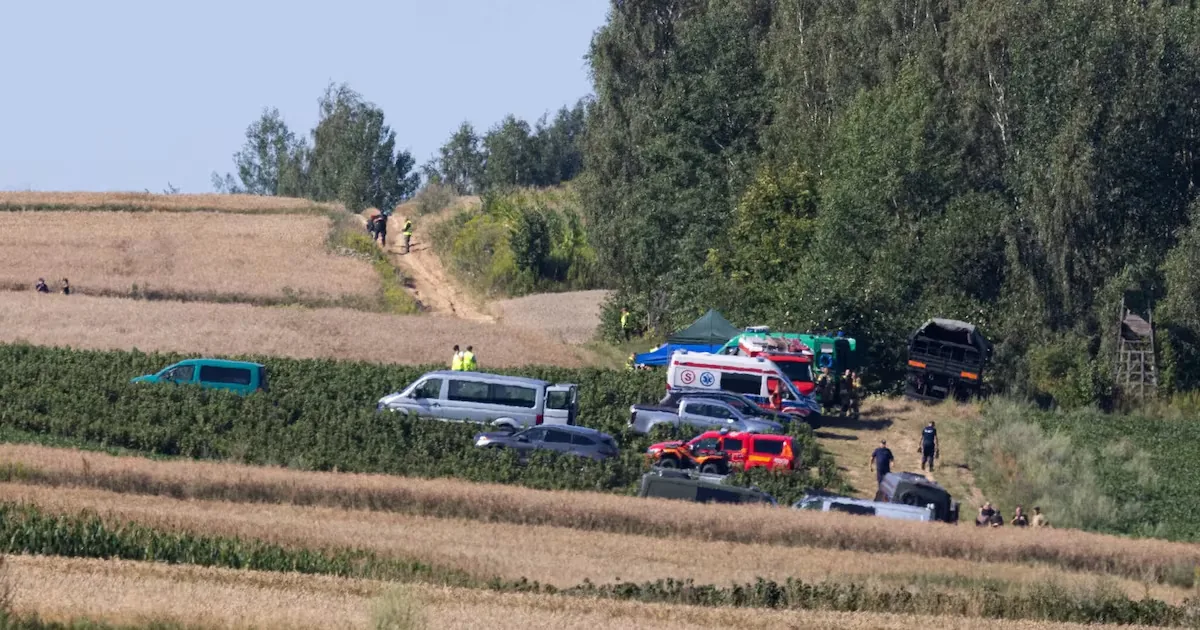
The plans are known at a time when Poland faces the incursion of a Russian missile that crashed into a field on Thursday morning. Polish authorities launched an investigation following the incident. The explosion left a crater about 10 meters wide near the eastern village of Tarnawa-Kolonia, about 80 kilometers from the border with Ukraine.
After visiting the incident site, Polish Prime Minister Donald Tusk said that “there is no reason to think that Poland was the intended target of this missile.”
He added that there were “no reports of casualties or damage” as the object fell in an uninhabited area, and added that the Polish Army had been “prepared to shoot down the missile if it had continued its trajectory.”
NATO’s supreme allied commander for Europe, General Alexus Grynkewich, said: “NATO will continue to take all necessary measures to defend NATO territory.”
Read more What if they don’t come back? Traveling abroad with children after a separation
While attacks on Ukraine were taking place, Poland, a NATO member, deployed fighter jets to protect its airspace, according to its Armed Forces.
Ukraine’s Foreign Minister, Andrii Sybiha, stated in a post on X that a Russian Kh-101 cruise missile had entered Polish territory.
António Costa, President of the European Council, said: “Last night, Russia launched a massive combined attack against Ukraine. During the attack, Polish airspace was also violated, which once again underscores that Russian aggression poses a threat to the security of Europe as a whole.”
Ursula von der Leyen, President of the European Commission, said the Russian missile incident in Poland was another “unacceptable violation” of EU airspace.
At least 13 people died in Ukraine, including one in Kyiv, in Thursday’s attacks, which extended to the western city of Lviv.
A missile attack in the central city of Kryvyi Rih, the hometown of Volodymyr Zelensky, left at least six dead, including two girls aged five and 12, according to the head of the local military administration. The Ukrainian leader had warned the country hours in advance about the massive attack launched by Moscow.
Oleksandr Vilkul, head of the defense council, said: “In a village on the outskirts of Kryvyi Rih, an Iskander-M ballistic missile, launched from Voronezh, directly hit a private home where a large family lived, causing the death of two girls aged five and 12 and four adults.” He added that eight other people were injured.
Another six people, including two children, died in the Dnipropetrovsk and Poltava regions.
The Kyiv military administration confirmed one death, and the mayor, Vitali Klitschko, reported fires in several districts.
In Lviv, near the border with Poland, rescue teams were working to clear debris to reach trapped people after Russian missiles damaged two apartment blocks and injured 26 people, authorities reported.
Late Wednesday, Zelensky posted: “The Russians prepared a massive attack several days ago, and there is a high probability that the attack will take place tonight… Please, in all regions of Ukraine, pay attention to air raid alerts today and stay safe.”
Zelensky also reiterated his request to Ukraine’s allies to supply Kyiv with the missiles missing from its air defense system. “It is important that our partners fully understand what is happening and that the protection of people’s lives depends directly on their willingness, or lack thereof, to provide air defense missiles.”
The attacks occurred a day after Zelensky met with Tusk in Lublin, a city located in eastern Poland, 48.9 kilometers from where the Russian missile fell.
“Poland’s security depends directly and unequivocally on the effective actions of the Ukrainian Army, including in the air. If the Ukrainians had had much more than they have been asking for from the beginning, perhaps that ballistic missile would not have been launched towards Poland,” said the prime minister.
“After this incident, we will study as soon as possible the possibility of providing more aid to Ukraine, including the transfer of additional missiles for the Patriot systems, if the need arises,” Tusk said.