







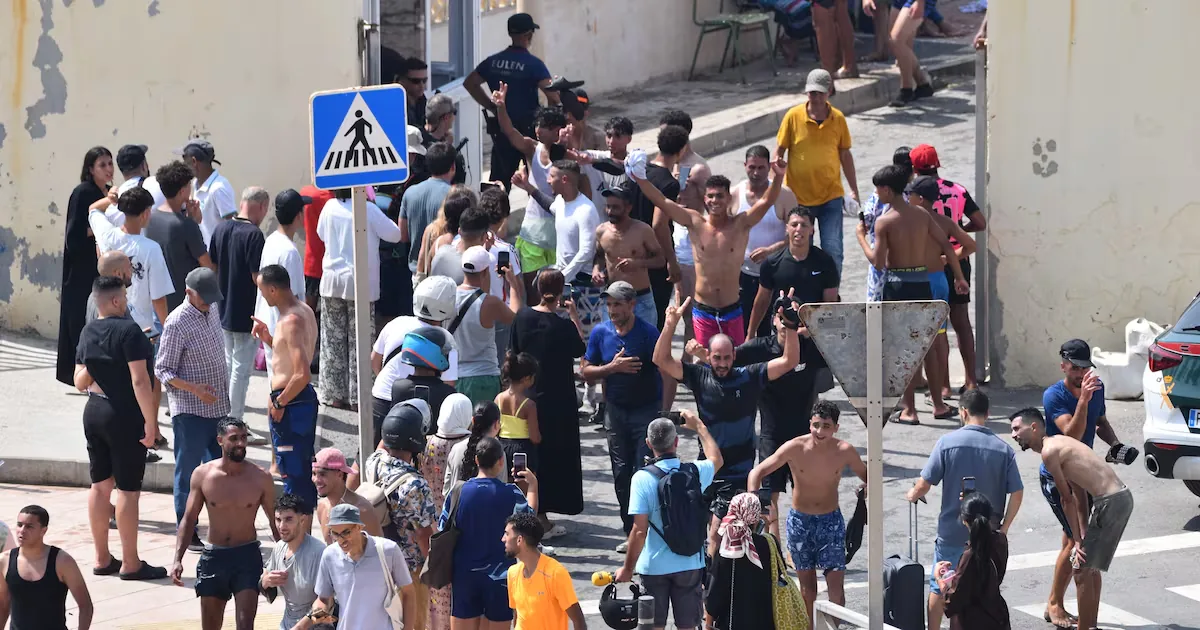
The governments of Spain and Morocco have agreed to implement measures for the delivery “as soon as possible” of “all” migrants who have entered Ceuta illegally in recent days, especially this Thursday, when they massively flanked the fence at the El Tarajal breakwater.
Read more Employees in the tech sector urge the U.S. to lead a global effort to manage advanced AI risks
Sources from the Ministry of the Interior indicated this Thursday that the two countries have agreed to “strengthen coordination and efforts to address these flows and have committed to reviewing and implementing measures for the delivery, as soon as possible, of all persons who have entered illegally” the autonomous city.
The minister in charge, Fernando Grande Marlaska, has remained in permanent contact with his Moroccan counterpart, Abdelouafi Laftit, and this Friday he will be in Ceuta to face this migratory crisis.
Along the same lines, the Spanish Prime Minister, Pedro Sánchez, has assured that they are preparing “the necessary measures” to “restore normality as soon as possible,” according to a message on X, reported by Europa Press.
After speaking with the city’s president, Juan Jesús Vivas, he said that the central government is focused on giving an “immediate” response to the situation in Ceuta and working with Moroccan and international authorities.
Read more France condemns the violation of Polish airspace during Russian attacks on Ukraine
So far, the government defends that cooperation with Morocco is “excellent” and avoids blaming the neighboring country’s authorities for the massive entry of people into national territory. On the contrary, both countries agree in pointing to the “criminal organizations” and “human trafficking” that seek to “instrumentalize” the recent Supreme Court ruling that prohibits “hot returns” of people who arrive swimming to Ceuta and Melilla.
The Ministry of Foreign Affairs has also distanced this migratory crisis from Pedro Sánchez’s trip to Algeria on July 20, a country with which Rabat maintains a historic confrontation.
“The relationship with Morocco is excellent and is not affected at all by the good relations with Algeria,” sources from the department led by José Manuel Albares told Europa Press, also noting that coordination on migration, as well as on “other issues,” is “very intense.”