


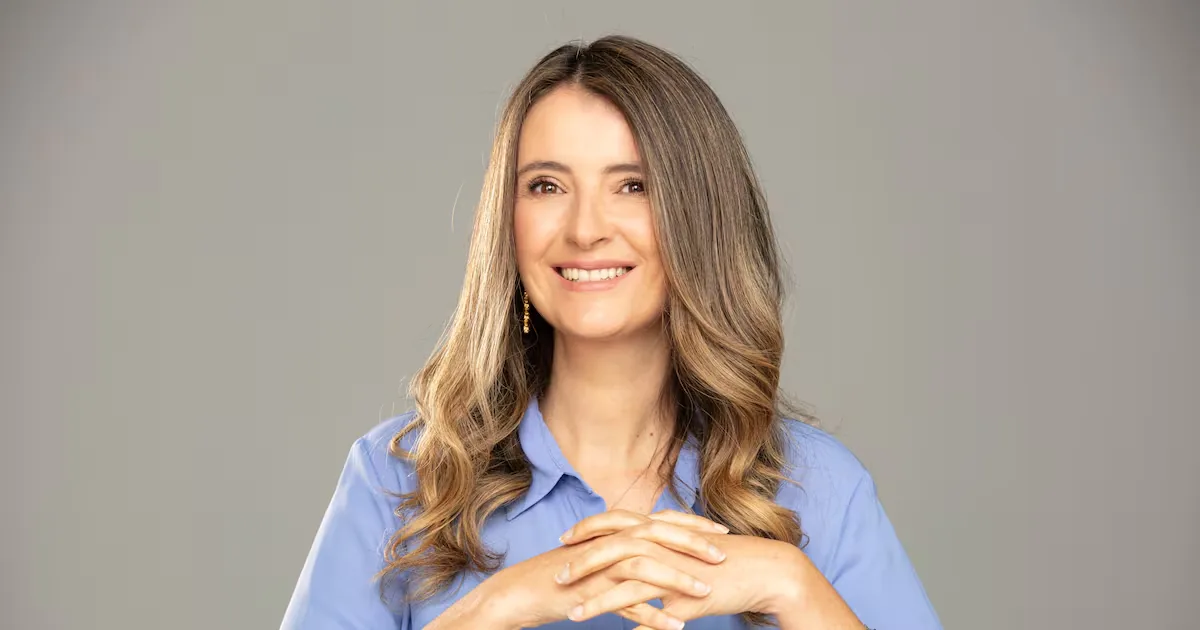
Lawyer, senator for 12 years (2014-2026) and opposition leader in Colombia, Paloma Valencia Laserna (50) was proclaimed last December as the sole candidate for the country’s presidency by the Democratic Center political party, led by former President Álvaro Uribe Vélez. On her campaign page, she presented herself as “the first woman with a real chance of winning the presidency.”
Read more Antonio Spadaro: “León XIV has become a counterweight to Trump, but not by political choice”
Ten days before the first presidential round on May 31, the Guarumo firm’s poll assured that both Valencia and far-right candidate Abelardo de la Espriella would defeat leftist Iván Cepeda in the June 21 runoff.
But the standard-bearer of the Democratic Center collapsed in the final stretch of the electoral campaign. With 6.92% of the votes in the first round, she came in third place and was out of the second round, in which De la Espriella finally prevailed over Cepeda, President Gustavo Petro’s political protégé.
“I believe that in elections where there is so much polarization, that’s what happens,” Valencia comments to La Tercera, seeking an answer to her electoral defeat. This week, the legislator announced her retirement from the Senate, stating that “the future is forged from home.” But she is far from abandoning politics.
In fact, Valencia will participate this Monday, at The Ritz-Carlton Santiago Hotel, in the launch of Mujeres D, a platform that seeks to make visible, connect, and promote female leadership in the spaces where decisions that transform society are made. At this event, the former presidential candidate will deliver a keynote speech and then join the panel titled “Female leadership as a driving force to strengthen democracy in Latin America.”
This week you closed a 12-year cycle in Congress, after announcing that you will not return to the Senate and commenting that “the future is forged from home.” What does this last phrase mean? How does your political career continue?
No, my political career continues. I have always managed to maintain my home relationships with my professional duties, but since I decided to be a party candidate, I could not be a candidate for Congress. In Colombia, there is an incompatibility between both things: that is, if you are a candidate, you are a candidate, and not a candidate for Congress. And therefore, the congressional cycle ended. I was a senator until last July 19, and now what comes is working from the party, helping the party consolidate in regional elections. And also working in the private sector and surely re-engaging with media communication.
Almost two months after your defeat in the first presidential round, what explanation do you have for having achieved only 6.92% of the votes?
I believe that in elections where there is so much polarization, that’s what happens. The one who is going to pass, passes with the vast majority, because the phenomenon of the useful vote materializes very consistently. I believe that the attacks we experienced in the last 10 days were tremendously serious, because many lies were told and the presence, let’s say, of bots and all those farms that today change the conversation on social networks, well, we didn’t really have a plan for how to deal with such a circumstance.
After the first round, you gave your support to Abelardo de la Espriella. How do you interpret this victory of the far-right candidate against Iván Cepeda? What did Colombian voters who gave him their backing in the runoff want to say?
I believe that people in Colombia were very tired of Gustavo Petro’s government. It has been a government of many failed promises, a government that leaves us with at least four tremendously serious crises.
The security one: the government’s policy was permissive with drug trafficking, which allowed illegal groups to take over territory, increased kidnapping, increased homicide, and increased the recruitment of minors. This is no small matter for a country with a history of violence like Colombia’s, which in the last 50 years has had more than 500,000 people murdered due to drug trafficking-related violence.
Secondly, a tremendous crisis in the management of public finances, leaving us with a debt increased by 40%, with an absolutely inflexible budget, overflowing state spending, and people are already beginning to feel that the state is only serving to spend money, having no resources for public works or social investment.
We have a crisis in the health system. Colombia was one of the countries with one of the most robust health systems on the continent and in the world, and due to the whim of a nationalizing left, they decided that the health system could not be maintained, and today what we have is a tremendously serious health crisis. Colombians who were not used to this now have no medicines, no appointments, and several of the service providers are bankrupt.
And finally, a crisis in terms of energy sovereignty, because with a false environmental discourse they destroyed the possibilities of oil and gas exploitation, and now we are importing it 40% more expensively, with an additional thing, and this is very serious, we are going to have an El Niño phenomenon, that is, a period of enormous drought, and it must be said that more than half of Colombia’s energy matrix depends on water, and when it doesn’t rain, you have to use thermal power. The vast majority are gas-fired, but since we stopped producing gas, now we will have to import gas. But gas is not simply imported; it needs regasification plants to convert it from liquid to gas, and Colombia is not ready for that to happen. So it is possible that Colombia may have to face a blackout.
I believe these are President Petro’s legacies, with a discourse of polarization, hatred, and little effectiveness in resolving conflicts and the problems of Colombians.
Read more Over 340,000 people evacuated and dozens of flights canceled after Typhoon Noul’s arrival in China
Regarding the security crisis, do you believe that Petro’s Total Peace policy to seek an end to the armed conflict was ultimately a failure?
It was a total failure, because what we saw was not the arrival of security for Colombians. In fact, Colombia had been showing permanent figures of decreasing violence, in terms of homicide, in terms of kidnapping. And with the Total Peace policy, what we saw was a renewed increase in those indicators. Besides that, the growth in the number of men with illegal weapons in the territory. This government is handing us over with approximately 30,000 men with illegal weapons and a very marked territorial control in many territories of Colombia. That is, the territorial expansion and the enormous expansion in armed men is significant and, of course, represents a great challenge for Colombia, because it was also tied to a deterioration in the capacity of the force to respond to and repel the action of narcoterrorism.
And in that sense, what do you think of the measure announced by De la Espriella to eliminate the office of the Peace Commissioner, which has led negotiations with illegal armed groups?
I think it’s fine, but that’s totally insufficient. Those are headlines that, of course, you need, because you can’t continue to have total peace, but I don’t think anyone was thinking of continuing it. Now what comes is the action of the public force to retake the territory. That’s where the challenge comes in, because it encounters a public force that is quite underfunded, a public force where more than one segment of the soldiers doesn’t even have a rifle. By breaking relations with Israel, we were left without weaponry. More than 60% of the helicopter fleet is stranded. In other words, there are logistical problems of great complexity that the government will have to address quickly to generate results.
Is there concern about any of the other proposals with which De la Espriella comes to power?
No, well, we wish him well. I believe that many of De la Espriella’s proposals coincide with ours. The need to reduce state spending, the need to recover territory and security. The need for the health system to move forward. But let’s say, one thing is what is said and another is what is done. Now the government will have to go from proposing these solutions to executing them, where it will find the big problem that it is a completely bankrupt country.
Do you consider that the new government arrives with enough figures and a robust party structure to administer the country?
Well, I see that it was a government that was elected speaking ill of politicians, but now it has all the political parties it criticized as government parties. I believe that is necessary, because one cannot govern without the Congress of the Republic. But I think that, evidently, one already begins to see complaints from the population saying: “How is it that before it couldn’t be done and now it can? Things they criticized me for, now seem to be good.” They are going to have a problem, let’s say, in redefining the discourse with which they are going to govern.
Do you believe that Abelardo de la Espriella’s electoral victory consolidates the region’s shift towards the far right?
I think there’s a trend of electing outsider candidates of any affiliation. I believe that the advent of social media has greatly changed politics, because the nodes where information that gave, let’s say, a certain certainty to citizens was normally produced have changed. Today, people seek emotional connection with social media videos, and that leads people to make decisions where political outsiders have been favored. And I think it remains to be seen what the fate and results of those outsiders will be. I still believe that institutional responses are better for politics. Where there is knowledge, where there is continuity, where one builds upon what has been built, where there is recognition of the effort of those who came before. Because the solution to social problems doesn’t have a magic wand that you wave and they simply get solved.
Within this climate of polarization observed in the region, what do centrist parties have to do to re-enchant voters again?
As a party, we are a center-right party, a party that has a clear idea of a fraternal economy, which implies not only trust in the free market, in understanding the importance of the private sector, of the market, of the development of the private sector, but also very clearly understands that one not only protects the entrepreneur, one must protect the worker. That very clearly understands that it is not only economic development, but the well-being of the poor citizen. And that implies having a very complete vision of the balances that politics entails. It is not simply economic development forgetting the poor. The market has shown in Latin America that it does not automatically solve the problems of poverty, segregation, and social exclusion that Latin America faces.
One needs to have a state pushing, pushing with education, pushing with opportunities, with access to credit, with breaking down barriers that our systems have and that one cannot simply say that everything can be left to market forces, because the market leaves aside a large number of citizens who are in poverty.
I believe that today what the country needs, perhaps the region needs, is to understand that extremes are pernicious. It’s not just the worker against the entrepreneur, nor is it the entrepreneur against the worker. It’s achieving both. It’s not abandoning mining-energy development to protect the environment, nor is it just the environment. It’s the fusion of sustainable development, with a protected environment, but with energy sovereignty. I believe that these middle ground points that polarization prevents from being seen or believed to be true are what the Latin American world is demanding.