







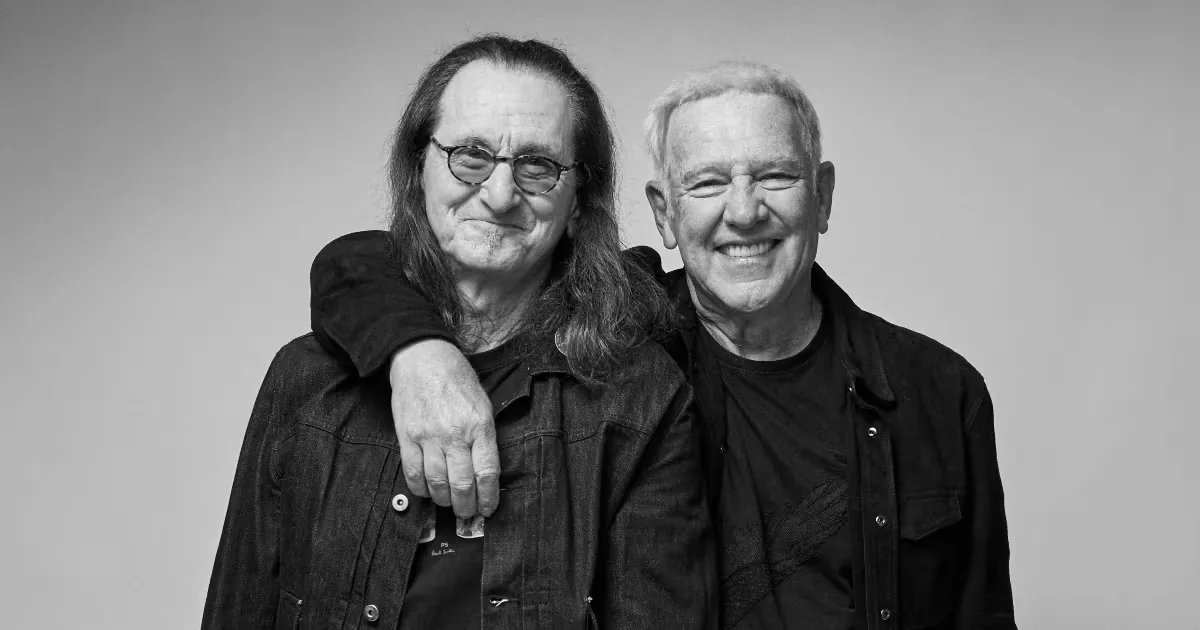
Rush’s second life was not meant to happen. Or at least, it wasn’t what the two survivors of the Canadian band, bassist Geddy Lee (72) and guitarist Alex Lifeson (72), longed for. “We had put Rush aside in our minds and in our lives, although you can’t escape the name, it always comes back to you,” Lee reconstructs in a Zoom conversation with Culto.
Read more Paloma Valencia: “The people in Colombia were very tired of Petro’s government”
On the night of August 1, 2015, at what is now the Kia Forum in Los Angeles, California, the trio unknowingly played their last concert with their historic lineup, completed by drummer and lyricist Neil Peart. They then took a break from major tours to devote themselves to their personal projects and private lives, a rest that faced its deadliest blow with Peart’s death in 2020, due to aggressive brain cancer.
With tragedy in their faces, without the man who had designed the band’s imagery and who had turned drumming into an art, Lee and Lifeson decided to close the curtain on Rush’s history and promised never to return to the road if one of their pieces was missing.
“It was almost like we were afraid to play our own songs back then, after Neil passed away. We had put them in a box, put the box in a closet, and tried to move on with our lives,” Lee corroborates.
But music – like life itself – sometimes takes unexpected paths. The singer also says there was a “first spark” that twisted their obstinacy: it was in September 2022, when Lee and Lifeson were invited to the massive tributes held in London and Los Angeles for the late Foo Fighters drummer, Taylor Hawkins, where they shared the stage with a large group of artists including Liam Gallagher, The Pretenders, Queen, and Paul McCartney, among many others.
There, both performed with different drummers filling Peart’s void – Dave Grohl, Chad Smith, Omar Hakim – and played band classics like Working Man or YYZ. But what was a reverence to a third party ended up being a revelation for themselves: the two musicians realized that they still felt invigorated when they played the songs of their old band, which they already believed to be extinct.
Geddy Lee continues: “After those two concerts, we started to look at our music a little differently. Playing those songs again in front of so many people and with so many different musicians, great musicians who showed us so much love, and the audience was so happy when we got on stage, I think that sparked something in us and we started to realize that bands come and go, but music lives forever.”
-The story has spread that Paul McCartney himself, present at those shows, spoke with you to convince you to return. What was that conversation like and why did his words have such an impact on you?
Geddy Lee: Well, you have to go back to that moment, we had decided not to play any Rush songs for a long time, and when we were rehearsing in London, Dave Grohl came up to us and said, “Hey, Paul McCartney is outside and he asked me if he could meet you because he’s never met anyone from Rush before. Do you want to meet him?” You know, that’s the stupidest question you can ask a musician.
“He came in and we immediately started chatting. And, honestly, he’s a lovely person, very open and generous. So we started chatting and joking, and that was it. When we played the concert, he stayed to watch us perform. He had never seen us play before and he got very emotional. At the after-party, a group of musicians were gathered around a sofa, drinking good wine and joking. He came over to sit with us and we were having a great time. He wanted to tell Alex and me to, of course, go back on tour. We told him, ‘Well, no, no, we have no plans to go on tour.’ And he was emphatic, trying to make us change our minds, he said, ‘No, that’s what we do. Do it. That’s what Ringo says.’ So I sent him to where Alex was. I said, ‘Well, you convince him.’ So Alex and he had a very funny conversation and, honestly, it was very touching to hear him say those things.”
Indeed, Alex Lifeson was not so convinced about resuming duties. For him, Rush was a finished chapter, a full stop.
He describes it in this same Zoom with Culto: “I was probably a little more reluctant, I worked on other projects, like Envy of None, and I was constantly playing, I really enjoyed the Taylor Hawkins concerts we did, it was fun to get back together, but I wasn’t in a hurry to get back on the road. It’s just that touring didn’t excite me much, but when Geddy and I started playing these songs, it was special. We were rehearsing and, when we started playing the songs, I had simply forgotten what it was like to perform them, they are difficult to play, they are really challenging. Then, when it started to take shape, I personally got more excited about the idea; I mean, it took me a while to get really excited, but the more we started working on it, the more realistic the idea of coming back became, the more excited I got, and then we rehearsed for a year and a half, which is a lot of rehearsal time, a lot of rehearsal time.”
By 2024-2025, the instrumentalists began a more frequent rehearsal routine with a view to a definitive return, now venturing into the resurrection of Rush. Finally, in October of last year, they announced the Fifty Something tour, which would bring them back to touring after a decade and which already began on June 7 at the Kia Forum in Los Angeles, where they performed their last show with Peart. The same tour that will pass through Chile in 2027 with two dates scheduled for January 17 and 19 at the Estadio Bicentenario de La Florida (tickets on Ticketmaster), on their return to Santiago after their memorable performance in 2010 at the Estadio Nacional.
Geddy Lee speaking: “We are proud to play our own songs again that we had worked so hard on. Although we worked on those songs with Neil, of course, for many, many years, that will never change and we will never disrespect that, but it was that spark that brought us back. It wasn’t until late 2024-2025 that my esteemed colleague and I were jamming in my studio and started playing Rush songs for fun and one thing led to another, we just fell in love with the music and fell in love with how damn hard it is to play those songs, so it was almost like we were challenging ourselves every time we got together. And then one thing led to another, we started talking more seriously about it.”
In this revamped version of Rush, the new drummer is Anika Nilles, 43, originally from Germany and suggested by Lee’s bass technician after seeing her on tour with Jeff Beck. But beyond all that curriculum, she has a particularity: she is not a Rush fan and had never played any of the band’s songs live.
Lifeson adds: “Anika needed to learn 40 Rush songs and they’re not easy, and we needed to get back in shape. But by the time that period was over and we got on a real stage, with the lighting and the gear and the reality of being back playing live, it became super, super exciting. I’ve enjoyed every second and I’m looking forward to the next million seconds.”
But the story – and the return – of Rush cannot be reduced to the simple tale of musicians smitten by their own virtuosity and professional abilities. The Canadians’ biography is also the chronicle of a deep friendship: Lee and Lifeson met when they were barely 15 years old in high school, sat together in the classroom, and had instant chemistry.
Later came Peart, with whom they launched one of the most unique careers in the history of popular music. In the 70s, they combined the vitality of hard rock with the search for progressive avant-gardes like almost no one else had, resisted the contempt of an industry and journalism that never came to understand them, established their own ethics behind the backs of major commercial lures until generating an increasingly expansive cult, and let many laugh precisely at that profile, embodied in the stories of their shared tours with Kiss, with the Americans demolishing hotels amidst excesses, parties, and women, while the members of Rush rushed to their rooms to read and go to bed early.
In between, they evolved to embrace synthesizers, keyboards, and a lighter sound in the 80s, while their lyrics circulated science fiction, philosophy, humanism, and the great topics of existence, such as adolescent loneliness in Subdivisions, individual freedom in Freewill, or the allergy to fame, exposure, and celebrity in Limelight, inspiring thousands of young people who fell spellbound by such an image of creators distanced from the paradigms of rock stars, almost escaped from Star Trek.
For this very reason, Lee and Lifeson have decided to give interviews – like this one – together via Zoom, each from their respective studio in Toronto, saturated with basses and guitars hanging behind them, while at times they torpedo the dialogue to crack jokes and quips typical of their relationship, in a sharp sense of humor that contrasts with the solemn nature that seems to cover their music.
For example, Lee is accompanied by his Norwich Terrier dog, who suddenly falls asleep and starts snoring. “At times I thought it was my stomach,” Lifeson blurts out. His partner responds even more sharply: “No, it’s her, it must be because she’s heard all these answers before.”
-In this reunion, what have you learned again about your friendship? Very few musicians stay together for 60 years without any cracks.
GL: We’ve been friends since high school. I would say one of the most important ingredients of our friendship is that we laugh almost all the time we’re together. We have a very similar sense of humor and that gives us a lot of energy. And it just makes you happy to be together. It’s just, you know, times get tough, especially when you’re on tour.
Read more Antonio Spadaro: “León XIV has become a counterweight to Trump, but not by political choice”
“It’s a lot of pressure. But if you can smile and laugh most of the time, you stay in a good mood. And that’s very important. Then everything is seen more clearly. I think that’s key for us.”
Alex Lifeson: That’s absolutely true. I think that was also the secret to our relationship with Neil. He liked to laugh and needed to laugh as much as we did. So we spend most of our time laughing, if we can.
-Speaking of Neil, is there any particular lesson he left you that still resonates with you when you go on stage?
GL: I don’t know. I don’t know if there’s a lesson. I mean, as a band, we felt the same way about playing. We all love to play. But Neil preferred rehearsing to playing live. But of course, the acid test for a musician, what defines a musician, is live performance. So I think we all go on stage with the same standards.
“But on this tour, he’s everywhere. I talk about him all night long. There are images of him on the back screen. We have selected songs that faithfully represent his trajectory as a lyricist. In addition to his drum parts, his lyrics permeate every moment of the show. That’s why I think there are very emotional moments for Alex and me. And there are moments when I simply can’t wipe the smile off my face because I know he would be looking at us and saying, ‘You guys are idiots.'”
-Alex, how do you think of Neil today?
AL: Well, when I think of Neil now, I just see his face smiling and laughing. I don’t know. I had a pretty easy time making him laugh because I think he found me a bit absurd and maybe a little crazy. So I draw inspiration from that when I remember him. And that feeling made me feel very good, especially when I got close to him during his illness. He was such an interesting guy.
“He was a very cultured person with a lot of life experience. Being around him gave you an idea of what he was thinking. I think, as Geddy said, I also had a very high level of demand, such a high standard of performance that, inevitably, it pushed you to do your best. That really brought us together. We felt like we were a team all the time.”
-In that sense, what have the rehearsals been like? Because you have gone back to playing songs you hadn’t played for decades, like A Farewell to Kings, whose last live performance was in 1979. Have you felt challenged? Has it been a journey back in time, reconnecting with the people you were in those years?
GL: Well, yes, of course, there’s some time travel involved, because our rehearsals were intense. We’ve always been a band that rehearsed more than any other we knew, because we couldn’t stand the idea of not going on stage and giving our best. So, in my particular case, I hadn’t played that much in many years.
“So it was two intense years where I prepared to play those difficult songs again. And Alex and I would never have gone on stage on this tour if we didn’t believe we could play as well, or even better than ever. And we were determined to achieve that.”
“And then, when Anika came along by chance, she understood it from the beginning, seeing how much we enjoyed playing our songs. I think she had a lot of work to do. And, of course, we’re talking about someone who wasn’t a Rush fan per se; in fact, she had never played a Rush song before playing with us. So it’s a big job, replacing someone irreplaceable. I think she, when she worked from home, spent a year learning more than 40 songs. And when she worked from home, it was, you know, a job. But when she sat in the same room with Alex and me, our mutual enthusiasm was contagious. Don’t you think, Al?
AL: Yes, of course. Absolutely.
-Rush was always a band that grew in opposition to the canons of the more official industry, albeit with great success. What is it like to be Rush today, in a scene so different from the 70s and 80s, dominated by social media and digital platforms?
GL: Well, I’m not an expert in the modern music industry, but what I see, I don’t like.
AL: I would say the same thing.
GL: You know, I think it’s very difficult for young musicians to get started. It’s very difficult for songwriters to get paid what they deserve. I think the modern music industry has devalued the art of creating an album.
“Obviously, albums no longer mean what they meant to the industry, but I think they are still very important to music lovers. And that is reflected in the resurgence and popularity of vinyl fans during the golden age of this format. I don’t want to sound like an old grump, but it’s the plain truth.”
“When music came on records, you had to take good care of them, because otherwise they would get scratched and couldn’t be played. I think that care you had to take with a record fostered a certain respect for it, you know? And then, when I was a kid, I would take out a record, take meticulous care of it, listen to it, and look at the cover as if it were something magical. And I think people love music as much as they used to, but I don’t think they appreciate all the work that goes into creating it in the same way they do today. Alex, well you make more records than I do…”
AL: Yes, it’s a completely different experience now compared to the past. The whole process was a wonderful adventure. Today it’s very different to go on tour, live concerts, recording an album, being together in the studio and working on the songs. But they are your creations, they are growing and it’s beautiful to see the evolution of the songs. Then you get to the final mix and everything fits together. All that experience is still wonderful. It can’t be compared to anything.
-And speaking of present and future, what’s next for Rush? Are you working on new songs?
GL: We don’t talk about anything other than playing well every night. Right now, we have no plans to do anything other than try to survive this tour and bring it to as many people as possible within our capabilities. You know, we’re not kids, so we can’t play in every city. We can’t go to every country. It’s simply not physically possible for us. That’s why we work very hard to stay in good health so we can play to the best of our abilities every night. And that’s all we think about.
In the future is the reunion with Chile in 2027. How do you remember that night in 2010 at the Estadio Nacional?
AL: Oh, it was incredible. It was amazing. It was a huge audience the first time we played in Chile. The crowd and everything, I could see people crying in the audience. They were very excited that we were there. I remember the sky seemed the size of the stadium. It was a magical night. I really enjoyed the days I spent in the city traveling. I met new people and it was a wonderful experience. We are looking forward to coming back.
GL: Yes, I remember that was right after the miners were rescued. And that was in the air, so there was a kind of electric atmosphere apart from us playing. The country was happy that these people had been saved, the ones they pulled out of that place. I’m very happy to be back. It was an unforgettable experience.
Read more Over 340,000 people evacuated and dozens of flights canceled after Typhoon Noul’s arrival in China