








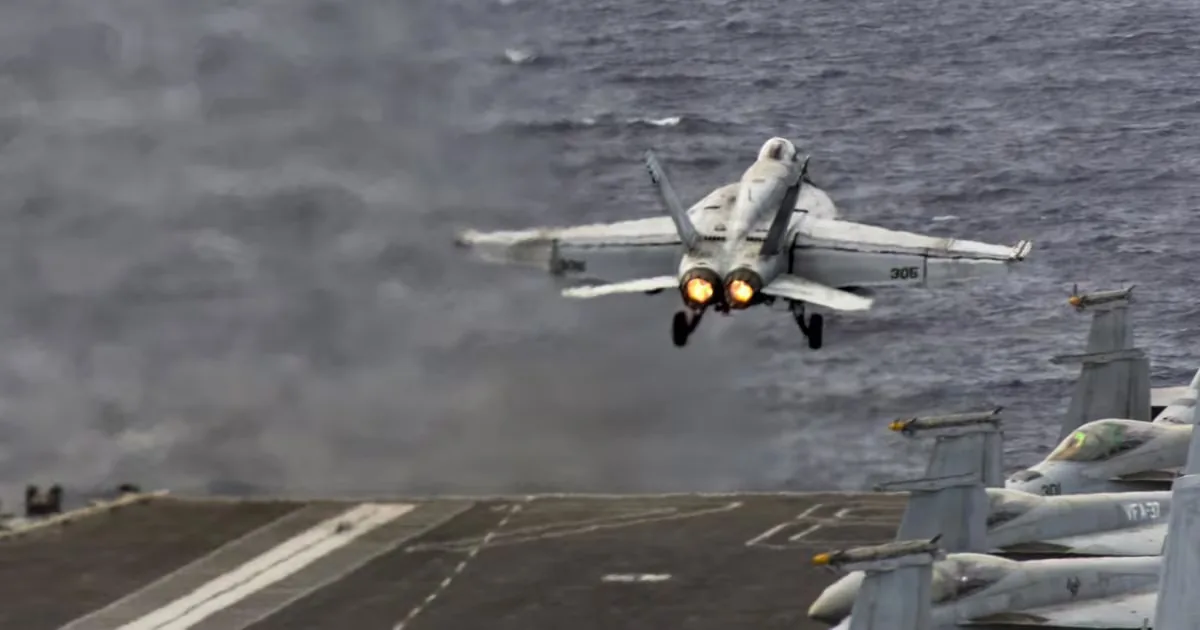
At least on American aircraft carriers, the trend will be to return to steam. After nearly a decade of complaining about electromagnetic technology in aircraft launch systems, President Donald Trump sent the Pentagon the order to redesign these ships, aiming to restore steam catapults and replace the modern ones.
This directive, signed in a national security memorandum, orders the Secretary of Defense, Pete Hegseth, and the Undersecretary of the Navy, Hung Cao, to initiate a change that could involve millions and millions of dollars. The first time Trump referred to this intention was in 2017, in an interview with Time magazine. Since then, he has expressed his intention to remove electromagnetic platforms from aircraft carriers on multiple occasions.
The memorandum gives Pentagon leaders a 60-day deadline to develop “a plan on the necessary measures to replace the Electromagnetic Aircraft Launch System and Advanced Weapons Elevators with steam and hydraulic systems for the construction of the USS Doris Miller.” This Ford-class aircraft carrier is already two years behind schedule in its assembly.
The new mandate could cost billions of dollars. This affects the most advanced ships of the Navy, and in the long run will mean that more sailors will have to operate the aircraft launch system, in addition to it being more difficult to maintain. This comes precisely at a time when the Navy is struggling to put enough sailors on ships.
Trump’s memorandum states that the fourth Ford-class aircraft carrier, the USS Doris Miller, will be the first ship to incorporate these changes, while the USS Gerald R. Ford remains unmodified for now, as well as the future USS John F. Kennedy and USS Enterprise.
This return to steam, which may seem counterintuitive, involves a deep reengineering of the vessels, since Ford-class aircraft carriers are designed from the ground up to operate with electric power. They do not initially have space for the complex network of high-pressure pipes that in previous models transported steam from the nuclear reactors to the catapults.
Steam, at least in previous models, was also used in kitchens, heating systems, and desalination plants. This will mean that restoring these pipes will require rebuilding entire sections of the ships, as well as reviving industries that have been inactive until now.
The first time Trump spoke about returning to steam on aircraft carriers was in 2017, in an interview with Time. “You know, the catapult is pretty important,” he said at the time before recounting a conversation he claimed to have had with a Navy officer.
“So I asked: What is this? ‘Sir, it’s our digital catapult system.’ It sounded bad to me. Digital. They have something digital. What is digital? Also, it’s very complicated; you have to be Albert Einstein to understand it. And I asked: What system are you going to use? ‘Sir, we will stick with the digital.’ And I said: ‘No, you won’t. You’re going to use the damn steam system; the digital costs hundreds of millions of dollars more and is useless,’” Trump recounted then, in a sequence he would repeat every year in journalistic interviews and political rallies.
After returning to the White House in 2025, Trump mentioned steam catapults during Tulsi Gabbard’s swearing-in as Director of National Intelligence, and did so again when addressing the crew of the USS George Washington, an aircraft carrier based in Japan.
“We built an aircraft carrier for 19 billion dollars, which is crazy. The price is crazy,” Trump recalled last month at the Army War College in Pennsylvania. “It had all kinds of modern elements; instead of using steam for the catapults, they used electric systems,” he commented.
“So, when I visited the ship, I said: I want to meet the person in charge of the catapults. A man approached accompanied by four of his assistants. And I asked: What is better: the electric catapult or the steam one? He had been there 25 years. He told me: ‘Steam is better, sir. We can fix it with a hammer and a blowtorch. When the electric system fails, I have to call MIT to bring geniuses here.’ I insisted: ‘Steam is better?’ ‘Yes, sir, it is better.’”
The conflict between steam and electromagnetic systems has been going on for years, in a context where the Navy has argued that the electric transition reduces structural stress on fighter jets during takeoff and speeds up flight missions. Meanwhile, Trump maintains that he prefers the “already proven” and easy-to-repair steam catapult mechanism.
According to the Wall Street Journal, which was the first to report on the directive, senior U.S. Navy officials and industry leaders “have resisted the measure due to the enormous cost that removing such a complex system, which was an integral part of the design,” of the most modern aircraft carriers would entail.
General Atomics, the company that manufactures the electromagnetic aircraft launch system for Ford-class aircraft carriers, stated that Trump’s decision to return to the steam system “deserves careful reconsideration.” The company told the newspaper that work on the new ship is nearly 50% complete and that “changing course now would carry significant risks in terms of costs, schedules, and integration.”
Senator Mark Kelly, a Democrat from Arizona and former astronaut, was more blunt in his reaction to the news. “I have taken off from the bow of aircraft carriers hundreds of times, I have a master’s degree in aeronautical engineering, and I am a test pilot; even so, I wouldn’t suggest to the Navy how to design specific systems for their ships,” Kelly wrote on social media. “Donald Trump should stick to what he knows best: ballrooms, bankruptcies, and cheap talk,” he commented.