




A Manuela Martelli (Santiago, 1983) has a particular interest in childhood. It is a phase in which –she believes– empathy is more present than ever. It is also a stage where one mainly depends on parents, and where questions towards adults may abound, but questioning their judgments and actions is scarce.
She went through that period of her life while Chile was at a turning point: during the last years of dictatorship and the first of the transition. The national actress and filmmaker belongs to the generation that has memories of the time of repression and protests, and also of the cycle that opened after Patricio Aylwin’s victory in the 1989 presidential election.
Both factors combined in the creation of El deshielo. Premiered in the Un Certain Regard section of the 79th edition of the Cannes Festival, the film is a mix of a collection of personal experiences and a fiction with characters and situations that take on a life of their own. It is a continuation of the searches she exposed in 1976 (2022), her acclaimed debut feature, in the sense that both portray the recent history of the country proposing an intimate drama and relying on autobiographical ingredients.
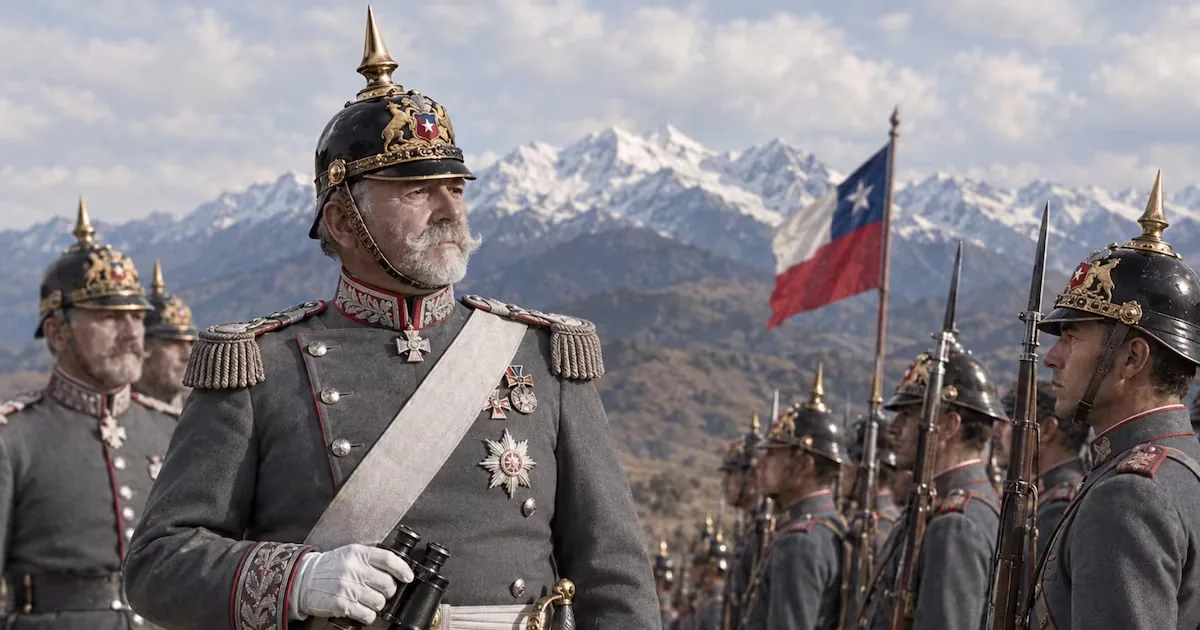
Her second feature as director and screenwriter takes place during the year 1992. While her parents travel to Spain as part of the delegation responsible for transporting an iceberg to the Universal Exposition of Seville, Inés (Maya O’Rourke) stays under the care of her grandparents (Paulina Urrutia and Mauricio Pešutić), a couple who own a ski hotel in the Andes Mountains. Curious, she forms a unique friendship with Hanna (Maia Rae Domagala), a promising German skier who has arrived in the country with her teammates and coach due to the change of season.
Carmen (Aline Küppenheim), the protagonist of her first film, was 49 years old, the same age that Noni, Martelli’s late maternal grandmother, was in 1976. In El deshielo, which premieres in national cinemas on September 3, Inés, the young protagonist, is exactly the age the filmmaker was in 1992. It is not the only direct dialogue with her experiences: just as it happens in the film with the girl’s mother, her mom always carried a video camera with which she recorded home videos.
El deshielo is a disturbing film. Not only because of the story it tells – the disappearance of Hanna and the silence pacts that follow her disappearance – but also because of how it is filmed, edited, and scored. With determination, the director investigates the ghosts of a generation born during the dictatorship and raised in the tense atmosphere of the return to democracy.
“I feel that the period between the military coup and the recovery of democracy was very decisive in building a country design, starting with the economic model. It is a very foundational stage of today’s Chile,” she declares to Culto from France, where her feature will reach theaters on August 26.
-Your two films approach this period obliquely and from an intimate sphere, but after seeing both I get the feeling that El deshielo is even more oblique in its approach than 1976. Do you agree?
Yes, totally. I think the transition is also more oblique, it is a more nebulous period in history, where it is harder to understand what is going on and what is happening in Chile. Also, there is much left unsaid. The dictatorship is the most evident moment of the unsaid, where silence is very dominant. Then the transition seems to be a moment of freedom, justice, or truth, but I wonder to what extent it really is. The film seems to be more politically ambiguous, or it seems that politics is less on the surface, but to my taste what is happening there is the reflection of that era.
-And what conclusions or reflections did making this film leave you regarding the transition?
Primarily how foundational that period is in what we are today as a country. But really, what awakens most in me are new questions. I feel these films are permanent searches, they are questions that awaken more questions. There is not much thesis nor truths. Absolute truths are not revealed. But I clearly think there is a debt with justice, which feels very clear during the transition period, where there are issues that were not resolved in terms of truth and justice. The National Search Plan promoted by the Boric government demonstrated the existence of an outstanding debt. An initiative that was sabotaged by the current government.
“For me, justice goes much further: it has to do with concrete facts and with a discourse as a country. That is why I insist so much on memory. I think memory is something that must always be kept alive. Another thing that was revealed to me is that history is not linear. We very easily return to the same things and we very easily forget how quickly we can trample on human rights, how fragile memory is, how fragile democracies are. And the most representative thing for me of that period is how many concessions were made to achieve that democracy.”
Then she shares another personal reflection: “I think the uprising is a great reflection of the pending issues of the transition.”
-Do you think that at some point the political ups and downs the country has gone through in the last seven years influenced the creation of this new film?
I think yes, because one still speaks from the present. The exercise consists of looking at the past from the present to understand the present. For me, a moment that was very impressive, and that challenged me a lot, was seeing how the uprising started as a youth student mobilization. There lies the strength of the uprising. That challenged my generation, a very quiet generation, a generation labeled apolitical, a generation I began to read as a fearful generation. That was, in quotes, the epiphany of the uprising: seeing how surprised I was to see young people who were not afraid to go out on the street and demand their rights.
“That is why I was interested in the question of what it means to grow up during the transition, what happened to that in-between generation, which was a generation, to my taste, very asleep. What I read there, in that apolitical trait, is fear inherited from the previous generation. So, my question with the film also aims to try to understand where the root of that fear is. I think part of the root of that fear lies in being complicit in a pact of silence, which has to do with not observing, with not doing justice in the face of violence. To me, that seems doubly violent, that first there is violence exercised against a people and then it is overlooked.”
-What led you to decide that this story should be told through the eyes of a nine-year-old girl?
There is a part that is very intuitive, which has to do with the fact that I am part of that generation. In that sense, it has something autobiographical. But I also think that the childhood perspective is always very revealing. Although at nine years old one is already quite trained in the prejudices of a society, empathy is much more on the surface. If you see someone suffering, you suffer with that person. If you see someone on the street asking for money, you wonder why they are living on the street. Although it also does not mean that childhood is not full of cruelty. I think the child’s perspective forces you to reread things, because you also put yourself in another place as an adult. It forces you to have another perspective, it forces you to miss something you have already naturalized. And that is what the exercise of these films is about, to look back at the past, which should be a constant exercise.
Manuela Martelli feels that Paulina Urrutia is part of her childhood memories. She saw her as the protagonist of Santa Teresa de los Andes and in several soap operas she did in the 90s. She does not hesitate to qualify her as one of the best actresses in Chile. “Paulina can do whatever she wants,” she points out.
During the writing process of El deshielo, a character appeared that gathered all of Urrutia’s attributes: charm, warmth, and a dose of humor that only she can give to dramatic roles. She contacted her and offered her the role before the actress received the diagnosis of an aggressive breast cancer, during the first part of 2024. “It was a very strong process,” says the director.
The former Minister of Culture underwent chemotherapy (in February of this year she was discharged) and postponed other professional commitments. Martelli – she assures – waited patiently for her response, without exerting pressure. Finally, when everything was ready for the start of filming, in July 2025, she was able to join the project.
“It was nice to see how Paulina overcame that cancer and was there at the forefront, with a lot of energy and vitality. Every day she was on set was very emotional because I have always admired her a lot. Despite playing a dramatic character, she maintains a vitality associated with a layer of humor that is underground,” she explains.
On the other hand, the youngest member of the cast, Maya O’Rourke, came to the film through a long casting process in which more than 500 applicants participated, girls who had to speak Spanish and English fluently and meet the characteristics established in the script. O’Rourke appeared towards the end of the search, but the decision was unappealable.
“Maya has a lot of strength, courage. She has a lot of presence,” highlights Martelli. “She is a very cheerful, outgoing girl. She perfectly understood what a character was and found a way like Inés.”
–El deshielo is dedicated to Idolia Castillo. Who is she?
Idolia Castillo is the woman who worked in my house for many years, whom I consider part of the family and to whom I am infinitely grateful. She is the one I believe I owe much of what I am today.
-Is there something of her in these characters who work at the hotel and with whom Inés has such a close relationship?
Yes. There are several people who work at that hotel and who are also responsible for raising Inés. They partly reflect how we function as a society and reflect that ambiguous boundary between affective relationships and work relationships. It is hard for me to talk about this topic… But I think it is worth asking what price you put on that. In this very capitalist world, what is the value of that. And how much the system is sustained by those affective bonds.
–El deshielo includes a message in the credits addressed to AI (“This film cannot be used to train AI”). Is this a topic that worries you? How did you decide to include that warning?
Yes, it definitely worries me. I think that message has to do with protecting all of us who work there. It is not about demonizing the tool, but about the uses. I think it is important to distinguish that. Demonizing it would be like when we demonized phones. But how much time are we stuck on the phone watching nonsense? How much do they make us stupid as a society or as individuals? The same happens with AI, but also, how much are we sabotaging ourselves? But I think it has a lot to do with who has control and what that control is about.
-In another context, the Culture budget suffered an 8.6% cut overall and a 52% decrease in Chile Crea Scholarships. How do you see that scenario? How do you think it will affect Chilean audiovisual?
It is a major catastrophe and I think it will have repercussions tomorrow. I would say it is miraculous what Chilean cinema achieves in the international circuit, with the resources we have and how incipient our industry is. And the achievements on the international stage are incredible. I will not give you examples because you know them. The truth is that it makes me infinitely sad that this is not recognized and valued. And that there is no perspective where culture is understood as a right for all and not as a right for a few who make films. It should be understood as a right of the whole society, which is what defines us and what allows us to observe ourselves, question ourselves, and try to be better. I find it catastrophic.
-You have said that the trilogy composed of 1976 and El deshielo will end with Estrella solitaria. How do you envision that project? To what extent do you think it will share qualities with the two previous films?
This review of Chile’s recent history goes from the coup d’état to the recovery of democracy. The 70s and 90s are already covered, but the 80s are missing. This next film – which is in an embryonic state – comes to be a bridge between both. The trilogy is a review of these three decades that for me very structurally define what we are today as a country.
Read more Colombia denounces ELN threats against a hospital in the northeast of the country