







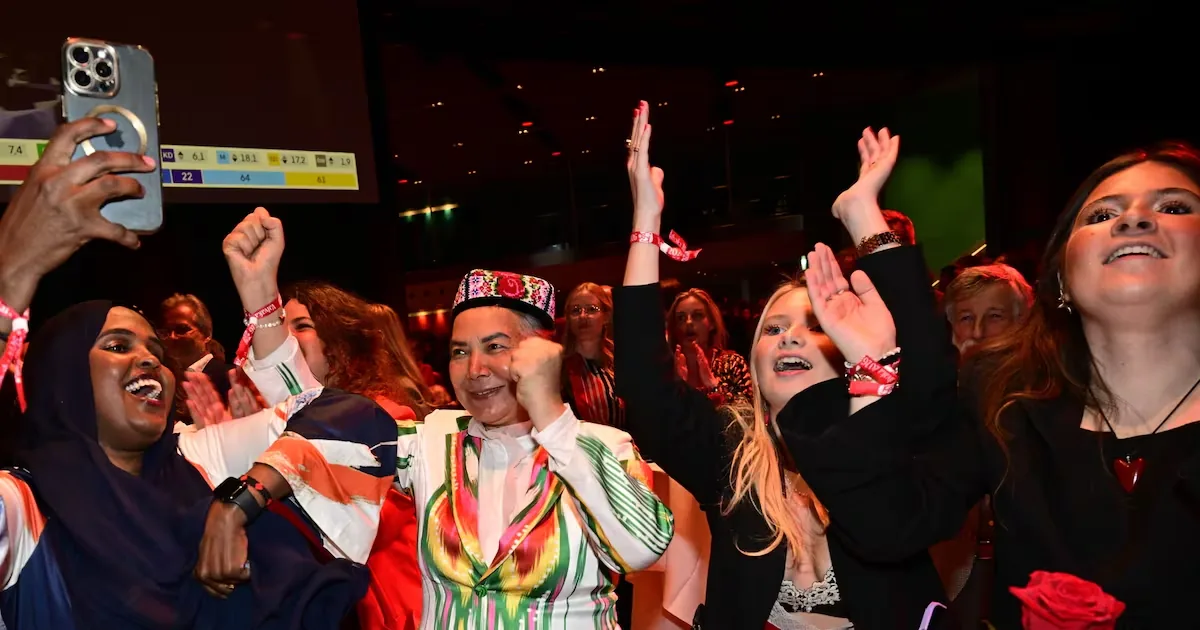
Sweden closed its polling stations this Sunday after a tense and polarized campaign, with personal attacks between leaders and Trump-style announcements. The first exit polls of the parliamentary elections, released after the polls closed at 8:00 p.m. local time, gave the advantage to the center-left opposition bloc led by Social Democrat Magdalena Andersson.
Read more Pope Leo remembers the victims of the Twin Towers attack
According to the projection by the public broadcaster SVT, Andersson’s coalition reached 51.3% of the votes, compared to 46.8% for the right-wing bloc that has governed the country since 2022. The private channel TV4 offered a similar picture, with a slightly smaller advantage for the opposition: 51.3% versus 47%.
With around 74% of the ballots counted, the preliminary official count delivered by the Swedish Electoral Authority gave the center-left bloc 50% of the votes and the governing coalition 49%, figures that will need to be updated as the final count progresses, which will take the whole week according to the Scandinavian country’s electoral regulations. The count will not be completed until Wednesday, when votes abroad and part of the early vote are tallied.
The public television projection forecasts for the Social Democrats a worse result than in 2022, when they obtained 30.3% of the support. However, their likely partners (the Centrists, the Left Party, and the Greens) would receive slightly more support than four years ago.
The breakdown by party placed the Social Democrats as the most voted force, with 28%, followed by Prime Minister Ulf Kristersson’s Moderates with 18%, and the far-right Sweden Democrats (SD) with 17%. The result implied a three-point drop for the SD compared to 2022, the first setback since the party entered Parliament in 2010.
The far-right party, with neo-Nazi roots, had improved its results in every parliamentary election since Jimmie Akesson became party leader in 2005.
The Christian Democrats and Liberals would achieve a better result than in the last elections, with around 6% of the votes. Until last week, all polls predicted that the Liberal Party would fall below the 4% threshold needed for parliamentary representation.
The setback would bring forward the end of four years of government by the Tidö Agreement coalition, made up of the Moderates, Christian Democrats, and Liberals, with parliamentary support from the SD. That alliance broke a historic taboo in Swedish politics in 2022 by including a party with neo-Nazi roots in the power structure. Andersson now faced the challenge of forming a majority together with the Centre Party, the Green Party, and the Left Party, forces with differences on taxes and energy.
Kristersson’s coalition entered the day behind in the polls, despite economic improvement and security advances that the government attributed to its management, according to the British newspaper The Guardian.
The prime minister himself had announced his intention to formally include the SD in the cabinet if his bloc retained power, which would have represented the end of another taboo by granting ministerial portfolios to a party with that origin.
Kristersson told reporters he expected a “very, very exciting” evening, according to the same outlet. He insisted that “the momentum” was on his side, despite unfavorable polls for his party. “We are team leaders; that is our role in Swedish politics,” he said, adding that the key to achieving results was “the ability to reach agreements.”
Hours after the polls were released, Left Party deputy Ida Gabrielsson summed up the opposition mood, according to the Spanish newspaper ABC. “It seems we can say goodbye to Tidö,” she said. “It feels good. I’m not the one claiming victory in advance, but still, it seems we can say goodbye and many people are tired,” she added.
The SD’s setback came just days after Alternative for Germany (AfD) won regional elections in Saxony-Anhalt, which had increased international interest in a possible entry of the Swedish far-right into government. The result also added to what happened in Denmark, where Social Democrat Mette Frederiksen won two consecutive elections with one of the European Union’s most restrictive migration policies.
Read more Houthi offensive in Yemen leaves 500 dead, 1,500 injured, and deepens displacement crisis
Akesson’s party had emphasized a few months ago that, if the right-wing parties again achieved an absolute majority, they would demand to enter the new Swedish government. Kristersson had shown willingness to do so during the campaign and even publicly offered them the Immigration portfolio.
Part of the explanation for the result lay in the phenomenon of the so-called “Magda’s Moderates,” as ABC described. These are urban middle-class voters who in previous elections opted for conservative alternatives and this time leaned towards the Social Democrats, rejecting the right’s collaboration with the SD and seeking a more technical management of immigration and security, without supporting the expulsion of young people with foreign passports raised in Sweden.
Andersson’s program included reducing asylum grants to the minimum levels allowed by the European Union, tightening citizenship requirements, and strengthening activity and training obligations for those receiving public aid.
“The welfare state is not only an economic model but is also sustained by solidarity and trust among people,” explained Lawen Redar, Social Democrat spokesperson on integration policy, during the campaign. “If a common language and basic cultural ties are missing, this solidarity erodes,” she said.
Andersson, who voted Sunday morning in Nacka, on the outskirts of Stockholm, described the campaign as “a story of two faces.”
“There have been many lies and disputes, but at the same time there are many sensible people across the country,” she told Swedish public television. “The goal is to win and set a new course for Sweden.” She added to Reuters that the country had become “a tougher, quieter, but also poorer society,” with wages buying less and less.
Much of the campaign debate focused, in fact, on Swedes’ personal finances, according to political correspondent Fredrik Furtenbach on Radio Sweden. “The parties have tried to outdo each other with promises of more money. It has been a kind of auction,” he said.
In a country where the 46 largest fortunes accumulate as much wealth as 75% of the population, according to Oxfam, Andersson focused much of her campaign on raising taxes on banks and the highest incomes to strengthen the welfare state.
If the center-left bloc finally manages to win by a narrow margin, Andersson will face negotiations to form a government that will last several weeks, if not months. The Left Party has insisted during the campaign that it will demand to be part of the Executive, while the Centre Party has already emphasized that it will not support any coalition including the post-communists.
The Centrists, who in the past have been part of coalition governments with the conservatives, have also defended the possibility of including the Christian Democrats in the future Executive. Andersson, for her part, has stated in recent weeks that she is willing to collaborate with all parties except the Sweden Democrats.
According to the newspaper El País, if Andersson finally returns to lead the Nordic country (with 10.6 million inhabitants) it will be a breath of fresh air for European social democracy, at a time when, among the 27 EU members, only Spain, Denmark, and Malta have a head of government from this political family.
The result will be provisional until the final count is completed, a process that in Sweden takes about a week, according to the Riksdag, the Swedish Parliament. Based on preliminary figures, the incumbent prime minister can announce in the following days whether he remains in office or resigns, and the new Riksdag must vote on the government’s continuity no later than September 29. If the polls are confirmed, Sweden would end four years of right-wing governments and the SD would suffer its first setback since entering Parliament.