









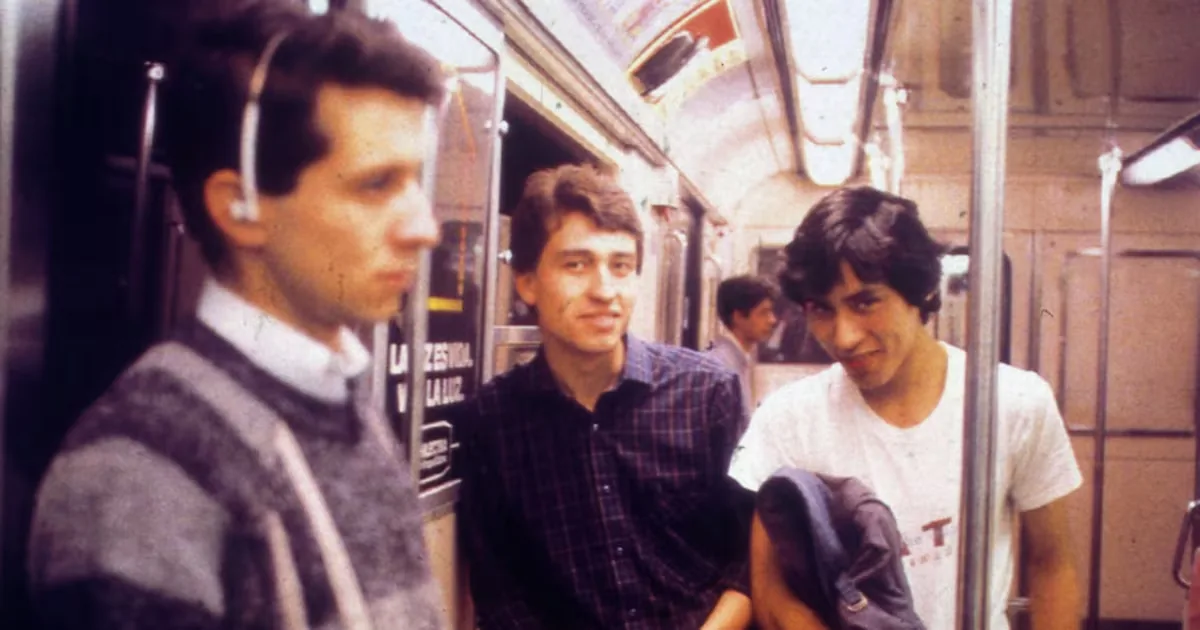
Among the thousands of young people wearing snow-washed jeans and plaid shirts who arrived at Estadio Chile (now Víctor Jara) on the afternoon of November 2, 1986, was a young Chalo González. The now renowned sound engineer with a long career in Chilean music was then 16 years old and had bought a ticket to see Los Prisioneros, who were performing with their new electronic album Pateando Piedras. “I was already somewhat impressed with La voz de los ’80”, he says on the phone with Culto. “Like all middle-class young people, we were very sensitive to anything Los Prisioneros did at that time because they sounded very different from everything else back then.”
Read more U.S. Congress Leader Rejects Slowing AI and Calls for Meeting with Industry: “China Will Surpass Us”
For Chalo, the trio of González, Narea, and Tapia was special. It was the first Chilean rock band he saw live at his school, Miguel León Prado in San Miguel, the same commune from which the band emerged. Therefore, he did not hesitate to go see them at Estadio Chile. “It was like an island in a sea of repression and insecurity. That catharsis at Estadio Chile is unforgettable for anyone who went”, he recalls. “Before that, the band had a somewhat underground journey through fairs and schools. But when they took the stage at Estadio Chile and played Muevan las industrias, you were watching a European band: they came out with a different look, lighting, sound, and equipment. That concert changed my life.”
Released by EMI on September 15 of the “decisive year,” Pateando Piedras was the trio’s second album. Its impact was such that it expanded their audience base at a pivotal moment in their career. “It marked a before and after in the early history of Los Prisioneros because it was the album that made them the most important Chilean band of that moment thanks to hits like Por qué no se van or El baile de los que sobran,” explains Alejandro Tapia, author of Ya viene la fuerza: Los Prisioneros 1980-1986.
At the same time, the album presented a unique musical proposal that marked a radical change in sound, moving from the classic guitar, bass, and drums format heard in the memorable debut, La voz de los ’80, to the plastic universe of keyboards and programmed drums. In the Chile of Sábados Gigantes and the Festival de la Una, the trio aimed to sound modern. “Pateando Piedras inaugurates a modernity in Chile that we had not seen before”, says Julio Osses, author of Exijo ser un héroe, la historia de Los Prisioneros. “It was a modernity already hinted at in La voz de los ’80, but Pateando Piedras takes it to the extreme and consolidates it.”
Of course, it was decisive for the figure of Jorge González, who developed much of the compositional work. “I highlight that with this album he positioned himself as the greatest composer of the decade and, over time, one of the greatest composers in the history of Chilean music, because this album was worked on especially by him, along with Miguel,” states Emiliano Aguayo, author of Maldito Sudaca: Conversaciones con Jorge González. “And it was like a two-for-one, because thanks to the popularity and release of Pateando Piedras, somehow that made people start listening more to La voz de los ’80, which had been more of a word-of-mouth phenomenon.”
In tune with the era, the album began circulating on cassette. This is how Chilean musician Pablo Ilabaca first heard it. “I got to know it thanks to my brothers because they had the cassette; even my parents really liked Los Prisioneros,” he recalls. Originally from Gran Avenida, Ilabaca remembers that the people from San Miguel were considered a kind of local idols. “For the people in the area, that Los Prisioneros lived on Gran Avenida was a source of pride. So for us, they were always like our older brothers.” He also saw them when they came to play at his school, Don Bosco. “They came to play the album Pateando Piedras and Jorge’s keyboard or electronic drum broke down, so he said ‘I’m going home to get another one.’ So he went home to get another and came back to the school. Excellent album.”
He was a child then, but singer-songwriter Pedropiedra has a memory of the album. “I was also a kid, I was 8 years old when it came out, but I remember Muevan las Industrias, I think it played a lot on the radio,” he says. Even then, he paid attention to the details of the lyrics. “I was always struck by ‘I’m going to reach the big machine,’ the ‘González nor Tapia’ [from Por qué no se van], ‘mud plus cement’ [from El baile de los que sobran], all of Jorge González’s lyrics have marked me. The weight he gives to everyday words.”
Also as a child, now musician and composer of Los Bunkers, Francisco Durán was able to see Los Prisioneros in the late eighties. It was the first rock concert of his life. “We were fortunate to see them in ’87 at Ferbio, in Concepción,” he tells Culto. “I was 5 years old, our parents took us, and regarding the album Pateando Piedras, I have a very vivid memory of leaving the concert with all the people singing the songs, singing Muevan las industrias, ¿Por qué no se van?, I remember that very well. I got to know that album very young; there must have been a pirated cassette at home because I don’t remember having the original at least at that time, but of course, we knew all the songs.”
Piero Duhart had a similar experience. In his childhood days in the capital of Biobío, the voice and guitar man of De Saloon heard that album for the first time. “It’s an album that came to my house through my older brother,” he recalls. “He is a couple of years older than me and surely had access to Los Prisioneros before I did and came home with that cassette. I remember it was a white cassette, I listened to it a lot, I really loved that album. And you can’t fail to highlight how enlightened and sharp Jorge González was in the lyrics, those very, very intelligent, very sharp lyrics.”
*
From the start with the dramatic low keyboards of Muevan las Industrias, the album marked a leap forward in the trio’s artistic proposal. “All the songs are great, always with a very pop spirit, the electropop sound that appeared on this album, all the songs with very good choruses,” analyzes Piero Duhart. “One also obviously can’t overlook that there are classic anthems of Chilean music like El Baile de los que Sobran, Quieren Dinero, but it also had a darker side. There were songs like Estar Solo, which I loved, or Por Favor. So, of course, it’s an essential album for Chilean music.”
The experience of recording many albums allows Chalo González to outline some musical keys when listening to Pateando Piedras. “In the production, it feels slightly precarious because they hadn’t fully mastered the machines. Jorge radically changed the band’s style, and although Claudio [Narea] probably wasn’t very happy about it, those aesthetic and sonic turns by Jorge make something sound strange at first and then become a classic. They tackle very punk and intense themes, like Quieren dinero and ¿Por qué los ricos?, showing a very strong social resentment over a sound where the machines feel somewhat helpless and the rockabilly guitars are somewhat alone.”
The truth is that Jorge González showed an early interest in machines even from the days of La Voz de los ’80. “He started working with small keyboards and then with the income they got from their gigs and what happened with the first album, they bought Casio keyboards, cheap, which were the most accessible, and that ultimately gave Los Prisioneros a very distinctive sound,” says Alejandro Tapia.
Besides, it was a generational interest, in times of strange new hairstyles, wrinkled pants, and shoulder pads. Miguel Conejeros, then a member of Pinochet Boys and later a prominent exponent of national electronic music with his project Fiat 600, recalls. “There was certainly a search on the synth pop or techno pop side, coming from the whole new wave movement and all those Anglo and European bands we listened to,” he says on the phone with Culto. “Clearly, we were looking at those sounds coming from there. And of course, there were Electrodomésticos exploring that, Aparato Raro, ourselves, and Jorge, with this album, was the first to materialize it. I always liked it.”
For Miguel Tapia, who secretly listened to Yazoo, that influence was decisive. “By the time of this second album, the influence we had from these groups was clearer, songs like Muevan las industrias have a lot of that more Depeche Mode sound. We sampled the gas cylinders and lowered the tuning, and they ended up sounding like metal. We started discovering samplers, keyboards, sequences, and it was another world, very daring,” he told this outlet.
The story also connects Miguel Conejeros with Pateando Piedras. The drum machine Körg on which González worked the first demo of El baile de los que sobran was his. He had acquired it, along with a Roland SH-101, with the money obtained from selling a Fiat 600. “We already knew Jorge and made a change because Jorge was very interested in programming things”, he recalls. “And he asked us for that electronic drum, so he lent us an amplifier with three inputs, we plugged in there and played. At that time, we went back and forth with instruments along Gran Avenida.”
The machine sound that runs through the album also intertwines with electric and acoustic guitars. “If something strikes me about the album, it’s the balance it has between the opening which is Muevan las industrias, which is very techno with those gas cylinders they recorded, versus tracks like El baile de los que sobran, which has a guitar and is very human. Quieren dinero also has that very good Narea guitar. Also, Por qué los ricos has a lot of guitar and bass,” analyzes Pablo Ilabaca.
The most successful songs allowed them to connect with the audience and showed the group’s ability to reinvent themselves. Although prejudices about Los Prisioneros persisted for a while. “Some musicians continued to look at them critically, somewhat dismissing them”, points out Alejandro Tapia. “Only when songs like El baile de los que sobran or Muevan las industrias became hits did their contemporaries realize that Los Prisioneros had actually reinvented themselves.”
Besides prejudices, the tonal elasticity of synthesizers and electronic drums was a novelty. And there was not always much willingness to understand it. “The people doing the sound didn’t quite understand that a band would come with an electronic drum, especially if you went south. It was very hard to make those things sound,” recalls Conejeros. “There was a kind of rejection from those typical somewhat picky sound engineers, who had a lot of rock schooling, who if you didn’t have an electric guitar, bass, and drums, they looked down on you. There was a kind of disdain for the technical part of seeing you arrive with keyboards they considered toys. I was good friends with Sergio Gómez, may he rest in peace, he was the stage manager and in charge of synchronizing the keyboards, the MIDI part, the electronic part. And he always told me about the disasters they had on that whole tour due to voltage drops that affect the instruments. So it wasn’t easy to deal with technology in those years. It was quite risky to fill stadiums and play with those instruments at that time. Nowadays, they are much more stable and there are other protocols that make it less complicated, but back then it wasn’t easy. Once again, Jorge pushing forward.”
That musical proposal also dialogued with its time. When the Pateando Piedras cassette arrived at record store bins in September 1986, unemployment was at 12.1%, according to Central Bank figures. “Jorge has a strong social and civic sense, more than from a party or political position. He always wrote about what happened to him, both in love and in the neighborhood, socially,” points out Emiliano Aguayo. For his part, Chalo Gonzalez comments that the album very well illustrates that mediocrity of the eighties he experienced as a teenager. “Muevan las industrias very well defines the aesthetic of ’86 and that feeling of an ultra-gray Santiago.”
Talking about when misery came over a musical base that could resonate in the sweaty spaces of discos also refers to a tradition of songs offering social criticism with a dancefloor vocation, like Ni chicha ni limoná or La Batea. “It’s a very social, very political album”, says Francis Durán. “I think that mix of having a very shared, very social message with danceable rhythms is an explosive mix, and I feel it’s part of Los Prisioneros’ trademark. And without a doubt, it’s an influence on the rest of the music made in Chile from then on. Also being able to dance the complaint, dance the dissatisfaction with some things.”
*
Besides presenting Los Prisioneros among machines, metal, and technology, Pateando Piedras allowed the group’s popularity boost on the Pacific coast. That led them to venture outside Chile. They performed at Montevideo Rock in Uruguay at the end of ’86 and the following year played for the first time in Argentina, Peru, and Ecuador. There was a key factor there. “El baile de los que sobran had a sound that didn’t exist in Latin rock. I mean, you had this more Tears for Fears thing from Soda Stereo, these more The Police things from GIT, or this totally modern new wave thing from Charly García. But the sound of El baile de los que sobran was something that didn’t exist, that’s what opened doors for them,” explains Julio Osses. “In several countries, Peru, Colombia, Ecuador, it happened that Soda Stereo had already entered before, they were the industry’s favorite band. But when Los Prisioneros arrived two years after Pateando Piedras in Colombia—because they hadn’t been able to get there before—they arrived as stars. They arrived as a phenomenon that had already entered people’s hearts.”
For Chilean musicians, Los Prisioneros’ influence in the effort to cross sounds and styles has been felt in their work. Francis Durán explains it this way. “Of course, it has resonated in us and in me as a composer and producer as well. I think there are things in my first solo album, Lunar, that have a bit of that influence because there are common points. Common points with Depeche Mode or New Order, with all that synthpop movement that Los Bunkers have been adding to our musical palette and I also in my way of producing lately. So yes, I would definitely consider it a great influence.
From his side, Pablo Ilabaca points out how González’s music flows among the notes of one of his most emblematic projects. “The first 31 Minutos album is almost all programmed, and I think there’s a lot of influence from Los Prisioneros. For example, Bailan sin cesar, Mico, el micófono, or the drum programming of Mi equilibrio espiritual is very influenced by what I listened to or felt in Los Prisioneros’ music. That’s the direction.”
With the name arising from an expression by Miguel Tapia when wandering the streets with his friends in San Miguel, the album combined artistic ambition, social message, commercial success, and an international window that was decisive for the trio. “I think this album is a turning point for Chilean music in general”, defines Chalo Gonzalez. “With La voz de los ’80 they created a precedent of popular rebellion, but with Pateando Piedras there was a kind of cultural shake-up in society.”