






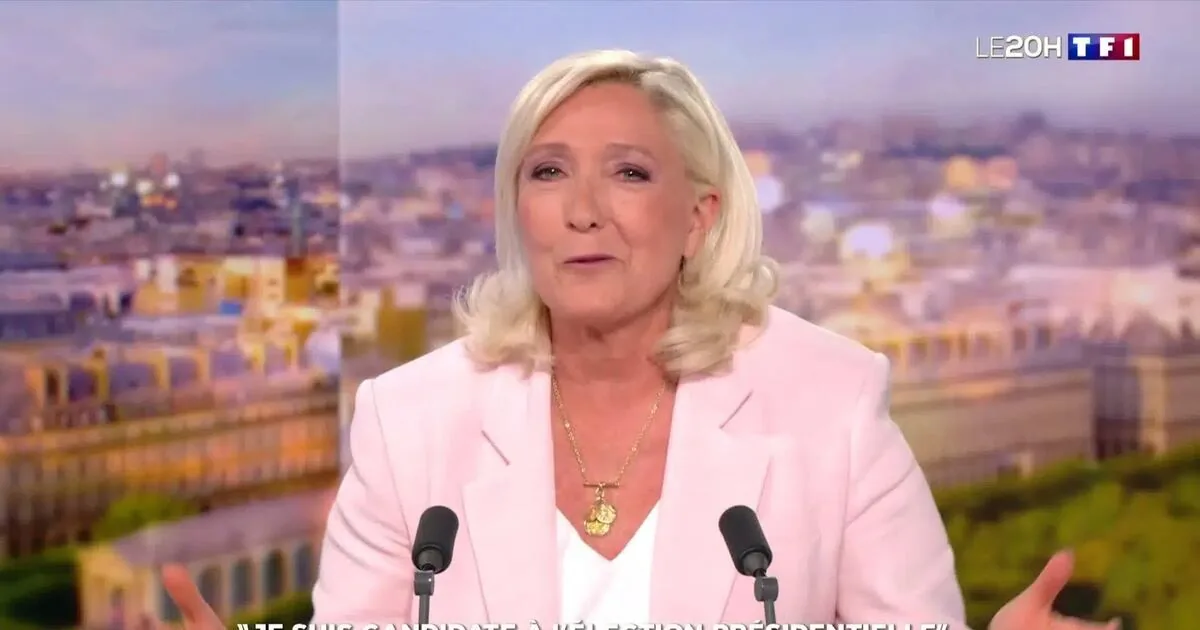
After 15 years of being elusive, French millionaires are abandoning the traditional right and encouraging Marine Le Pen’s arrival at the Élysée Palace in 2027. Generally, the far-right leader faced rejection from the banking sector to finance her presidential campaign. However, ahead of her fourth candidacy, she already has the support of several magnates.
Read more Datos Paula: the route of vegan fondas for this 18th
Among her supporters are the ultra-conservative media businessman Vincent Bolloré and the creator of the company Smartbox, Pierre-Édouard Stérin. Now, her support core has expanded to include the president and CEO of LVMH, the largest luxury goods company in the world, Bernard Arnault, the richest man in France.
Left-wing media and voices have been warning about the so-called “bollorization” of the French media landscape, referring to Bolloré’s growing dominance over television and cinema (Canal+, CNews), radio (Europe 1), print media (Le Journal du Dimanche and publications of the Prisma group), and publishers (Hachette). With this, the arguments of the National Rally, Le Pen’s party, have a whole “ecosystem” to be heard in the Hexagon.
Vincent Bolloré, 74 years old and with an estimated fortune of about 10 billion euros, is among the largest fortunes in France. For years he promoted the unification of the right-wing space, and in the fall of 2025 he held a private meeting with Marine Le Pen. From there, in 2026 he helped politically project his protégé Jordan Bardella, whose books were published by Fayard, a publisher controlled by Hachette.
But his control of the media space is frequently challenged: With intellectual Bernard-Henri Lévy as a promoter, about a hundred writers linked to the Grasset publishing house denounced last spring “the ideological war that authoritarianism seeks to impose on culture and the media.”
Likewise, led by actress Juliette Binoche, about 600 film professionals carried out a boycott against the media magnate and published an open letter in the newspaper Libération from the Cannes Festival warning about the ideological advance of the far right.
The most recent scandal linked to Bolloré’s media was the departure of CNews commentator Xenia Fedorova, identified by the French government as a Russian propaganda agent. CNews has been equated with channels like Fox News or GB News for becoming, according to its critics, a platform that spreads conspiratorial, reactionary, and xenophobic messages.
Among the reported episodes is the public humiliation suffered by the mayor of Saint-Denis, Bally Bagayoko, after winning the election this year. As the first black mayor of Saint-Denis (belonging to the far-left party La France Insoumise), he has been the target of serious racist attacks and derogatory comments in French media.
Bolloré, who declares himself a practicing Catholic and publicly defines himself as a “Christian democrat,” has defended his role in the media and denied embodying an authoritarian project. Before a parliamentary committee, he stated that CNews “has no far-right ideological project” and attributed its audience to the fact that, in his opinion, “it tells the truth.” Even so, a year before the presidential elections, he promoted the foundation of the Institute of Hope, a think tank that, according to its own description, seeks “to restore common sense and prosperity to France,” and which aligns with proposals put forward by Le Pen.
Bernard Arnault, who recently left the list of the 10 richest men on the planet, leads the LVMH group and has an estimated fortune of about 123 billion euros. At 77 years old, he shows increasing political visibility: in April he shared a dinner at the Parisian restaurant Drouant with Marine Le Pen and other major businessmen, according to Le Nouvel Observateur.
Arnault’s presence at Donald Trump’s inauguration was read as a gesture of rapprochement towards far-right positions, also driven by his son Alexandre, close to Trumpism and Jared Kushner (Trump’s son-in-law), and by his affinities with figures like Jordan Bardella. Ahead of the presidential elections, Arnault has set aside some of his discretion: he created an account on X and publicly criticized an investigative report by the newspaper Le Monde about his empire, joking about his own situation.
Read more Brazil: Lula will go to the UN to tell Trump to «stay out» of his country’s elections
His political weight is now also reflected on social networks, despite his wife, pianist Hélène Mercier, making headlines by stating that, in a hypothetical duel between Jean-Luc Mélenchon (the leader of La France Insoumise) and the National Rally, she would support the far-left party.
More discreet but equally active is Pierre-Édouard Stérin, creator of the company Smartbox and with an estimated fortune of 1.4 billion euros. Stérin set his tax residence in Belgium during François Hollande’s government and is preparing his return to France through a “metapolitics” project called Projet Périclès.
Inspired by strategies like those of the Heritage Foundation that contributed to Trump’s rise, Stérin seeks to promote an agenda aligned with Le Pen: national renewal, limits on immigration, and a fight against “wokeness.” He describes himself as a traditional Catholic and “ultraliberal” and, according to estimates, would have allocated up to 150 million euros in the last decade to finance conservative initiatives.
His personal ties with the National Rally leader are notable: during the 2022 campaign, he lent his mansion in Normandy for Le Pen to prepare for the debate with Emmanuel Macron. In 2023 he bought for 2.5 million euros the villa in Rueil-Malmaison that belonged to Jean-Marie Le Pen, the far-right candidate’s father.
François Durvye, Stérin’s right-hand man in charge of his fund Otium Capital, served as economic advisor to Jordan Bardella until this summer.
The concentration of the media market in the hands of Bolloré and associates has brought problems for workers in the sector: “There is some self-censorship among journalists regarding these billionaires. After all, you could ruin your relationship with a potential future employer,” said Amaury de Rochegonde, economic journalist for the weekly Stratégies and Radio France Internationale, in statements to Deutsche Welle.
Bolloré and Stérin have also joined forces: “Both have met and seem to want a union of the far right, that is, the conservative wing of the Republicans, with the National Rally,” Rochegonde said.
Alexis Lévrier, media historian at the University of Reims, experienced firsthand what it means “to kick that empire”: “I received thousands of messages: insults, but also death threats, including one from an arms dealer.” The trigger was an interview at the end of February. In it, Lévrier demanded the revocation of CNews’s license, as well as that of C8, another channel owned by Bolloré.
C8 had previously received dozens of warnings for sexism and homophobia, among other things. “Many of my research colleagues no longer dare to denounce the Bolloré empire. French cultural figures have also remained silent. Traditionally, they were defenders of humanist values,” he said.
But for Hervé Joly, historian at the National Center for Scientific Research (known as CNRS), Stérin and Bolloré are the exception. “The National Rally barely has public defenders among businessmen,” he explained to Deutsche Welle. “Historically, businessmen did not support the far right before it came to power. Businessmen usually support established conservative parties.”
Read more The Prime Minister of Sweden resigns after the leftist bloc’s victory in the elections