


After the Chilean victory in the War of the Pacific, along with the triumphal arches, the receptions for the survivors, and the praises, a conclusion as valuable as it was uncomfortable was drawn in the liquid center of the high command of the Chilean Army: there were serious deficiencies that urgently needed to be corrected, and the celebrations for the victory had covered them up.
Read more Classism, glory, excesses, and redemption: the revelations brought by the biography of Zalo Reyes
This is explained to Culto by historian Rafael Mellafe, a specialist in military history: “The War of the Pacific revealed several shortcomings in the organization of our Army. Lack of a General Staff, war academies, logistical planning, and several other points that, during the war, were practically improvised but yielded results.”
Thus, it was during the government of President Domingo Santa María that the Army began to seek a new model to reorganize itself. And the focus turned to Europe. “They began to look for a new reference, a new ‘school’ in Europe – says Mellafe – and the one that clearly stood out was the Prussian one.”
Prussia was perhaps one of the two most important German states of the old Holy Roman Empire, (the other was Austria, later separated into its own kingdom during the Napoleonic Wars). An important part of the European nation system, a prominent center of the Enlightenment, with bustling Berlin as its capital, it was one of the powers that at the beginning of the 19th century formed part of the coalition that defeated the emperor of the French, Napoleon Bonaparte.
It participated in the subsequent Congress of Vienna (1814-1815), which redesigned the map of Europe after the Napoleonic defeat, and from there, especially with progressive internal reforms and sustained economic growth, made Prussia the most important and influential German state during the era of King Wilhelm I. This progress extended to its army, which was completely reorganized and modernized with professional standards.
As a result of the War of the Duchies against Denmark (1864), the War against Austria (1866), and later the Franco-Prussian War (1870-1871), Prussia achieved the most important primacy among Germanic-rooted states, and in 1871, in the Hall of Mirrors of the Palace of Versailles in Paris, Wilhelm I was proclaimed Emperor of Germany. A new state had been born, and Prussia was its main engine.
Therefore, as a burgeoning European power with a modernized Army that had successively defeated Denmark, Austria, and France in less than a decade, the Chileans decided to adopt its model. Especially because of the result of the Franco-Prussian War in which Prussia practically crushed the French army and also captured the very emperor Napoleon III (the nephew of the famous Bonaparte).
“Prussia had emerged victorious in the war they fought against France between 1870 and 1871, even laying siege to Paris – explains Mellafe -. Their way of waging war drew attention for their maneuvering capacity and speed in movements, especially using the railroad. Moreover, Prussia already had academies for the different branches of its army, which provided a great opportunity to develop strategic thinking and planning.”
Read more Houthis claim missile and drone attacks against Riyadh and Saudi Aramco facilities
Until then, the predominant school in the Chilean army was the French one. “Let us remember that many high-ranking officers from the Napoleonic wars served in Chile during our independence, such as Jorge Beauchef or José Rondizzoni. They brought the French school to our Army, which over time was reflected in the uniform, red ‘glance’ pants, the blue jacket, and the kepi,” Mellafe points out.
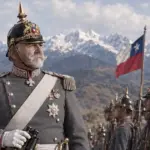
To implement the change, Captain Emilio Körner, a German artillery officer, was hired, who arrived in the country in 1885 with the mission to begin the modernization process of the Chilean Army under Prussian standards. The man had a good resume: he was a professor at the Artillery School of Charlottenburg, Berlin; he studied as a General Staff officer at the Imperial War Academy of Berlin in the 1870s. Additionally, he had real battle experience, having been awarded the Iron Cross second class for his performance in the Franco-Prussian War.
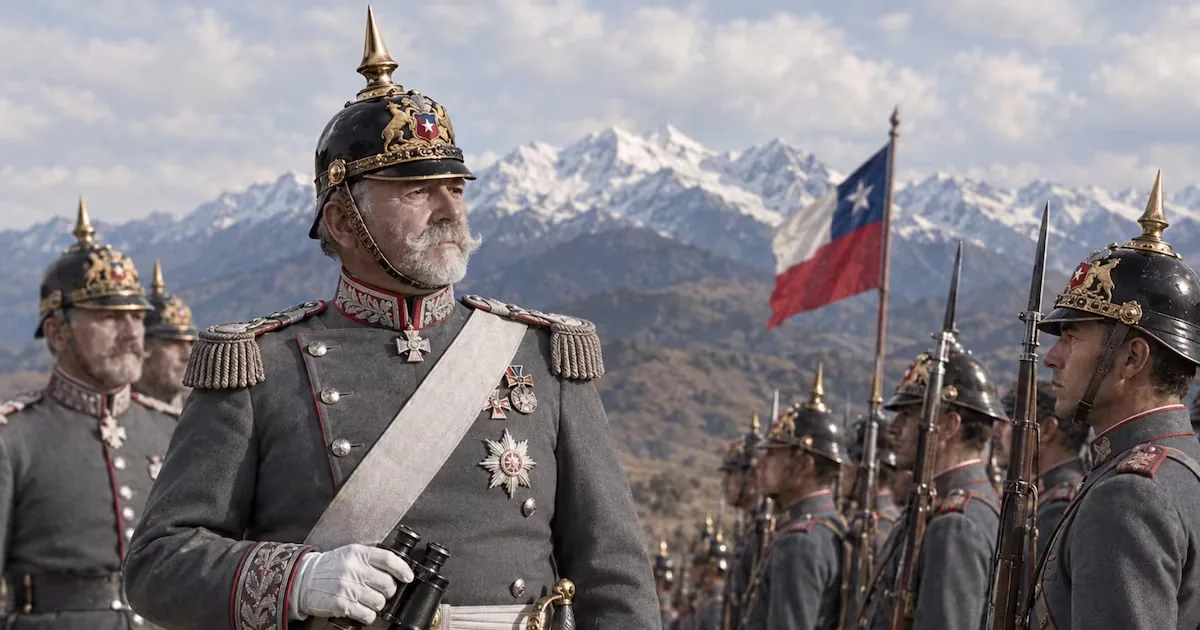
How was Körner’s work in the Chilean Army? Mellafe comments: “Beyond the obvious, such as uniforms, the pickelhaube helmet, and Prussian weaponry, the Army War Academy was created, the Infantry School was founded, and the army’s doctrine was changed from French to Prussian. That is, the way of thinking and analyzing the military institution’s problems was changed.” Körner even reached the rank of Inspector General of the Army between 1900 and 1910 (today equivalent to Commander-in-Chief).
The influence even reached the ceremonial level, visible to this day in the Military Parade. Anyone who has followed it more than once will remember the melody that accompanies the parade of the Military School. It is the Radetzky March.
Composed in 1848 by Johann Strauss Sr., in those corners of History it was not intended to honor a Prussian, but an Austrian. Strictly speaking, Field Marshal Count Joseph Wenzel Radetzky, who was victorious in the Battle of Custoza in northern Italy during the 1848 revolution. With that result, Austria suppressed the nationalist peninsular revolt – led by the Kingdom of Piedmont and Sardinia – which opposed the Austrian occupation of the region. The composition caught the attention of the Prussians, and it was King Frederick William IV himself who ordered it to be adopted by the Prussian army. That is how it arrived in Chile.
“In 1896, the deputy director of the Military School, Major Gunter von Bellow (a purebred Prussian) thought that the march written by Johann Strauss (Sr.) would be ideal for that institution and since then it has been part of the Military School,” says Rafael Mellafe.
Despite the years, for Mellafe the Prussian influence in the Army is still very noticeable: “The pickelhaube helmet is still used, the gray color of the uniforms, the ‘goose step’ in parades. Songs like I had a comrade, My rifle and I, and many more. Without a doubt, military doctrine has been changing and evolving over time, but the Prussian root remains.”
Read more Three media outlets denounce access blocks to the White House following Trump’s ban