
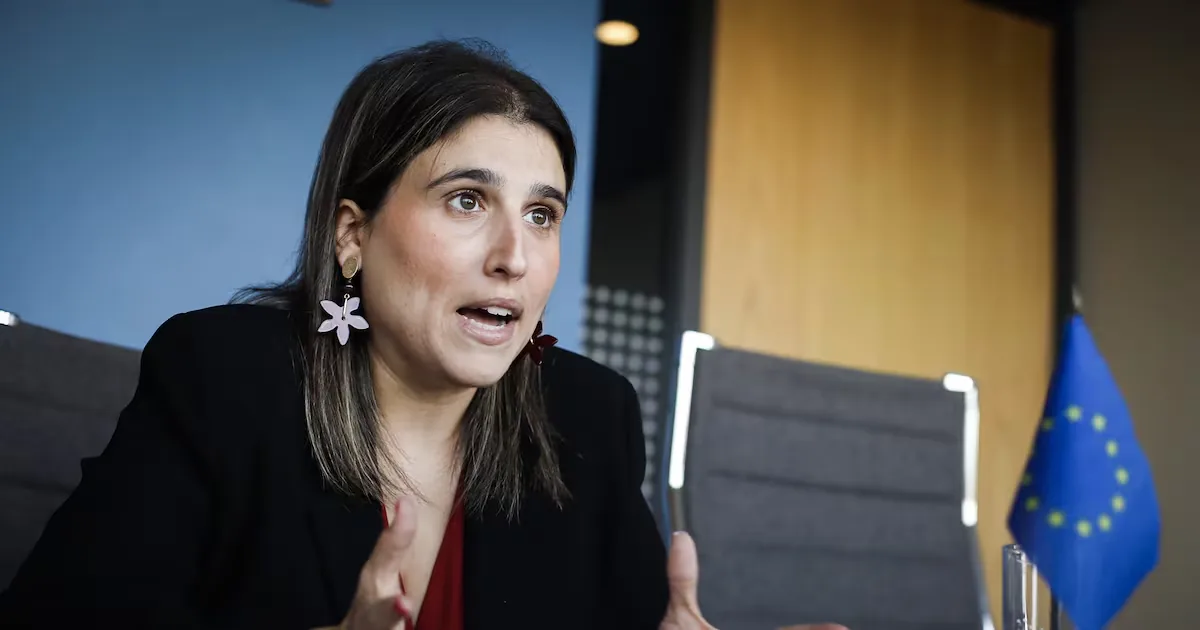
This is an almost flash visit. She arrived this Sunday night in Santiago and already this Wednesday she sets off back to Brussels. MEP Alícia Homs Ginel, from the Spanish Socialist Workers’ Party (PSOE), leads the visit to Chile of a delegation of MEPs from the European Parliament, on the occasion of the 30th meeting of the EU-Chile Joint Parliamentary Committee (JPC).
The JPC is the official forum for dialogue and parliamentary diplomacy between the European Parliament and the National Congress of Chile, created by the 2002 Association Agreement, and now reinforced in the new Advanced Framework Agreement (AFA) EU-Chile. With the AFA, the scope of the bilateral relationship is expanded to key issues such as climate change, digital transition, security, gender equality, and critical minerals, explain the EU.
Homs Ginel, 32 years old, is a member of the Employment and Social Affairs Committee; the Special Committee on the Housing Crisis in the European Union; and the Delegation to the Euro-Latin American Parliamentary Assembly.
On the Chilean side, it will be the first time the new composition of the JPC meets, headed by the president of the Chamber of Deputies, Jorge Alessandri.
Besides the meeting at the Congress in Valparaíso, the mission of the MEPs will include working meetings with the Minister of Foreign Affairs, Francisco Pérez Mackenna, and the Undersecretary of International Economic Relations, Paula Estévez; the National Prosecutor, Ángel Valencia, and the Undersecretary of Mining, Álvaro González. The MEPs will also meet with trade associations and the private sector and civil society actors in the areas of education and the environment.
The EU highlights the importance of PAcCTO 2.0, the main cooperation program of the European Union with Latin America to combat transnational organized crime, which works comprehensively in four key areas: police cooperation, judicial cooperation, penitentiary systems, and institutional strengthening.
Before addressing La Tercera‘s questions, Homs Ginel expresses her solidarity with Chile following the deadly hit-and-run that occurred on Sunday at the popular Caupolicán fair in Gómez Carreño in Viña del Mar. “I wanted to start this interview by expressing my condolences to the Chilean people for the accident that happened in Viña del Mar, which according to the latest figures was six dead, seven injured, including two infants. And I believe that from the European Union showing solidarity with the Chilean people is always important,” she emphasizes.
What are the objectives of the 30th meeting of the EU-Chile Joint Parliamentary Committee?
It is a very important meeting because it is already the second under the application of the agreement and it is a meeting where we will see how the agreement is working and what objectives we want to face. I think it is important to highlight that this meeting is the first under the new presidency here in Chile of President Kast. In fact, the committees have just been recently formed, so I think it will be a good time for all of us to get to know each other, especially the new members on the Chilean side, and to see how we can continue working to strengthen that very robust relationship that has always existed between the European Union and Chile.
This visit also coincides with the anniversary of the provisional application of the Advanced Framework Agreement. Is there any kind of evaluation from the EU regarding the implementation of the AFA?
It is true that it is still very early to have conclusions. Some states still need to fully implement it 100%, but what we do know is that companies, both on the Chilean and European sides, are very attentive to this agreement, especially in a moment of global uncertainty, with such changing, tense geopolitics. I think it is important to strengthen those ties between historically, as I said before, robust and reliable partners. And I think it is important that we continue that work. As I say, it is still very early to have results, but what we do know is that there is strong interest on both sides for this agreement to turn out as well as possible.
Among the agenda points of the European Parliament delegation, cooperation in the fight against crime stands out. What topics do you plan to address in this area?
We will see how the debate develops. Of course, it is a debate we will have now in Chile, but we have also had it in other forums, such as Eurolat, which also includes the Chilean component. And it is an issue that concerns everyone, because it happens here in Latin America, but it also reaches Europe. And it is important, in that sense, to be able to share information, work jointly so that this type of crime, which I would say is very worrying and very harmful to society, stops happening. I think there are many factors to consider, from education, from young people, so they do not get involved in that world, also to citizens, also in digital matters. In that sense, to prevent recruitment through social networks. I think there are many aspects we can share, take into account, and see how we face those challenges, because it really is an issue that worries citizens and to which we must respond.
And in terms of citizen security, what is planned to be offered in that regard?
That both in Latin America and Europe, it is important that we take into account people’s perception and also the reality of what happens, which are sometimes somewhat different issues. I think people really are feeling more insecurity. Many people link it to the migration phenomenon, but honestly, in the end, the profile of people depends on each person. We are talking about people, human beings, and I think we must not lose the human perspective of this whole situation that is happening, that must be managed, that we cannot deny, that must be managed, but I think it must be managed from a human perspective.
So, it is true that there is this perception of insecurity, but I think it is not fair to link it only to that, that there are other security factors that are not talked about as much and that are equally dangerous. We talk about cybersecurity, which people may not perceive as much, but that an attack on critical infrastructure can be chaos for a country. That a cyberattack on a ministry or the presidency of a government can paralyze a country.
I think there are many other broader security issues, beyond the traditional common ones, those hybrid wars we talk about, that I think people also need to know and be aware of to be prepared. And not only prepared, but also able to prevent and have the tools to see how to prevent these situations.
Read more Country Road Sessions: the musical energy of Nashville lands again in Chile
You referred to the migration phenomenon. The issue of illegal immigration complicates both Chile and Europe. How do you see this situation?
Personally, I do not like to talk about illegal immigration; I think “people in irregular situations” is more correct for a basic and human reason, and that is that I consider that there is no illegal person in this world, right? Because people ultimately flee their countries for different reasons, whether due to wars, because they have no future in the country, or more complex situations. So, that point I would like to emphasize.
It is true that, as I said, it is a point that is being seen in public debate both in Chile and in the European Union, in all states, even at the regional level. But it is true that I think, as I said before, we must not lose the human part of this whole situation. Obviously, it must be managed. It is true that there are countries that, due to their location, are more entry points.
And here there must be cooperation between countries to see how to improve those situations, that redistribution. Perhaps in Europe we talk a lot about this, about how we make the countries where they are entry points, then how we cooperate with the rest of the European Union countries. So I think it is important, as I said, that it is a phenomenon that happens, that has always happened, because people moving from one country to another has happened throughout history, but I think it is important not to forget that we are talking about people and we must not lose sight of the human part.
On the agenda is also cooperation on raw materials and energy issues. The European Union promotes massive investments in Chile’s green energies, highlighting renewable hydrogen and lithium. How is this reconciled considering the interests, in this case in raw materials, of giants like China in the region?
Obviously, we have that agreement that also includes raw materials and energy, but what it aims for and puts at the center is that yes, obviously, we can capture those raw materials, but always protecting the territory and not destroying that very good, very deep value that this country has, because if we destroy it there will be no more. So, I think it is important that we do it consciously. Obviously, these materials are needed, we must be able to access them. It is good that there are common agreements with the European Union, with other countries that Chile may have, but I think it is important that we do it wisely and taking into account that yes, access to these raw materials is possible, but we must also consider that we cannot destroy and leave Chile without raw materials, because if not, in the end, we all lose, not only Chile but also the rest of the partners.
You will hold meetings with civil society actors in the areas of education and the environment. What concerns do you want to convey in these matters?
In the environment, I think it is one of the key points of the agreement that we already put on the table from the beginning. We believe that in environmental standards, both in Europe and in Chile, there must be minimums, and obviously, I think we will have the opportunity to ask, now with the change of government, what the perspectives are in this regard and to see firsthand with the opinion of both government representatives and civil society how the country will face this challenge with the new government. Because in the end, as I said, the climate issue, if done by only one country, is useless; everyone has to do it.
So, I think that commitment is important. I think the agreement does well to require minimums, they can always be improved, of course, but not to go backward. For the good of the agreement and for the protection of the agreement, I think it is very important that we can have that conversation with both sides, right? Informatively, that they explain to us what their expectations and plan are for these years of government.
We have seen the mega reform, we have seen a bit all the aspects and proposals. I understand they have been in government for only a few months and you cannot judge or draw a hasty conclusion in that regard. So, I think it is a great opportunity that we can be here so that they can explain that plan firsthand to see that the environmental standards our agreement talks about, that all those reforms can enter and continue maintaining the agreement.
In education, I also think it is important, because in the end, as I said before, maybe with the issue of drug trafficking, with the issue of the environment, with an issue of equality, it is important to have a young generation aware of all the problems there are, not only in their countries but globally, so that there is a better future in the country.
Seeing the country’s unemployment figures, especially youth unemployment, I think it is also important to have a trained generation that can move the country forward. Yes, they are the future, but they can build it from the present, right? Therefore, education is undoubtedly a key factor and also knowing what the plans are in that regard would be very good to know.
Finally, I wanted to ask you about the heat waves affecting Europe that caused 10,000 additional deaths in the western part of the continent at the end of June. Do you think this is irrefutable proof for those who still doubt the existence of climate change?
Climate change is a fact, it is scientifically proven, it is not a question. Some say it is ideology, but the scientific data I think is very evident. There are increasingly worse heat waves in Europe. Yes, southern countries are a bit more accustomed, but fires come as they come. And northern countries are not so much. For example, in Brussels, we have experienced that in recent weeks. I think it is important to do awareness work, a lot of prevention work, and not to forget also the labor issue, those workers who also face those hours of heat.