
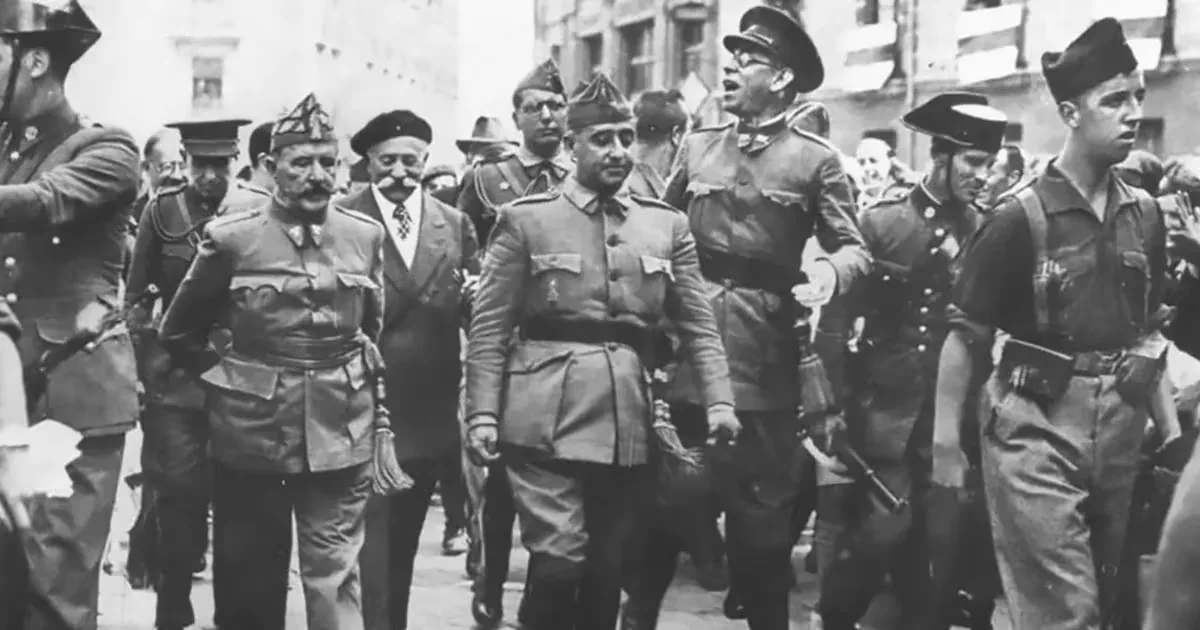
90 years ago, on July 17, 1936, in Melilla, Juan Seguí Almuzara, a general of the Spanish Army in reserve, gave the order of rebellion to the Spanish military garrisons of the city. The start of that rebellion occurred at 17:17, after General Emilio Mola, Captain General of Navarra, had sent a coded radiogram addressed to the also fugitive General José Sanjurjo (in Lisbon), General Francisco Franco (stationed in Santa Cruz de Tenerife), and General Juan Seguí (retired in military reserve in the city of Melilla). It was the beginning of the Spanish Civil War. “It starts in Melilla, with shots to the back of the head from the very first moment,” commented Spanish historian Julián Casanova on the RTVE program La noche en 24 horas, about how the first hours of the coup were.
Read more Or let us swear to die with glory: a story by Jaime Bayly
During the afternoon of July 17, all the Spanish military garrisons of the Rif Protectorate (the northern third of present-day Morocco) would fall under the control of the rebels. The next day, July 18, the coup plotters would execute the second phase of Mola’s plan: the rebellion of all the military garrisons on the peninsula, except those in Catalonia.
However, they failed in the rest of the territories of the Spanish state, either because the republican government apparatus convinced the commanders not to join the rebellion, or because those commanders did not dare to take the Army to the streets or, after doing so, quickly returned to their barracks, details the Catalan newspaper El Nacional.
The last phase of Mola’s plan was carried out on July 19 in Catalonia, and in Ibiza and Formentera, which had resisted the first coup attempt the previous day. In the Pityusic Islands, the coup plotters would ultimately prevail; in Catalonia, however, the response of the Generalitat and the civilian population would lead to the military rebellion’s failure. Barcelona would be the only city in the republican territory to defeat the rebellion by force of arms.
On July 20, with the Spanish territory divided into two masses that did not have enough strength to impose themselves on each other, the situation would evolve from an initial coup d’état to a civil war that would last three years (1936-1939) and cause one million deaths and more than half a million exiles.
However, the planning of the uprising is usually placed at the end of 1935, definitely accelerated by the victory of the Popular Front in February 1936, but conspiratorial movements were practically boiling from the beginning of the new regime. The path had started to be traveled much earlier with precise direction.
“There was a very concrete and meticulously prepared plan from before, it was not a spontaneous reaction, but the product of a monarchist-military-fascist plot,” explains historian Ángel Viñas, author of numerous books on the subject, to the Spanish media El Diario. The expert is emphatic against revisionist theses that place the origin in an almost inevitable response to the assassination, just a few days earlier, of the leader of Renovación Española, José Calvo Sotelo. Although these are the versions that Francoist propaganda zealously spread, they still resonate today.
Mola, not Franco, was the man in charge of directing the uprising. He was also not the one chosen to lead it, although he would end up leading the rebel side during the Civil War and become dictator for four decades. In fact, as Julián Casanova explains in his biography, Franco was slow to join the coup and did not commit definitively until June. The assassination of Calvo Sotelo ended up convincing him, even considering it “the signal.”
At that point, the Dragon Rapide was already waiting for him, a plane rented in England. The aircraft would transport him from the Canary Islands to Morocco on July 18 to take command of the troops stationed there. At that moment, the future dictator was not leading the uprising, but two days later, on July 20, José Sanjurjo died in a plane crash while being transferred from Portugal to the peninsula.
“This changes history, because Sanjurjo had been chosen to preside over the Military Junta, which was left leaderless. Franco plays his cards and wins,” historian Gutmaro Gómez Bravo explains to El Diario. The general’s decision to ask directly for help from Adolf Hitler’s Germany to move his troops from Morocco to the peninsula marked a first difference and “altered the leadership position between Mola and him.” According to Casanova, from Sanjurjo’s death onward, Franco “played his cards with skill and ambition” and began to present himself as the leader of the rebel military.
“Franco, obviously, not only comes to power, but from that moment on, that war that had started as a domestic war, which continues as an international war, becomes Franco’s war, the war of the Africanists, a war with fundamental fascist and Nazi support, and a war that at first the Republic controlled, because it had kept the most important cities,” Casanova commented on the RTVE program, where he also highlights that “it cannot be a classic military pronouncement because of everything happening in Spain and Europe with an ideological class conflict, clericalism, anticlericalism, agrarian reform, the separation of Church and State.”
“Half-failed, (Franco) will turn it into a brutal, cruel, long war, where many conflicts were resolved. It is not only an ideological or political war, it is a war that includes many wars at once, but with a very important international aspect,” he adds, referring to the foreign contingent that joined both sides: the rebels received massive military support from fascist powers, while the republicans were defended by volunteers and the Soviet Union.
The civil war not only leaves hundreds of thousands dead and massive exile, but also harsh repression and the beginning of a dictatorship that lasts nearly four decades. After Francisco Franco’s death in 1975, Spain embarked on a political reconciliation process culminating with the 1978 Constitution and the consolidation of a democratic system.
Read more Alba Gaviraghi: the flight of a new voice in Chilean cinema
Ninety years after the start of the conflict, the country is a democracy integrated into the European Union and one of the most developed economies in the world, although the wounds of the past remain part of the public debate, reports the Antena 3 network.
The Historical Memory laws, approved in 2007, and the Democratic Memory law, in force since 2022, seek to recognize and repair the victims of the Civil War and the dictatorship, as well as to promote the location of the disappeared and the removal of Francoist symbols.
Its supporters consider that these laws settle a pending debt with those who suffered repression, while its detractors argue that they reopen divisions already overcome and use the past for political purposes. The result is an intense debate that continues to occupy space on the political and social agenda.
While the political discussion continues, thousands of families continue waiting to recover the remains of their loved ones, shot or disappeared during the war and the first years of the dictatorship.
In this scenario, the newspaper El País asks: “How long will we continue talking about the Civil War?” “The Franco dictatorship officially ended with the approval of the 1978 Constitution, but those three years remain omnipresent in Spanish public life,” it states.
In a column in that newspaper, writer and journalist José Andrés Rojo talks about the “danger of unfractured memories.” “The Civil War is so far away that everyone feels authorized to believe that the narrative that serves is always that of their own, that of those with whom they establish a continuity that no one can dispute. Even more so in polarized times and with social networks. History as a discipline helps not to go off on tangents (…), but in the (always political) construction of a democratic memory, it is necessary to vaccinate oneself against any identity that presents itself without fractures,” he writes.
In the same newspaper, the Spanish-French historian Nicolás Sesma talks about the “lights and shadows” around this historical milestone. “Absolutely all countries that have suffered a traumatic past — that is, all — reflect on their history. Under these conditions, how could we not continue remembering, studying, and debating our own civil war? The exceptional thing would be not to do so. That would indeed make Spain different,” he points out.
And he adds: “History is an important part of who we are, how we perceive ourselves, and the image we want to convey, but national history is not a menu from which we can select only what comforts us; we must study both the lights and the shadows.”
Meanwhile, the struggle for Historical Memory remains open: the Francoist shields in Salamanca, the Cross of the Fallen in Cáceres that the Popular Party (PP) and Vox want to preserve, the former female prisoners of Yeserías in Madrid, or the Monument to the Fallen in Pamplona show the different ways of addressing the wounds opened by Francoist repression, notes the SER network.
Added to these are the uncertainties surrounding the Civil War museum projected by the PP and Vox government in Teruel. The opposition fears that the government of Jorge Azcón (PP), which repealed the Aragonese historical memory law, will change the content designed by two experts when the PSOE governed the autonomous community of Aragon.
Julián Casanova, expert in Historical Memory and professor of Contemporary History, explains the handicap for Spain that the Civil War was followed by decades of fascist repression while in other parts of Europe some repair could begin: “It took a very long time to recover the memory of the defeated,” and consequently, he argues, “it is no coincidence that the two laws have created many controversies, because there were already many people who from the beginning of the transition and democracy thought that we should not look back. And democracies have to publicly manage those pasts.”
“We have to assume the lessons we are giving about the Civil War. Assume that memories can be divided and denounce the political uses being made of the conflict,” he concluded.