


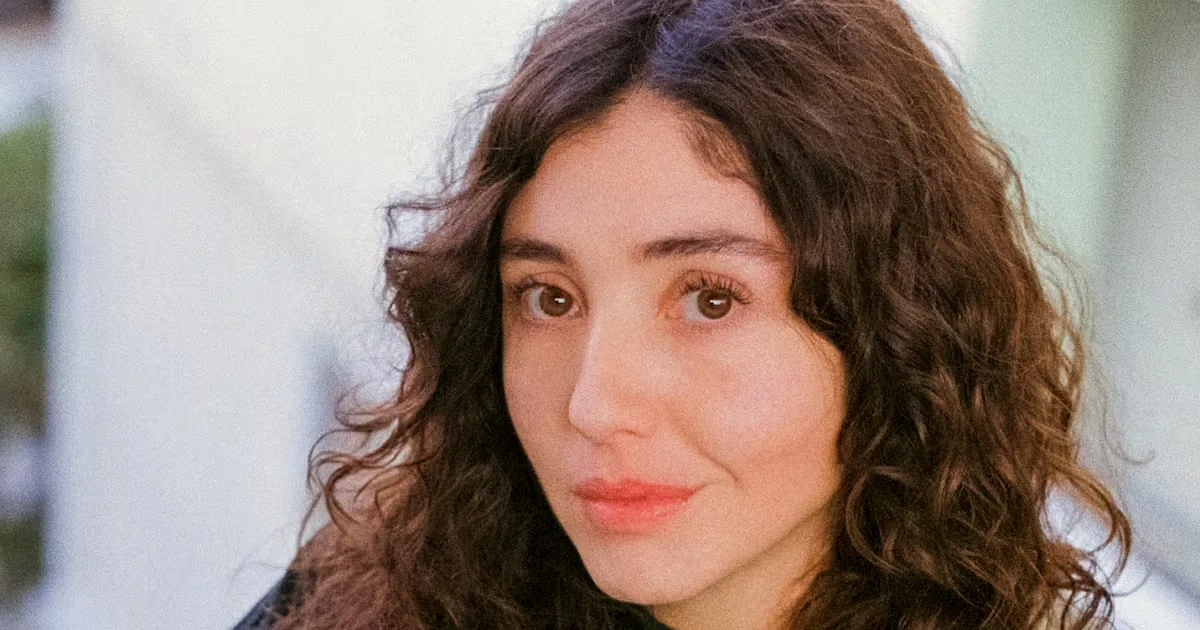
Shortly before the pandemic, Alba Gaviraghi (Santiago, 1992) had a dream that mixed drones and a student occupation very similar to the one she experienced in 2008, when she was in 10th grade at Liceo 7. The images revived by that dream – spending the night in the classroom, taking shifts with her classmates, receiving cigarettes and sweets from her mother through a gate – stayed with her and pushed her to put those ideas into a script.
This creative process resulted in Una fortaleza, her first short film as director and screenwriter, which has just been selected for the 83rd edition of the Venice Film Festival, to be held from September 2 to 12. Starring a cast with several new faces, the 14-minute film follows Antu (Antonia Pereira), a young woman who must decide whether to continue participating in the mobilization with her classmates or return home with her mother (Francisca Gavilán).
Graduated from the University of Chile in 2016, Gaviraghi has had a distinguished career in local film production over the last decade (the shorts Sigo acá and El verano del león eléctrico; Nunca subí el Provincia, by Ignacio Agüero). She also joined the teams of MAFI and Fidocs, and participated as executive producer in the development of La misteriosa mirada del flamenco, Diego Céspedes’ film awarded at the 2025 Cannes Festival.
With Una fortaleza, she steps into directing for the first time. In an interview with Culto, she admits that at first she was afraid to take that step. “Directing means stopping your producing career at least for a while. It was difficult to make the decision,” she says about a crossroads she resolved in 2019, when she had the mentioned dream and found space in her schedule to embark on her own adventure (she is also producer and editor of the short film).
The filmmaker says she applied several times to the Audiovisual Fund, without success. On three occasions, the evaluation committees argued that “it lacked the political discourse” and “it was not clear why the girls were occupying the school.” She admits she tried to incorporate that advice but did not succeed. Finally, on a fourth application – and after reaffirming that she would stay true to her original concept – she secured support from the body granted by the Ministry of Cultures, Arts and Heritage.
With a mix of elements referring to different eras – clothing typical of the 80s or 90s, a drone – Una fortaleza strives to portray the dynamics she herself observed and lived almost two decades ago.
“Most of the time we were not talking about politics. We talked about how everyone was doing, who got along well or badly with whom, about parents, about careers. There was an internal dynamic very different from, for example, a French film where political theory unfolds at all times,” she explains.
-What particularities of Una fortaleza do you think appealed to the Venice Festival?
I think something that Venice might have liked is this new approach to Latin American politics, from a more shifted, more ambiguous place. And also that it has a touch of genre cinema. Generally, these types of festivals that take a bit more risk in their auteur proposals are leaning towards works that have more genre elements. And I, without realizing it, now feel that the piece has an almost thriller-like tension, with the drone, with the confinement, with the looks, with the fear of eviction. It generates a kind of tension closer to a thriller than to a coming of age. I think maybe that seemed attractive to them.
-In the short, the mother’s face is never seen. Was it always written that way? What is the reason?
It was always written that way, without showing the mother’s face. It is meant to concentrate the maternal figure in that, as a figure, not as a character. When you put a face and name to a body on screen, it becomes a character. And it has to have its story, its life. For me, more than creating a mother, it was important to create a symbol of mother. I felt that fragmenting, showing little or only showing the back or nape helped a lot for that.
-Beyond what it proposes in Una fortaleza, do you feel any affinity with more traditional political cinema?
I love political cinema, but I think politics has changed too much for political cinema to remain the same. Nowadays politics is something completely new and political cinema has to renew itself with it. Politics now happens through cell phones, the far right returns… If before you saw handshakes between presidents, now they are fights on Twitter. Everything is a total distortion of what we understood as politics and therefore the social subject and the political subject change. And political cinema that embraces that politics must also change. It cannot remain discursive, theoretical, French. It has to inhabit other forms.
-The previous Chilean film that addressed a school occupation was La ola. What is your opinion of that film?
I think La ola, above all, is an aesthetic exercise of exaltation. It is a film that took risks around a genre very little explored in Chile, which is the musical, and that decided, for better or worse, to place itself in a political context that is not easy to address. Maybe you have to have lived it to speak with the expected authority, but you should not get lost in the fact that it is a hyperfiction film and its vocation is not reality. Of course, there are other types of works closer to reality, but that is not what I wanted to do with the short. You will not find the obvious in terms of slogans or discourses, but an emotion and a recognizable experience, treated from the edge, not from the center. In that sense, all artistic processes that subvert or distort what is expected about this type of political movements and actions seem valuable to watch or study, beyond tastes and results.
Alba Gaviraghi has worked in several renowned audiovisual production companies. Giancarlo Nasi, producer of Quijote Films, contacted her at a time when the company behind Blanquita (2022) and La misteriosa mirada del flamenco was expanding its ambition and size. He specifically called her to take leadership of the development department, an area dedicated to getting projects off the ground and positioning them in the industry.
“It is an intensely creative job that also demands a lot of resilience; there is a lot of rejection along the way. Alba is one of the few people capable of combining the creative and entrepreneurial sides so well,” Nasi tells Culto, also highlighting “her outgoing personality, her solidarity, and her sharpness.”
Read more Lionel Scaloni, the leader of the dominant legion of Argentine coaches at the 2026 World Cup
“What I like most about her is that she is a natural rebel. She will tell you directly if something is wrong or if she disagrees, and since she is extremely perfectionist, she also tells you straight how to improve,” he adds.
Leonora González, one of the founders of Parox, also worked closely with her. “She collaborated with us in the initial stages of several projects we are currently executing. Alba is a person very connected to reality, curious, with a very sharp critical judgment and also with a sense of fun and a lover of pop culture.”
Although they agree that jumping from producing to directing is a difficult and uncommon task, none are too surprised that she decided to take on that role.
“It is not easy because it is a long path that requires a lot of conviction, time, and energy. But Alba has plenty of talent and point of view. She had a script with a very beautiful and original story, born from her family experience. A script that today is a film and I am sure it will be successful because it is very authentic, entertaining, and sensitive,” González states.
The producer specifically refers to Hijas únikas (yes, with a k), Gaviraghi’s first feature film as director. Filmed between May and June 2025, the film is based on personal experiences and gathers stories from her family and friends. Instead of using the term “autobiographical,” she prefers another: “autofiction.”
The film revolves around Antonia (Antonia Pereira, the same protagonist of Una fortaleza), a 16-year-old girl who needs her absent father’s permission to go on her study tour to Argentina. With the 2006 student protests as a backdrop, the teenager embarks on a journey where she reconnects with a half-sister she did not know and rediscovers her bond with her mother.
“We are still looking for an international premiere, but we want it to reach festivals and national theaters soon, because Equeco and I are especially interested in the reception by the Chilean audience. Hijas únikas is a very Chilean film. Among the Pokemones, the Penguin Revolution, the Papitos Corazones, we hope it invites a generational reunion that leads to much discussion and reflection here with its audience. We recently finished editing and the plan is to finish post-production soon as well,” she details about the project that brings together the efforts of Agosto Cine, Equeco (Denominación de origen), and companies from Germany and Mexico.
Giancarlo Nasi knows the details of her short and feature films and can speak authoritatively about the results of both. “The quality does not surprise me. What did pleasantly surprise me is how honest her works are: with herself, with her personality, with the world, and with the era she grew up in. They are young, fresh stories, very different from other Chilean works. They are honest to the utmost. Only Alba Gaviraghi could have made them. She is a filmmaker in the deepest and broadest sense of the word,” he analyzes.
-To what extent do the protagonists of the short and the feature represent the person you were during those years?
During the creation of the characters, one tries to distance oneself a bit from those memories or accept that one has grown, but I was able to connect very quickly with my inner teenager, who is still very much alive… Maybe too much. Ideas flowed and I latently remembered things I felt, more than maybe things I did. And I started putting them on paper, in the short and the feature. What would I have done at that moment? How did I feel? What thoughts did I have?
“Connecting with the things that matter at that age, and not seeing it from an adult-centric perspective, was the key to being able to pour out that inner child. That is, these feelings and emotions are valid, and it is appropriate that cinema gives them that space instead of always looking at them from the concept of growth. I feel that my character in the short does not grow. In the film, there is not much of a growth arc either. I don’t think growth is that, something that happens overnight or in a specific stage of life. Your child, your youth, and your adult are always integrated in you as a person.”
-Making a coming of age film always starts from a somewhat nostalgic place. Do you consider yourself a nostalgic filmmaker?
Perhaps the exercise to reach the idea has some nostalgia. But when it comes to putting that idea into staging, I am not interested in conveying nostalgia. That is why the short plays with temporality. And although the feature has things from 2006 that generate a lot of nostalgia – reggaeton, Fotolog – it is narrated from the continuous action of a character living her present. Both films contain a very adolescent perspective from within; they do not look at themselves with nostalgia. I don’t want to generate nostalgia, which always pulls you to the past. I want to generate a reflection on how past, present, and future can sometimes be the same.
An admirer of Raúl Ruiz and Dominga Sotomayor (“they would be my father and mother,” she says), she envisions a future in which she will make new films as a director, although she does not limit herself to that role. In fact, she has just debuted as an assistant director – in Roberto Doveris’ new film – and is open to exploring other positions.
“I am grateful to be able to live from what I love, never having stopped making films and being involved in different processes. That is what fulfills me. So, when what fulfills me is there, I go and take it. The more projects and people I can work with, the better,” she concludes.
Read more Kimi Antonelli is making a strong comeback in Formula 1 and secures pole position for the Belgian GP