







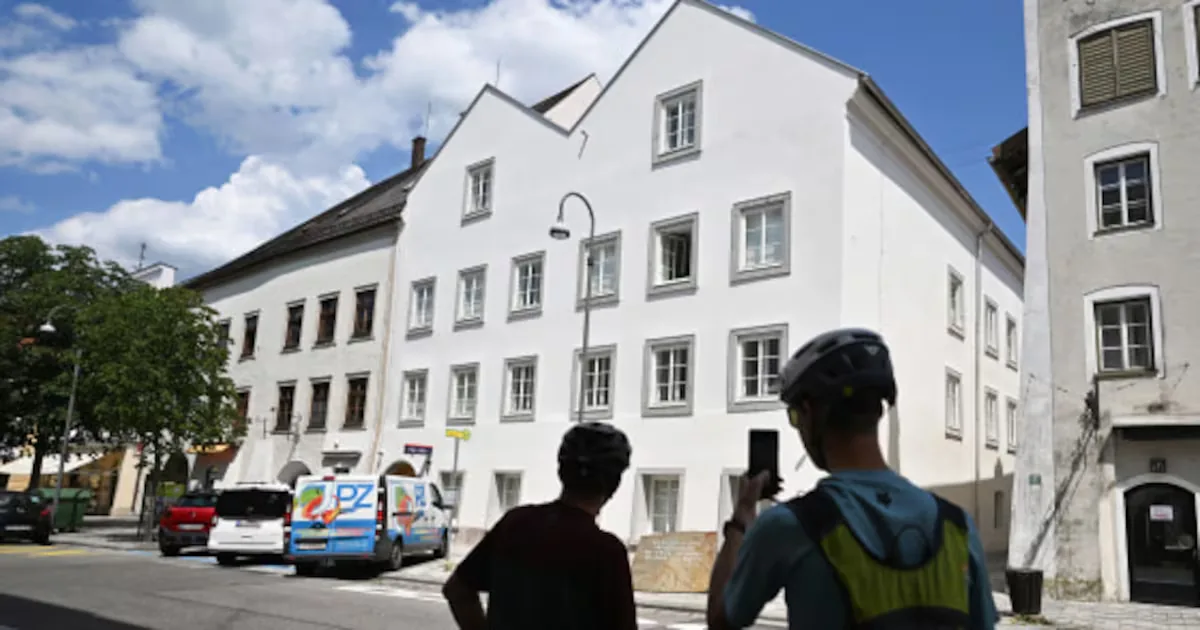
On a commercial street in the Austrian town of Braunau am Inn, near the German border, the 17th-century building where dictator Adolf Hitler was born on April 20, 1889, has become unrecognizable after several years of construction costing 20 million euros (more than 22 million dollars).
Read more U.S. prosecutors and Maduro’s lawyers propose that the trial begin in June 2027
The yellow cladding was replaced by a sober white facade.
At the entrance stands the police emblem, but on the sidewalk, a commemorative tombstone has been preserved with the inscription: “For peace, freedom, and democracy. Never again fascism. Millions of dead remind us.”
This inauguration “shows that the city of Braunau faces its history, that it assumes its responsibilities,” declared Mayor Johannes Waidbacher, in the presence of Interior Minister Gerhard Karner.
The mayor hopes it will bring “a little serenity” to its inhabitants and show “that one can look towards the future.”
The ceremony, attended by about a hundred people, including some thirty uniformed police officers, opened to the sound of an orchestra, AFP noted.
Authorities hope the inauguration will put an end to a long controversy in a country criticized for having been slow to acknowledge its responsibility in the Holocaust, in which 65,000 Austrian Jews died and 130,000 went into exile.
Experts estimate that some six million people, overwhelmingly Jews, died from the time the Nazis came to power in Germany until the end of World War II.
The inauguration of the police station comes at a time when the far-right is gaining ground in the polls.
According to a poll published on Sunday by the newspaper Kronen Zeitung, the FPÖ party, founded by former Nazis and part of the opposition, obtains 38% of voting intentions, compared to almost 29% in the last legislative elections in September 2024.
Adolf Hitler’s birthplace belonged to a family since 1912. In 1972, the state leased it and set up a center for people with disabilities, one of the groups that suffered the barbarity of the Third Reich.
Read more Iran attacks US facilities in Kuwait, Jordan, and an Amazon data center in Bahrain
Neo-Nazis often gather at this address. Still, its last owner, Gerlinde Pommer, opposed the building’s transformation and challenged its expropriation.
Authorities had to pass a special law for the general interest to prevail in 2016.
Three years later, the Austrian Supreme Court validated the purchase, for 810,000 euros (925,000 dollars), of the 800 square meters of surface area.
Several options were considered for the future. A commission of experts decided not to turn it into a symbolic place to prevent it from attracting neo-Nazis.
Its demolition was also ruled out because, in the opinion of historians, Austria must confront its past.
Finally, it will be converted into a police station to “make it clear,” according to the government, that no commemorations of National Socialism will be allowed.
But this has not ended the controversy. “This transformation will not deter any neo-Nazi tempted by pilgrimage,” Robert Eiter, from the Austrian Mauthausen Committee (MKÖ), an association of survivors of the Austrian concentration camp, told AFP.
He is “skeptical” about the ability of security forces to neutralize the site. “Without wanting to generalize, it is unfortunately often observed that a part of the police leans very, very far to the right,” says Eiter.
Read more New York City Mayor admits he lacks the authority to arrest Netanyahu