

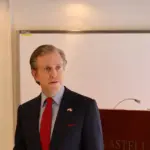


Claudio Lomnitz is a prominent social anthropologist and historian born in Chile (1957), but naturalized Mexican, who has dedicated himself to researching the politics and culture of Latin America. He is currently the director of the new Social Studies Laboratory on Disappearance at Columbia University.
Read more How heat waves amplify the water crisis in France
Since 2021, Lomnitz has focused his attention on providing an anthropological perspective on the transformation of the State and community in contemporary Mexico, especially on the study of the fragmented relationship between sovereignty and the State. This has resulted in the publication of a trilogy in Spanish: El tejido social rasgado, Para una teología política del crimen organizado and Antropología de la zona de silencio.
Lomnitz visited Chile for a new Norbert Lechner Chair at UDP, titled “The ‘internal enemy’ and the historicity of forced disappearance in Mexico.” In conversation with La Tercera, he analyzed the violence in that country.
How do you assess the current situation of forced disappearances?
Forced disappearance in Mexico is a problem that has been ongoing for a couple of decades and is becoming a very large phenomenon, and so far, there has not been a government in these years that has faced it decisively. It is not simply a matter of having a nice law, but of having a State truly determined to confront it.
The current government has been conducting many police operations against major drug trafficking bosses. Both the current government and other governments in Mexico have preventive detention laws that give States a lot of leeway to imprison people. But disappearance in Mexico is linked to the use of extrajudicial violence to create branches of economic activity, that is, there is international drug trafficking, retail drug dealing, violence in street vending or in the migratory flow of transnationals, also for illegal logging, violence to change land use, violence to carry out mining operations both illegal and sometimes even legal.
So, to confront this, the government would have to start by making an inventory of the violent economy, and not just play with statistics and laws.
You have placed the beginning of the current violence in the country in the 1980s and 1990s. What more specific political and economic transformations of those decades do you consider decisive for this subsequent number of disappearances?
I have consistently stated that the process began in the 1980s and 1990s and not just in 2003, 2006, when the war on drugs was declared and in the following years, when the numbers of disappearances multiplied greatly. The process begins in those years because it is related to the rise of a new form of social organization, which is what they call the cartel.
Before the 1980s and 1990s, there really wasn’t such a developed form of social organization in Mexico, because the complexity of drug trafficking before the mid-80s was not that great. This was because the drug trade moved Mexican products: marijuana and heroin, and from the late 80s, cocaine and later synthetic drugs appeared, which involved a much more complex international trade. That is, cocaine is not produced in Mexico. So it had to be brought from South America, from Colombia, from other points, which implied controlling international airports, controlling international ports, and not only smuggling across the Mexico-US border.
Thus, the rise of the cartel requires a much more complex use of violence, and that is where cases begin to be seen and worsen as that economy, those violent economies, advance and diversify. Also, because initially they were only drug trafficking and today there are many branches of the economy.
You have mentioned Zacatecas as a kind of sample button. What patterns have you detected there that are transferable to other regions of the country?
In the case study we did in Zacatecas, there were several types of phenomena that are quite common in much of the country and some that are specific. Zacatecas, in the years I was working there, 2022, 2023, 2024, was a state contested by several cartels, especially two: the Sinaloa Cartel and the Jalisco New Generation Cartel.
But there were also two or three other cartels disputing pieces of territory. The regions of Mexico where there were such disputes were regions with especially high numbers of disappeared persons, because some of them were war deaths. And Zacatecas was an area where there was a war between cartels, some of them people who are being kidnapped and forcibly recruited to replenish or enlarge the size of the armies. And there are other cases related to market control, for example, control of retail drug dealing.
In the case of Zacatecas and much of Mexico, there is a lot of territorial control of the drug trade in neighborhoods, in popular places, mainly through the sale of methamphetamine, which is a very cheap and highly addictive drug. So, control over a neighborhood is exercised by such or such cartel, exercising a monopoly on the sale of methamphetamine usually managed by local people. Often they are not from the cartel, but youth gangs that buy the product from the cartel or have some member linked to the cartel.
So, when there is a war to control a town or city where the distribution of methamphetamine favors the other group, there are processes like extermination, especially of young people in those neighborhoods. You see that in Zacatecas and in many places.
Is there a difference between areas where there is competition between cartels and where one of them has control?
Where there is not much competition, there tends to be less homicide and disappearance than in areas where there is competition between cartels. And this means that cities that are much harder to control for a monopoly tend to always have a more constant process of disappearance and homicide or at least, if not constant, waves.
While there are territories that seem relatively peaceful in the sense that there is not much disappearance, but where there is firm control of the cartel, even states, not just areas. For example, the state of Durango, which neighbors Zacatecas, is a state that in recent times has had relatively low rates of disappearance and homicides, but with the control of a single cartel, which was the Sinaloa cartel, in that case very stable and very firm.
You wrote the book “Anthropology of the Zone of Silence,” what do you mean by that metaphor?
The zone of silence is an expression that journalists began to develop in Mexico. Mexico has been a place where there have been many murders and there continue to be murders of journalists and also threats against journalists and media. So, when that phenomenon began, which unfortunately has been going on for a couple of decades, the journalists who have really been at the forefront of covering this whole process began to talk about zones of silence, which is what happens when suddenly there is no journalistic coverage of such or such area because there are so many threats against journalists or media that the news stops appearing.
So I take that expression “zone of silence” and see it in the sense that journalists use it, and I turn it more into an anthropological problem. There is no zone where there is no communication. And not only that, but violence frequently targets communication. For example, in Mexico we have unfortunately seen, for 20 years, the use of very exaggerated and very public violence to send messages, such as decapitations, dismemberment of bodies in public places. At one time, bodies were hung from bridges in certain cities like Monterrey or Ciudad Juárez, etc. So these acts are not just violence in the sense of coercion against a person’s body, but also the use of the violated body as a public instrument to send a message. So violence itself cannot be seen exclusively in relation to silence, but must also be seen in its communicational dimension.
It is about seeing how communication works in a region like Zacatecas, in years when it was at war, and there is not a single answer to how it works, but several explored in that book. One very evident one is, for example, the use of social networks and rumor in general on social networks. For example, if there is a violent act, two bodies appear dumped in such a town. It may be that the media covering it put it in the news: Two bodies appeared dumped in such town, but since it is a zone of silence, the news report will be very brief and there will be no investigative journalism.
Journalism has to report that even the report often comes from the police and practically reproduces the government press release and adds no investigation. So social networks, Facebook, Instagram, lately TikTok, post rumors, so people can say there were two dead, be careful, don’t circulate because there was a shooting. Even the cartel itself sometimes uses those social media sources to generate information.
In what way?
For example, a sweeper enters. The Jalisco cartel is going to enter a neighborhood in Zacatecas. Let’s say it is trying to beat the Sinaloa cartel in one of those municipal seats. So it enters, carries out very public massacres and leaves bodies dumped or some head of a decapitated person. And at the same time posts on the Facebook page of that community saying: “Don’t worry, it’s us, we are not going to kill the population, we are trying to clean the seat of the scum of the other cartel.”
So the cartel itself uses social media. And that makes social media become a fundamental basic source of information. The cartel cannot use the press. So, that is an example of the type of communication analysis that must be done if you really want to understand how communication works in a zone of silence.