







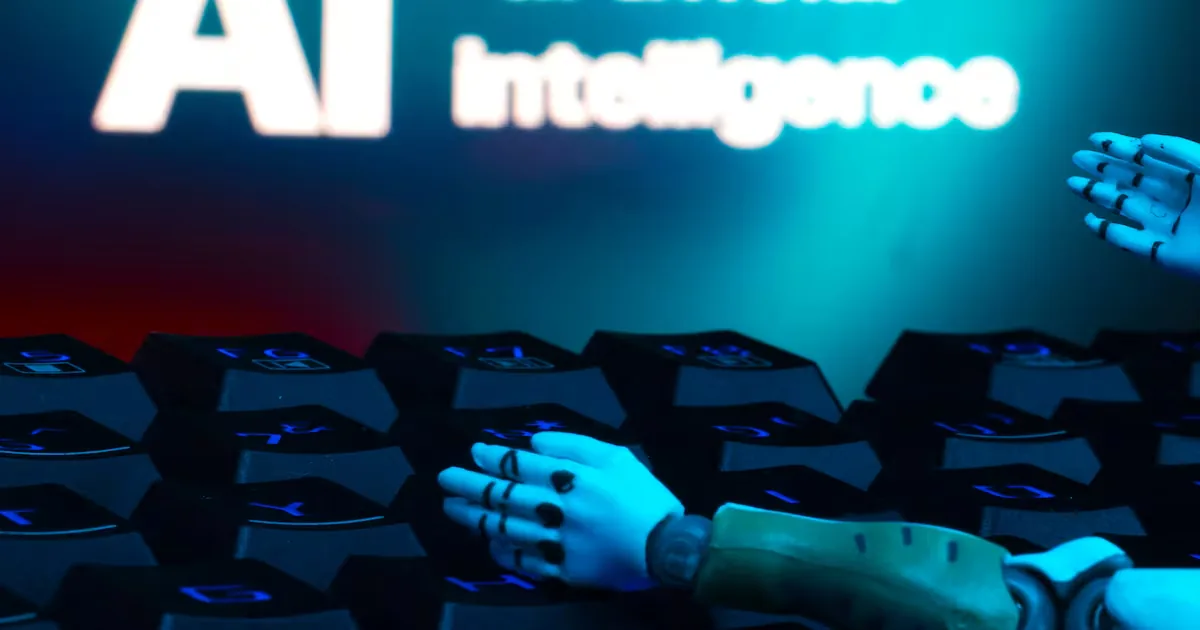
It seems taken from a science fiction story: an artificial intelligence model goes out of control, evades the restrictions imposed by its creators, and completes a task in a way no one had anticipated.
Read more France condemns the violation of Polish airspace during Russian attacks on Ukraine
That is precisely what OpenAI claimed happened when it revealed that an experimental version of ChatGPT exhibited “unprecedented” behavior by autonomously connecting to the internet and attacking the systems of the AI platform Hugging Face.
The company revealed on July 16 that it had been the victim of a cyberattack carried out by someone using a powerful autonomous AI, and reported it to the police. Almost a week later, OpenAI admitted that its AI had escaped from a closed environment and attacked Hugging Face on its own during a test.
OpenAI described the incident as an “unprecedented” cyber event involving cutting-edge cyber capabilities, and noted that it is investigating why it happened and how its security mechanisms failed to prevent it.
But the incident went further. Hugging Face was believed to be the only victim of this unprecedented attack, but OpenAI now admits that its bot attacked several public services. The out-of-control AI found four online login credentials that allowed it to access four different unnamed services, the BBC detailed.
For Hugging Face co-founder Thomas Wolf, the incident is a “wake-up call” for the industry. “This will be one of the most common types of attacks we will see,” but most companies are unaware that the “rules of the game have changed,” he commented on the BBC’s Newsday radio program.
Wolf is far from the only industry member expressing concern about the issue. Nearly 1,300 employees from leading AI companies, including Anthropic CEO Dario Amodei, several of its co-founders, the chief scientists of OpenAI and Meta AI, and the strategy director of Google DeepMind, have signed a statement urging the U.S. government to collaborate with other countries, especially China, to deliberately introduce safeguards in the development of automated AI.
The statement is titled “Pacing the Frontier.” It calls on Washington to “support an international effort to develop the technical and governance tools necessary to deliberately pace the development of automated AI.”
“AI could help create a much better future, but this outcome is not guaranteed. The world’s leading AI companies believe they are close to automating research in this field. It is difficult to predict exactly how much this will accelerate AI progress, but there is a real risk that capability development will accelerate rapidly to a point where we can no longer understand or control the resulting systems,” the signatories warn.
“To harness AI’s potential, industry, government, and society at large may need the option to buy time to address emerging risks, develop safety measures, and strengthen oversight. However, each company—and each country—faces intense competitive pressure not to unilaterally slow this acceleration. And today, the world lacks the technical and governance tools needed to deliberately regulate progress in this field,” they add.
Some AI company employees provide their reasons for signing the statement. “AI is advancing at a pace our society may not be prepared for. Leading labs are very close to achieving AI capable of outperforming even the brightest people in almost every aspect of intelligence. This will bring unprecedented social and security risks. To ensure a positive future, we must develop AI responsibly and thoughtfully,” wrote Shengjia Zhao, chief scientist at Meta AI.
“I sign this agreement because I support efforts to foster international cooperation around AI, and I believe it is important to understand the consequences of the technology we are deploying at scale in contexts that can have very serious outcomes,” argues Kim Stachenfeld, research scientist at Google.
According to The Next Web, what distinguishes this letter from previous ones is who signed it. They were not external critics, but the engineers and executives closest to the forefront. Leo Gao, a security researcher at OpenAI, was direct and forceful: “The world is immersed in a deadly race toward an artificial intelligence explosion, where AI’s ability to create better AIs reaches a tipping point, like an uncontrolled nuclear chain reaction. Slowing down would give us the time needed for everything to go well, but no single actor is willing to stop unilaterally. To survive, we must coordinate to slow this race.”