








A month before the Emmy Awards nominations announcement was released, critic Glenn Whipp wrote a column for the Los Angeles Times titled “Welcome to the most disappointing Emmy race in years”. The specialist dissected the possible contenders for the 78th edition of the ceremony and –perhaps most importantly of all– assured that the current landscape made him nostalgic for the past of television, particularly for the era when “series had ambitions that went beyond mere entertainment.”
His column ended with a jab that surely did not sit well with executives and creators: “We already have enough television to watch. But right now it’s hard not to wish some (series) were better.”
The list of nominations offered few arguments to refute his words. With few exceptions (The Pitt, Pluribus, Hacks and some others), among the aspiring group, correct productions abound and fictions of true substance are scarce. It is not necessary to go back too far in time to find a more substantial harvest and confirm a drop in quality: just a year ago, Severance, Andor, The White Lotus and The Last of Us were competing for the Emmy for Best Drama Series (all with new seasons in preparation, except for the Star Wars production, which has already finished).
Now, of the four that repeat their presence in the category (The Pitt, Slow Horses, The Diplomat, Paradise), the only one that comes close to acquiring the form of a cultural milestone is the first, which is effective but not precisely innovative: it has brought back into fashion the medical drama format that has so many followers worldwide. And of the handful of titles making their debut in that section (The Gilded Age, Friends and Neighbors, A Knight of the Seven Kingdoms, Pluribus) only the latter aspires to the greatness of series of yesteryear.
The Emmys are not the definitive thermometer to measure the health of television’s present – it’s impossible to forget that titles like The Wire and Better Call Saul were never awarded – but their configuration provides a good basis for analyzing trend changes and the potential beginning and end of eras.
In the newsletter she writes weekly for El País, Spanish journalist Natalia Marcos stated that “we are facing a rather decaffeinated Emmy race that speaks to the current state of series” and emphasized that “it is difficult to find productions worthy of honors.”
In conversation with Culto, Marcos elaborates on this topic. “Reviewing this year’s nominees for Best Drama Series, I think it’s clear that we are in a very different television moment,” she notes, also pointing out that in this edition “there are many new seasons of series that, although they have many merits in their respective fields, are still just good series. I can’t imagine The Diplomat winning an Emmy for Best Drama Series, or the science fiction of Paradise. Even Friends and Neighbors, which might seem in line with television from 15 years ago (…) And A Knight of the Seven Kingdoms is a very worthy proposal, but in no case does it reach the magnitude of its parent series.”
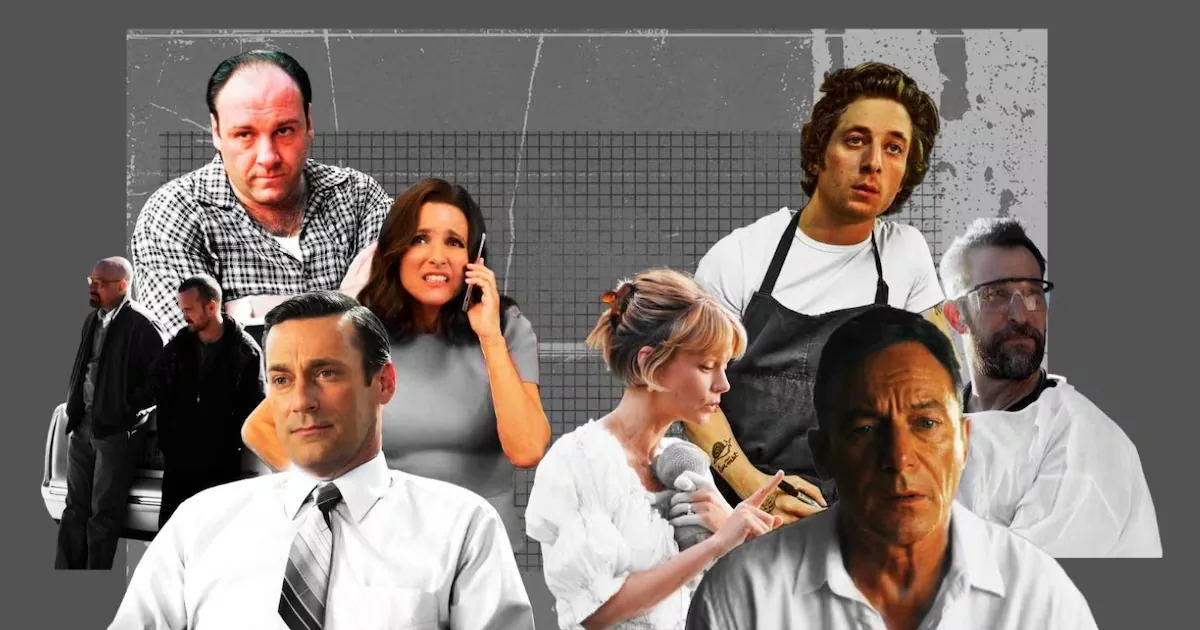
The two best on the list represent opposite worlds. On one hand, The Pitt is an efficient medical drama, honest in its pretensions (which, it’s worth mentioning, showed some weaknesses in its second installment). On the other hand, Pluribus is an heir to the era dominated by productions of the stature of The Sopranos, Breaking Bad, and Mad Men. For the first time with a female protagonist, screenwriter Vince Gilligan weaves the portrait of a writer facing the pain of losing her partner and the bewilderment that the world is united in a large interconnected network seeking her happiness. The pen that created Walter White and Saul Goodman trusts the audience’s intelligence and offers a product designed for the viewer to interpret as they wish.
While highlighting the “bravery” of Gilligan’s new fiction, the El País specialist is categorical. “I believe that we are at a moment of cycle change, awaiting the next great television drama. But in the meantime, we have The Pitt, which very well champions traditional television and reminds us that anti-heroes and convoluted, dark plots are not necessary to make a great series,” she states.
“I think it can be argued that the true boom of television has passed, with the explosion of series seeking prestige that came after Mad Men and Breaking Bad, giving way to greater sobriety, and undoubtedly a reduction in the offering on cable channels. Streaming services have largely filled that void, but not entirely,” Brian Lowry, a critic with extensive experience who now writes for Status.news, tells **Culto**.
There is an Emmy category that is useful to analyze closely: Best Miniseries or Anthology Series, where Netflix has a streak of three consecutive wins thanks to Beef, Baby Reindeer, and Adolescencia, television phenomena that delighted audiences and critics and sparked countless conversations, particularly the latter two.
This year the landscape is less brilliant. While the platform is a favorite with the second season of Beef, the truth is that this new incarnation – it is an anthology series – did not achieve the same impact as its predecessor. And among the rest of the candidates (Love Story: John F. Kennedy Jr. and Carolyn Bessette, DTF St. Louis, The Beast in Me, All Her Fault) there is no title that has reached the same heights as the winners of other years.
This edition’s contenders are also very far from the “losers” of other ceremonies. We are talking about titles like I May Destroy You and The Underground Railroad, which the IndieWire portal chose as the first and second best series of the 2020s, respectively.
While agreeing that this year’s competition is a possible sign of an industry downturn, Marcos avoids pessimism.
“I believe that golden age began with the start of The Sopranos and ended with the finale of Breaking Bad. Now we are in another moment with much more production, more niche, with less impact and cultural prestige perhaps, but which allows more diverse audiences to access series they may like. Great series are still being made, of course, but that era ended. And I don’t think it’s a bad thing, it was time to evolve and move on to more diverse television, an heir to that era,” she explains.
Matt Brennan, editor-in-chief of The Envelope (the Los Angeles Times awards magazine), recently anointed Industry as “the last great drama of television’s golden age.” Premiering in late 2020 on HBO (on the BBC in the UK), it follows a group of twenty-somethings as they navigate a ruthless world of finance, power, and ambition. The story has captivated critics – especially with the reinvention it experienced in its fourth season – but the Emmys have ignored it year after year.
“I have come to define the ‘golden age’ as a period in the history of the television industry, not just as a set of clichés – anti-hero stories, for example – or an aesthetic of ‘prestige.’ I applied the term to Industry because the first season was filmed in 2019, when the era was beginning to decline, and then, in one way or another, it managed to survive the drastic transformations – the Covid-19 pandemic, the writers’ and actors’ strikes, and the continuous wave of media consolidation – that ultimately led to the end of that creative fervor,” Brennan tells **Culto**.
Read more German police shoot dead alleged perpetrator of mass ramming at Berlin Pride parade
For the specialist, the current business conditions make it difficult for a new wave of titles with the character and daring to define an era to emerge. From his perspective, the aforementioned glorious stage “arose from a revolution in the television business, which began with the entry of premium and basic cable television into the creation of scripted prime-time programming, and then with the development of streaming. This rapid expansion in the number of television channels and platforms, and the consequent need to fill their programming, allowed projects that would have been too ‘risky,’ ‘niche,’ or ‘experimental’ to prosper.”
Brennan illustrates his point with an example: “It’s hard to imagine Prime Video producing Transparent now, but it was widely discussed, acclaimed, and awarded after its premiere in 2014.”
There is another question strongly connected to whether we are in a moment of decline or transition: who is making the best series right now? If for years that question had only one answer (HBO), today the landscape admits other interpretations, especially after the extinction of heavyweights like Succession, Barry, and Veep.
Launched in 2019, Apple TV had an ambitious but somewhat uneven debut. Over time, its bet has gained consistency and has built one of the most attractive streaming catalogs. It scored triumphs with the comforting comedy Ted Lasso and the intriguing Severance. Last year it dominated the Emmy comedy categories with The Studio, its Hollywood satire which is already preparing its second cycle. while from its third season the espionage thriller Slow Horses became a regular contender (and, like The Pitt, returns with new episodes every year, a rarity in this era).
And now it has just celebrated its best mark in the main TV awards, with a total of 89 mentions and triple presence in the drama and comedy races. That is, at least in terms of industry recognition, its strategy has paid off.
The Curse of Widow’s Bay is a good example of the platform’s audacity and eye. With ingredients of comedy and horror, it’s the kind of project with a difficult-to-classify concept that not all companies in the sector would be willing to finance and greenlight. The series starring Matthew Rhys currently has 19 Emmy nominations and it would not be unreasonable for it to snatch a few categories from Hacks, the HBO Max production that is presented with its final season (it received 24 nominations, a record for a comedy in a single year).
“Of the streaming platforms that have so revolutionized the medium in recent years, Apple TV is currently making the television that seems closest to the series of the ‘golden age’,” emphasizes Matt Brennan, who particularly highlights The Studio, The Curse of Widow’s Bay and For All Mankind, “which I have often described to my friends, half-jokingly, as ‘Mad Men in space’,” he says.
“Netflix may have held that title in the era of House of Cards and Orange Is the New Black, but that era ended, coincidentally, around the time Industry premiered on HBO,” he himself maintains.
For his part, Brian Lowry believes that “Apple TV is far exceeding expectations in terms of series that feel fresh and daring, or simply entertaining, like Pluribus, Severance and Friends and Neighbors.”
Although The Curse of Widow’s Bay seems “a bit overrated” to him, Lowry expresses his enthusiasm for another series in its library: Sugar, the story with Colin Farrell as a private detective, which is currently airing its second cycle and moves between film noir and existentialist drama. “It’s a fascinating experiment that you don’t see much elsewhere,” he states.
“There’s a lot of talk about Apple TV lately as the heir to HBO’s prestige, but I don’t think HBO Max has lost its capacity yet. There are The Pitt or Hacks, big favorites in the awards this year,” warns Natalia Marcos.
“I do believe that Apple TV is the best positioned now to take risks, because having Apple behind it, a giant that does not have television, by any means, at the center of its business model, it can afford to make big-budget series that are not concerned with following trends. They can escape the algorithm, and that is always positive. I don’t know if it’s economically profitable, but while it lasts, let’s enjoy it,” argues the Spanish journalist.
And what about Netflix? As Marcos suggests, its curation is mandated by the algorithm and by finding a new hit that allows them to launch their next big franchise. Today their efforts are also focused on figuring out how to prevent the second seasons of their successes from plummeting in viewership – it happened with Wednesday, Avatar: The Last Airbender, Beef and many others, causing headaches for their executives and investors – and on deepening their initiatives in other areas of the business (live broadcasts, games, etc.).
Its performance at this year’s Emmys clearly illustrates a rather uninspiring present in terms of quality. Outside of Beef, there’s little substance on the list. There are The Beast in Me, Black Rabbit, Monster: The Story of Ed Gein and Stranger Things, which had a spectacular ending but did not generate consensus among its followers or the press. If in the final count the streaming service appears with 111 mentions (compared to HBO/HBO Max’s 122) it is largely thanks to its vast production allowing it to be nominated in almost all categories.
FX is another influential name that is not having its best year. Between the ups and downs of The Bear (which competes in the Emmys with its fourth and penultimate installment), the almost total omission of Alien: Earth (relegated to four technical categories) and a less solid performance than expected from Love Story: John F. Kennedy Jr. and Carolyn Bessette, it is worth asking if the network led by John Landgraf has already lived its era of greatest brilliance.
It is the same question that haunts every actor in the industry and that will probably be fully answered in the coming years.
Read more Brazil recalls its ambassador in Argentina after Milei’s insults against Lula