








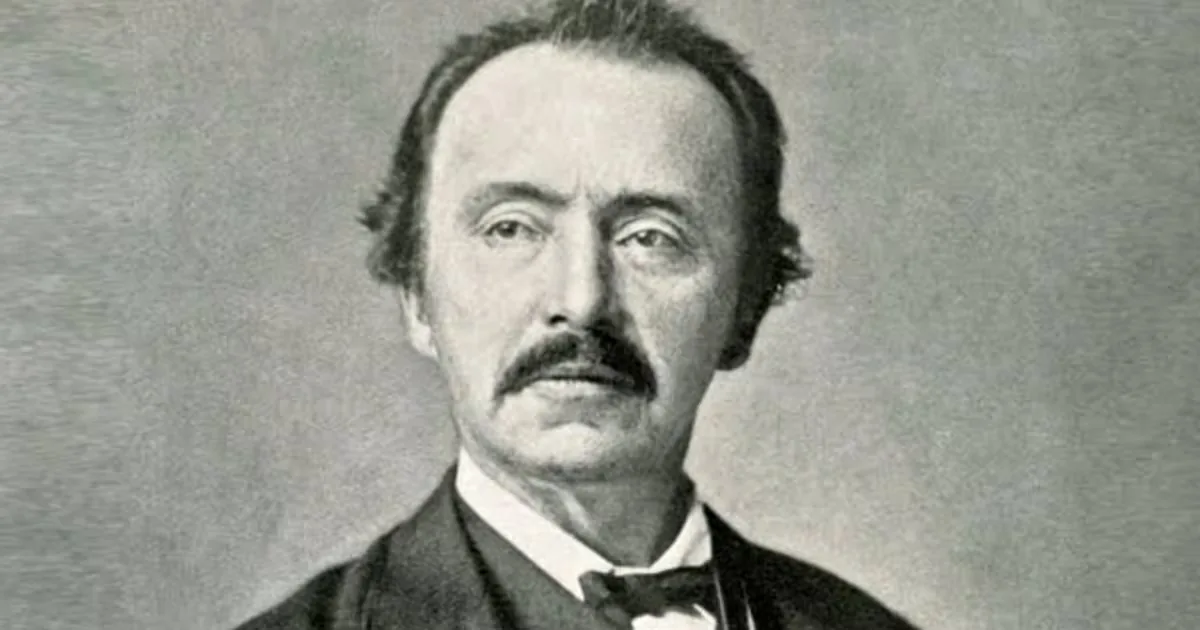
For Christmas of 1829, when he was 8 years old, the boy Heinrich Schliemann, son of a wealthy family in the north of present-day Germany, received a book as a gift. It was no coincidence since the boy loved to read. It was an Illustrated Universal History for children. Quickly, the first thing he checked was his favorite period of the past: classical antiquity. Specifically, the Greeks. On one plate, the book recreated the fire that destroyed the mythical city of Troy, located in Asia Minor. This convinced the boy that Troy had indeed existed. And even more. He set out to find it. “Father, you must be wrong! Troy exists! Otherwise, how could they have made this drawing?” he would have said to his father.
Read more Netanyahu warns Iran that Israel’s response will be «much more powerful» if it decides to attack
The anecdote is cited by Pilar Luis Peña in her article A man named Schliemann and a dream called Troy, and it accounts for the great life goal of the German: to find the remains of the true city of Troy, the historical setting of The Iliad, the epic poem attributed to Homer. He was convinced that The Iliad was not just fiction, it had to have some real basis.
After a somewhat sad childhood and youth, the truth is that his determination and his ease with languages made Schliemann a millionaire by his thirties thanks to his skill as a merchant. But business did not make him happy.
Little by little, Schliemann gathered capital that he planned to invest in his great dream, to discover Troy. For that, he began to prepare as best he could; in 1866, he moved to Paris, where he began studying Ancient Sciences and Oriental Languages at the University of the Sorbonne. There, basically what is now known as Ancient History was taught.
After a failed marriage to a Russian aristocrat, in 1868 he traveled to Greece for the first time. On Greek soil, and at his own expense, he began his first excavations, guided only by his own intuition. He started on the island of Ithaca, the land of the legendary and cunning hero Odysseus, the protagonist of the epic poem Odyssey, by Homer, which had just been adapted to film by filmmaker Christopher Nolan. Without making any significant finds, he moved to Mycenae, and then went to Turkey, then part of the Ottoman Empire.
There he had the stroke of luck he needed, as he met Frank Calvert, British consul in the Dardanelles, who had bought half of the hill of Hisarlik, in Turkey. In that place, Calvert claimed, there was suspicion that Troy was located. In fact, Calvert himself had done a couple of excavations without results. But, enthusiastic, Schliemann assured that he, with his substantial resources, could do it.
In 1869 he married a 17-year-old Greek girl, Sophia Engastromenos. With her, he had two children whom he baptized, of course, with Greek names: Andromache and Agamemnon. The following year, 1870, and after receiving permits from the Ottoman authorities, he began his excavations on the aforementioned hill of Hisarlik. He was convinced he would fulfill the dream of his life.
The difficulties, Peña specifies in her article, were not few. “The cold, the insects and vipers, the looters, the lack of hygiene of the place.” Soon, Schliemann noticed that there was not a single city in the place, but several. “He realized that the original ground of the hill was seventeen meters deep and that under the dust of so many centuries lay not the Homeric Troy but the superimposition of six cities.” Initially, Schliemann believed that the one corresponding to Troy II was the Troy sung in The Iliad. Years later, he corrected this finding and established it in Troy VI (or Troy VIIa).
The problem was that Schliemann, not being a professional archaeologist, resorted to rough methods that did not take care of site preservation. “In the last century there was no machinery like we have today, so all the excavation was done with pick, shovel, and wheelbarrow,” says Peña.
As if that were not enough, and in order to excavate as deeply as possible, he used even worse methods. National Geographic says: “His workers used, according to some accounts, dynamite and heavy machinery to reach it, which destroyed much of the upper, more recent layers, and caused the irreversible loss of information of great historical importance.”
These harmful and unprofessional methods when carrying out excavations opened the so-called “Schliemann Trench”, a gigantic 17-meter opening in the hill of Hisarlik, which destroyed part of the site and the remains completely. His methods, as Jill Rubalcaba and Eric H. Cline point out in their book Digging Troy: From Homer to Hisarlik, were “savage and brutal,” even by 19th-century standards: “He dug through layers of earth and everything they contained without keeping proper records: he did not map the finds nor describe the discoveries.” But destroying the site was not the only thing Schliemann did at Hisarlik.
Read more Greta Thunberg returns to protests in Berlin
In 1873 the expedition achieved its first great success by unearthing a large treasure of gold and silver objects from the depths of the earth. Schliemann, with only The Iliad as a possible guide, and no more interpretive resources than his own intuition, dated them as the Treasure of Priam, the legendary king of Troy, the father of the Trojan heroes Hector and Paris.
The fabulous loot consisted of copper objects, several silver cups and two gold ones, a jug of the same material, and a silver vase inside which appeared two diadems, 8,750 rings, six bracelets, two cups, a wide variety of buttons, and other objects; all finely crafted. The problem was that Schliemann did not report the discovery to the Ottoman authorities. Secretly, he took the treasure to Greece, the homeland of his wife, and hid it on the farms of some of her relatives. But his thirst for recognition was greater and he had Sophia photographed adorned with the Trojan jewels.
Of course, such a violation was not going to go unnoticed. In 1874 the Ottoman authorities accused him of theft of national heritage and sentenced him to pay a fine. Schliemann, undaunted, decided to turn the sanction into an opportunity. “He paid it fivefold on the condition that they allowed him to keep part of that find and renewed his permit to excavate. In compliance with that agreement, he left the agreed part destined for the ancient museum of Constantinople,” says Hugo Francisco Bauzá in his article Homeric Troy: from Schliemann to Korfmann.
Years later, it was shown that Schliemann’s dating was far from reality. In its magazine, Smithsonian Magazine, the Smithsonian Museum states: “Although Schliemann claimed that the treasure of necklaces, diadems, brooches, weapons, and other objects he unearthed at Hisarlik belonged to Priam, later excavations showed that it actually came from Troy II, a layer dated around 2400 BC, long before the Trojan War. The ruins of Homer’s Troy, for their part, are several layers above, at the level of Troy VI.”
But as the saying goes… while Schliemann waited for the Ottoman government to renew his permit to excavate at Hisarlik, he headed to Mycenae, Greece. There he continued his work and made another fabulous discovery. In the acropolis of the city, in 1876, he discovered a funerary complex, and in it he found a gold mask that Schliemann – again with nothing but his pure intuition – attributed to the legendary Mycenaean king Agamemnon, one of the Achaean leaders in the Trojan War, and who appears, of course, in The Iliad.
However, years later, it would be shown that, as with the treasure of Priam, the real dating corresponded to another time, not the one the monarch supposedly lived. The mask was probably forged between 1550 and 1500 BC, which would place it about 300 years earlier. Nevertheless, it went down in history, mistakenly, as the mask of Agamemnon.
Heinrich Schliemann died on December 26, 1890, during a trip in Naples, Italy. Although he is a controversial name in the world of archaeology due to his rudimentary (and destructive) excavation methods, the truth is that his findings laid the foundation for the historical narrative.
“The excavations of H. Schliemann at Hisarlik (Turkey), between 1870 and 1890, proved the historical existence of the Troy described by Homer. The recent discovery by archaeologist M. Korfmann (2009) of an important wall surrounding that ancient city corroborates Schliemann’s ideas and gives historical basis to many circumstances narrated by Homer,” says Bauzá.
However, archaeologist and historian Eric Cline in an interview with The Guardian newspaper was more blunt: “If you look at the excavation maps, you will see a hole in the middle where it says ‘Palace removed by Schliemann.’ He took Priam’s palace and then discarded it. He found Troy, but he also destroyed it.” And all because of a childhood fantasy.
Read more Iran criticizes London’s «irresponsible» move to declare the Revolutionary Guard as a threat