







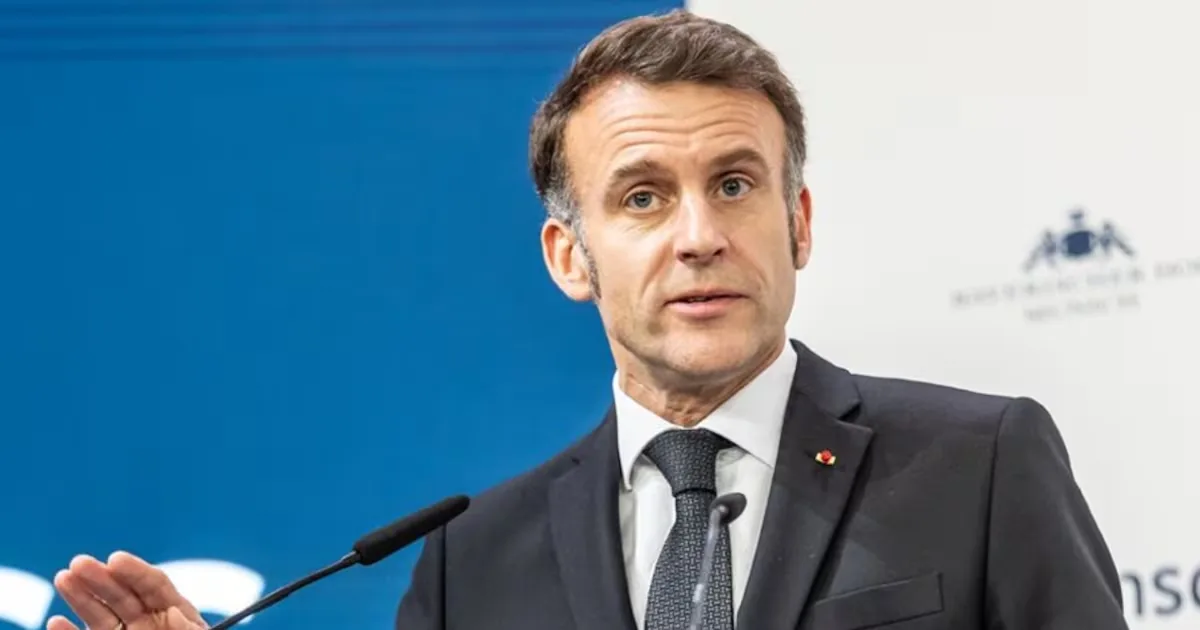
French President Emmanuel Macron announced on Friday that he has ordered the protection of the country’s critical infrastructure against drone attacks and cyberattacks. His statement came at a time when there has been an increase in drone incidents and suspicions of sabotage during the week.
“I have asked the government to prepare a plan to protect our critical infrastructure, as well as the most sensitive sites of our defense industrial and technological base, against drone attacks and cyberattacks. The Russian hybrid threat to Europeans and France has intensified,” said the president, who held a confidential meeting at the Élysée with the main candidates for the 2027 presidential election, dedicated to the deterioration of the international situation.
“No one is safe,” warned the president in a clear reference to the Russian threat. “We must all be alert, act, and do everything possible to anticipate, plan, and protect ourselves,” he insisted.
Russian hybrid attacks “will not go unanswered. It would be a mistake on Russia’s part to continue acting this way against Europeans.” The French president referred to the attempted drone attack at Leipzig airport in Germany in early August.
Macron warned that the situation is “serious” and that France is at a moment of “vigilance.” “The essence of deterrence is not to give visibility to what we will do. The intention behind this is to intimidate us and break the support effort for the Ukrainians. The consequence will be the opposite. We are not intimidated because we know that Ukraine’s security today and tomorrow is at stake,” he said.
Macron’s statements came a day after Polish Prime Minister Donald Tusk said—citing intelligence assessments—that Russia could launch “hybrid attacks with drones and missiles” against Poland and other NATO countries supporting Ukraine, presenting them as accidental.
In his address to Parliament on Thursday, Tusk stated that such attacks could be part of a Russian effort to test NATO’s resolve and sow doubt about whether the alliance would invoke Article 5, under which an attack against one member is considered an attack against all.
“According to intelligence assessments, Russia’s plan… includes hybrid attacks with drones and missiles against countries supporting Ukraine, including Poland,” Tusk said.
“These possibilities have been discussed for some time, but the information is now very consistent and, unfortunately, convincing,” he added.
Tusk said this was the most likely scenario he considered for the coming months, but not the only possible one. He did not reveal the identity of the intelligence services responsible for this assessment. However, a week earlier, he had stated that he had received a detailed report directly from CIA Director John Ratcliffe about possible events in the coming months.
The Polish prime minister did not specify whether Thursday’s warning was based on that report.
The United Kingdom has also raised alerts; the Chief of the British Defence Staff, Sir Richard Knighton, declared this week that the Russian threat means Britain is going through the “most dangerous” period of his 35-year military career. According to the BBC, work has begun on the so-called government “war book,” which has not been updated in decades.
“It’s not tanks you should worry about,” historian Margaret MacMillan, author of “The War: How Conflict Shaped Us,” told the BBC.
“It’s about cutting cables on the ocean floor. It’s about hacking systems on which so many things depend. The possibility of asymmetric warfare, cyber warfare, is growing by leaps and bounds.”
Europeans, especially the ruling elites of Western Europe, have succumbed to a “crisis of disbelief” lasting decades, said Andrew Michta, a Polish-American academic who is a professor of strategic studies at the Hamilton School of the University of Florida.
In his view, the UK, like many European nations, has very low levels of psychological preparedness and that authorities are not being honest about the threats ahead.
“The Germans have completely disarmed over the last 30 years. The UK is also largely disarmed and, more importantly, mentally. There is no preparation for what is happening because political elites do not address the public in a way that honestly reflects the seriousness of the situation,” Michta said.
Russian President Vladimir Putin has repeatedly said that Russia does not plan to attack Europe, but Foreign Minister Sergey Lavrov warned European nations not to send troops to Ukraine, which Russia would interpret as a declaration of war. “If Europe attacks Russia, it will be a completely different and very short war,” he said.
Read more Quito firefighters manage to control seven of nine forest fires recorded in the city
Hybrid war is a strategy that combines conventional military force with non-military methods such as cyberattacks, disinformation, and economic pressure.
Tusk’s warning came amid a series of Russian drone attacks near the Ukraine-Poland border in recent days.
Last Sunday, a Russian drone struck a passenger train near the Ukraine-Poland border, shortly after former British Prime Minister Boris Johnson and senior European security officials had passed through the same line.
Ukraine stated that all passengers had been evacuated minutes before the impact in Yahodyn, which hit the train’s locomotive.
Meanwhile, Polish fighter jets took off on Thursday after a Russian jet-powered drone approached the border during an attack in western Ukraine. The drone crashed or was shot down about 4 kilometers from Poland, according to preliminary information from the Polish army, cited by the Polish television portal TVP.
Tusk said a gas station near the Yahodyn-Dorohusk border crossing appeared to have been the target of the attack and that a “massive explosion” had been reported. The Polish army stated that no violation of Polish airspace had occurred.
Air raid sirens sounded in some areas of eastern Poland, while flights at Lublin and Rzeszów airports were temporarily suspended due to the activity of Polish military aircraft in the area.
The incident followed Russian drone attacks in the same border area on Sunday. One drone struck the locomotive of a passenger train covering the Kiev-Warsaw route, about 2 kilometers from Poland, while another hit a gas station near the Yahodyn-Dorohusk border crossing.
Meanwhile, Moldovan police found drone debris in a suburb of the capital, Chisinau. Residents reported hearing an explosion on the night of September 17 to 18. However, the Moldovan Ministry of Defense has stated that it recorded no airspace violations that night.
According to the Ukrainska Pavda newspaper portal, Russian attack missiles used to strike Ukraine regularly fly over Moldova. On the night of September 16 to 17, another drone crossed the country’s airspace and returned to Ukraine almost immediately.
On the other hand, Belarus began four-day military maneuvers on Wednesday near the Suwałki gap, on the border with Poland and Lithuania.
According to Radio Svaboda, the Belarusian service of Radio Free Europe, the exercises include training of mechanized and tank battalions in border protection, “counter-sabotage operations,” and defense against drone and light aircraft attacks, according to the Belarusian Ministry of Defense.
The exercises are being carried out partly near the Suwałki gap, a 104-kilometer stretch of the Polish-Lithuanian border that serves as the only land link between the Baltic states and the rest of NATO, and which separates Belarus from the Russian enclave of Kaliningrad.
Among the included locations are the Hoża training field, on the border with Lithuania, and the Brzeski and Różański ranges, located about 15 and 60 kilometers from the Polish border, respectively.
Amid this context, Ukraine reported that Russia was using Belarusian relay stations to guide drone attacks against targets in western Ukraine.
The Belarusian Ministry of Defense described the exercises as “purely defensive” and stated that the number of troops and equipment involved did not exceed the limits established by the 2011 Vienna Document, which requires prior notification to other States. No figures have been provided on the number of soldiers participating.
Belarus has been conducting maneuvers near NATO borders for years, often involving Russian forces.