





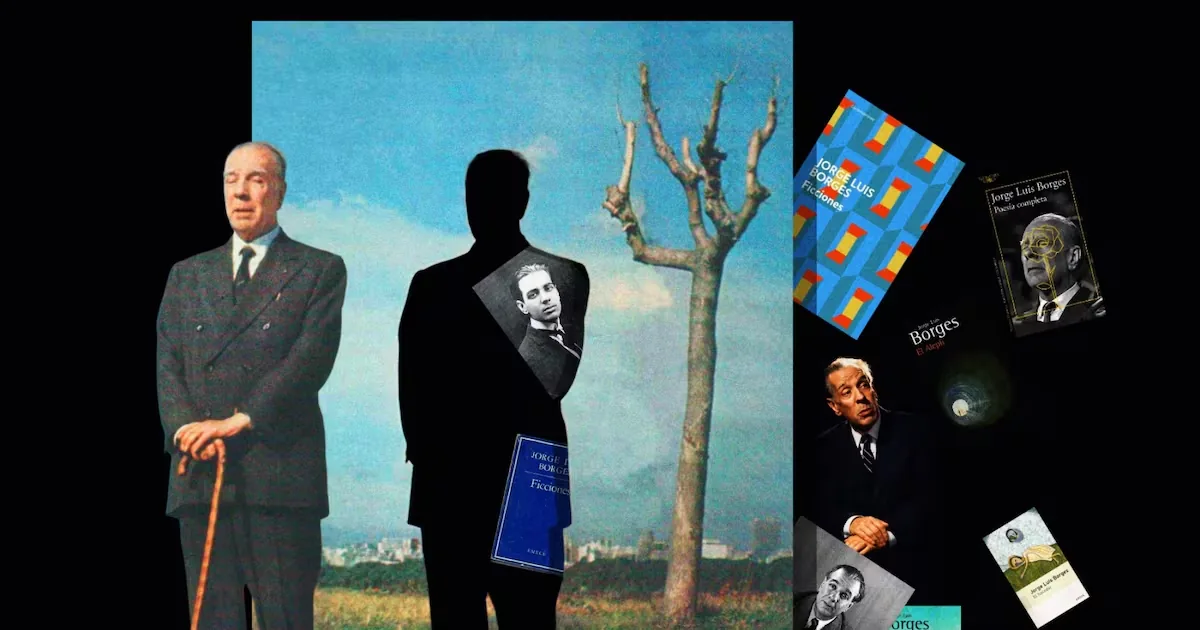
With a cup of coffee in hand, on the chilly Saturday, June 14, 1986, the then young poet Sergio Parra was moved when he turned on the dial to 93.3. “I found out on the radio. At that time we listened to La Cooperativa, where they announced the news that Jorge Luis Borges had died.”
Read more Explosion in building storing explosives leaves at least 45 dead in Myanmar
Having died at 86 years old in his residence in Geneva, Switzerland, where he lived with his wife, the translator María Kodama, a legend of American letters was bidding farewell, besides volumes like El Aleph or Ficciones. His death was a blow. The world already considered him a renowned author. For example, El País from Spain wrote: “Pulmonary emphysema extinguished yesterday, in Geneva, the life of the Argentine writer Jorge Luis Borges. The author of El Aleph and El libro de arena had moved three days earlier to his new apartment in this Swiss city, which he knew in his youth and which had been his residence for the last three months… Knowledgeable in several languages, with encyclopedic culture and blind for almost two decades, he recently married his secretary María Kodama. A towering figure of Latin American literature has died.”
“Jorge Luis Borges married María Kodama on April 26 after she had served as his secretary and guide for many years. Borges suffered from an almost total blindness, which had come slowly, as he said, in the form of a long sunset,” added the Spanish morning paper. “The Efe agency reports from Buenos Aires that his lawyer, Osvaldo Vidaurre, declared that the writer decided to settle in Geneva when he learned he had irreversible cancer and little time to live. ‘His last wish was to die and be buried in Geneva,’ he said. For just over a month no one had seen or been able to approach the writer, so it is presumed that during this period his condition worsened.” And, as usual in these cases, it included a biographical summary of the author.
The distinguished The New York Times also dedicated a note to the news. “Borges died of liver cancer, according to his estate executor Osvaldo Luis Vidaurre in Buenos Aires. Although he was almost unknown outside Argentina before 1961, his stories—meticulous in language and mysterious in their opaque paradoxes—later reached a modest group of followers in the United States, a readership base that steadily grew to international proportions. His writings explored the corners of the human psyche, the fantastic within the apparently mundane, imaginary bestiaries, and fables of dark libraries and arcane erudition. His prose stimulated the literary imagination of general readers, academics, and critics, and many hailed him as the most important Latin American writer of this century.”
In its note, the Times addressed a point that has always cast an uncomfortable shadow over Borges’s career: not having received the Nobel Prize in Literature. A phenomenon comparable to what currently happens with famous names like Haruki Murakami or Stephen King. “Although he was an eternal candidate for the Nobel Prize in Literature, it was denied to him. Perhaps it was a lesser concern for him than for others. After winning the prize in 1982, Colombian novelist Gabriel García Márquez said of Borges: ‘I hope he receives it, and I still don’t understand why they haven’t given it to him.’ Some have insisted that Borges’s aversion to politics, his reluctance to criticize the repression of post-Peronist regimes—‘I suppose they are a necessary evil for the next 50 years, more or less,’ he declared—prevented him from becoming a Nobel laureate.”
What does the archive say about this? A look at the online Nobel Prize registry—which makes records public only 50 years after each award—indicates that Borges was a candidate 38 times, between 1956 and 1974. In some years he was nominated by more than one person. The first time, his name was put forward by the French René Etiemble, an academic from the University of Montpellier. The last time, his name was nominated by 7 professors.
In any case, the NYT added about his last years: “Borges led a hermetic life, detached from the mundane. With an apparently fragile appearance in his later years, while leaning on a wooden cane shaped like vertebrae, he was courteous in his manners and speech. With blindness, he increasingly depended on assistants to read to him and to write what he dictated. Borges always wrote and read, and perhaps, in the end, the latter was paramount. ‘For me, reading has been a way of living,’ he once said. ‘I believe the only possible destiny for me was a literary life. I cannot imagine a world without books. I need books. They mean everything to me.’”
In Chile, in its Sunday, June 15, 1986 edition, La Tercera published a chronicle about the news: “Liver cancer ended the life of Jorge Luis Borges,” it headlined. It also included an interview with the Chilean writer and critic Edmundo Concha, who was his personal friend for 35 years. “In one of his letters, he told me, speaking about Chile: ‘You can’t imagine how pleasant it is to feel not so much applauded as understood.’ That was very important to him because he thought the role of a writer is to reveal reality to the reader. The affection from Chile pleased him, as happens to many Argentine writers who find here those who understand them, even more than in their own country.”
“He liked the people, the climate of Chile. He knew there were many readers for his level. He even found people who knew his texts by heart. He appreciated this a lot because he was of very high sensitivity and had a very fine sense of humor.”
At that time, Borges’s marriage to María Kodama in April 1986 had caused controversy. What shocked was the age difference: 86 and 41. However, Concha assured La Tercera that the woman “was not a recent apparition in Borges’s life,” and rather, she held a secondary place. “She was the very embodiment of feminine discretion; she always traveled with him but never appeared by his side when the spotlights were on. She did not attend events; he went alone.”
“Concha’s words are confirmed by Borges himself, who in 1976, while in Chile, referred to this woman, who was his secretary and through whose eyes he saw the world: ‘You notice María is here because you don’t feel her.’”
Concha was asked why Borges had not received the Nobel. He answered: “Very simple: for political reasons. What happens is that political opinions are guided by passion, and Borges should only be judged as a writer and criticized only if he writes badly.”
The La Tercera note also records the view of the respected critic Luis Sánchez Latorre (Filebo). “His work is so well known and disseminated, and it is because he had the genre of the great Writer. He never obtained the Nobel Prize like other geniuses he admired, such as James Joyce, Marcel Proust, Robert Musil, and Hermann Broch. Borges will be distinguished in this era for having been the most brilliant of all writers, and without the Nobel Prize, his work will be exalted even more; precisely, he will be considered the case of Supreme Injustice regarding the recognition of the values of the spirit of our time.”
Chilean writers were consulted in June 1986 and reacted to Borges’s death. The first to respond to La Tercera was Enrique Lafourcade. “The writer Enrique Lafourcade showed himself shocked and moved, stating that Borges’s death is an ‘irreparable loss for world literature,’ who deserved the Nobel Prize, to which he was nominated many times and never awarded.”
On the other hand, Roque Esteban Scarpa also reacted. “‘As a loss for Hispanic letters,’ said the writer and 1980 National Literature Prize winner Roque Esteban Scarpa, regarding the sudden death of Jorge Luis Borges. The member of the Chilean Language Academy added that ‘it affects us very painfully because Jorge Luis Borges was an honorary member of our entity.’ He highlighted the great qualities of the deceased as a writer, poet, and narrator, indicating that he was ‘painfully surprised’ by the news. He added that although Jorge Luis Borges had never been awarded the Nobel Prize in Literature, it was no less true that he had received all the greatest existing awards today, in merit and recognition of his outstanding contribution to Hispanic letters.”
The newspaper La Nación also carried the news on one of its pages. “The death of the author of Ficciones occurred at 07:45 local time (02:45 Chilean time) at the Geneva cantonal hospital, where he had been admitted for several days under a false name to avoid the press siege. The news of his death was officially confirmed by the mayor of Geneva, Robert Vieux, who specified that the cause of death was cardiorespiratory arrest caused by lung cancer that had afflicted him for several months and had spread recently. At the time of his death, the acclaimed writer was accompanied by his wife, María Kodama, with whom he had married by proxy in Paraguay on April 26, after a relationship of more than thirty years as secretary, guide, and literary collaborator.”
Additionally, La Nación recorded more reactions, such as that of writer Arturo Aldunate Phillips, National Literature Prize winner: “It is an irreparable loss. Borges was not only a genius of letters but a man of astonishing culture and unique lucidity. I had the fortune to share with him during his visits to Chile and was always impressed by his simplicity despite his immense wisdom. Spanish-language literature loses its greatest contemporary exponent. His work will remain a monument to human intelligence.”
Read more Meteor explodes over the United States: released energy close to 300 tons of TNT
Even the then Argentine president, Raúl Alfonsín, was shaken by the news. La Tercera’s note indicates: “President Raúl Alfonsín received the news of Jorge Luis Borges’s death with emotion, being informed at his residence in Olivos. This was communicated to EFE by Mario Quiñones from the Public Information Secretariat, who added that President Alfonsín immediately sent his condolences to María Kodama, widow of the greatest Argentine writer of all time. Raúl Alfonsín ordered the Argentine Foreign Ministry to send a wreath with the blue and white colors of the Argentine flag to the place where the body is located. An official statement regarding Borges’s passing will be issued in the coming hours.”
That Borges died in Geneva was no coincidence; he had chosen it because of his own past. In a 1981 interview with the New York Times, he explained why: “In a way, I am Swiss; I spent my adolescence in Geneva. We went to Europe in 1914. We were so ignorant that we didn’t know that was the year of the First World War. We got stuck in Geneva. The rest of Europe was at war. From my Geneva adolescence, I still have a very good friend, Dr. Simon Ishvinski. The Swiss are very reserved people. I had three friends: Simon Ishvinski, Slatkin, and Maurice Abramowicz, a poet