



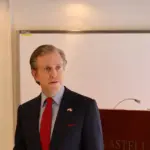




Mois Navon grew up as an American-Israeli child in California and only after becoming a prominent engineer – working at NASA’s Jet Propulsion Laboratory and IBM – did he discover a religious vocation that led him to study until he was ordained as a rabbi. However, he never abandoned his development as an engineer: his doctoral thesis in Philosophy was titled “The moral status of artificial intelligence: a Jewish ethical perspective.”
In Israel, he founded the company Mobileye, where together with his team he designed the EyeQ chip family, which today supports a significant part of the assistance and autonomous driving systems on the market (Intel acquired Mobileye in 2017 for US$15.3 billion, the largest tech sale in Israel’s history). Navon was also one of the minds behind Mobileye’s RSS (Responsibility-Sensitive Safety) model, the mathematical framework that defines when an autonomous vehicle is “responsible” for an accident.
Currently, Navon – who was in Santiago this week to give the talk Ethics and Artificial Intelligence: when technology begins to decide, at the Universidad del Desarrollo – teaches ethics and artificial intelligence at Ben-Gurion University and advises the Israeli Ministry of Innovation, Science and Technology on AI policies.
With such a curriculum, it was logical that the AI giant Anthropic called him early this year as part of a panel of experts from different religions to advise the company in formulating the so-called “Claude constitution,” to endow its AI model with something akin to morality.
His circle in the history of AI is even more complete if one considers that it was precisely with autonomous driving that the industry began to call on philosophers to resolve issues such as updating the “trolley problem” to address questions like whom an autonomous car “would decide” to save when faced with the possibility of harming pedestrians or passengers in certain hypothetical situations.
You have said that the “trolley problem” is just a rhetorical exercise, since in practice cars are not faced with decisions like that. But autonomous weapons in war are a reality. Anthropic precisely confronted the U.S. government by refusing to allow its models to be used for that (unlike OpenAI and Google). What is your position on this?
Well, I have written about autonomous weapons for war and police use. I think they should be used in both cases, provided there are limits. The world wants to ban them, but I don’t think that is necessary. Their prohibition has been proposed on the grounds of human dignity. It is argued that the fact that a machine decides to kill someone constitutes a violation: we are not respecting the human being, and only a human being can kill another human being. I, on the other hand, believe that the definition of human dignity varies depending on whether it is the market or the battlefield. On the battlefield — where the law of kill or be killed prevails — I see no difference between the action being carried out by a machine, a Tomahawk missile, or someone armed with sticks and stones. It is a different world and I do not consider it a violation of human dignity, which on the battlefield is about courage, defending your country, and being willing to sacrifice your life; I am not talking about torture or abuse, but simply that if there is a war, there is a war. And autonomous weapons will make war cleaner, faster, and more efficient. If we can get soldiers off the battlefield, it is much better for the world, right? There are all kinds of arguments against it, such as that countries will go to war because they have nothing to sacrifice, but I don’t think that is a valid argument against it. Now, I must clarify that autonomous weapons are already used today, for example, in Israel, where a human is kept in the decision process; that is, a human is the one who pulls the trigger, while machines go out to find targets. In Ukraine, on the other hand, machines go out, locate, and kill. I believe they are morally acceptable. I also believe that the police, within certain limits, can use them if they are defending the population. I consider human dignity a value we must take into account, but human life is also a value, and if the police protect human life, that prevails over the dignity of criminals.
Read more Anthropic dismantles an AI campaign to influence public opinion on the Sudan war
I suppose the moral question, both today and in the past, remains how moral the human decision behind it is, right? Not the tool used…
Yes, I think that is a good distinction. If we talk about going to war…, there is what is called, in just war theory, jus ad bellum, which is the justification to start the war; then there is jus in bello, which refers to the justification of actions during the conflict, and finally jus post bellum, which deals with how to decide to end the war. So, even if you comply with all the rules during the conflict, if there is no justification to start the war, then it does not matter that you acted correctly; simply, you should not be there. I think that is precisely it: there must be a justification to go to war. If we decide yes, that we must defend ourselves because we have been attacked, as happened in Israel, then there is a justification for war and we can carry out the necessary actions respecting the rules of war. If there is a justification to go to war, I consider the use of autonomous weapons morally acceptable.
Have you had any trouble explaining this by reconciling your religious beliefs with your perspective as an engineer?
No. If I understand the question well… Look, especially when I talk about it, I try to see what I consider right, what is the morally appropriate action. A good example is the debate about Claude, or about how to endow Claude with morality. It could be said that I have a concrete worldview and, therefore, I believe we should promote technology. It is very rare that I advocate banning something, because I am a technological optimist and I believe technology has advanced society. We live like kings thanks to technological development. So I would not want to stop that. On the other hand, there must be certain limits, such as what happens with deepfakes. But I think Claude, and language models in general, provide a great service and help people, although they require a framework of action, and I try to establish that framework within the technological field. We must regulate them. I think they should not be so close, I consider it necessary to limit their use, who uses them, etc. The same goes for autonomous weapons: I think they should be regulated, not banned. Those intuitions come from my ethical and religious training. One thing I consider important is that what makes my arguments unique is that I incorporate biblical and Jewish paradigms, but I present them from a philosophical logic. That is, I do not just say: “God says so.” Rather, I propose: “Look, there is this story; let’s analyze what it tries to teach us and how we can apply it. Does it make sense?” I apply the same approach when I argue about autonomous weapons. In Jewish literature, there is a distinction between the rules of war and the rules of the market. I try to argue that it is logical to consider that these are two different worlds. I can also argue that loving your neighbor, being kind to people, and all that are attitudes that on the battlefield would cost you your life. You don’t have to believe in God to understand it; it is something Jewish thinkers have been pointing out for a thousand years. So I take those ideas, that thought, and that conceptual framework, but I make them compatible not only for a Christian but even for a Nazi, you know? Those are, in a way, my sources of ideas.
You say you are a technological optimist, are you equally optimistic about humanity?
I remain optimistic that we do not want to self-destruct. Regarding these existential threats, the alignment problem, the idea that machines will take control, I share the opinion of people like Yann LeCun or Bill Gates, who are more optimistic and believe we will manage to maintain control, use technology, and give it the right focus. That is, we had nuclear weapons and were able to contain them. I think, ultimately, humanity will manage to contain this technology.
Read more The group of writers going to Germany to prepare Chile as Guest of the Frankfurt Book Fair 2027