




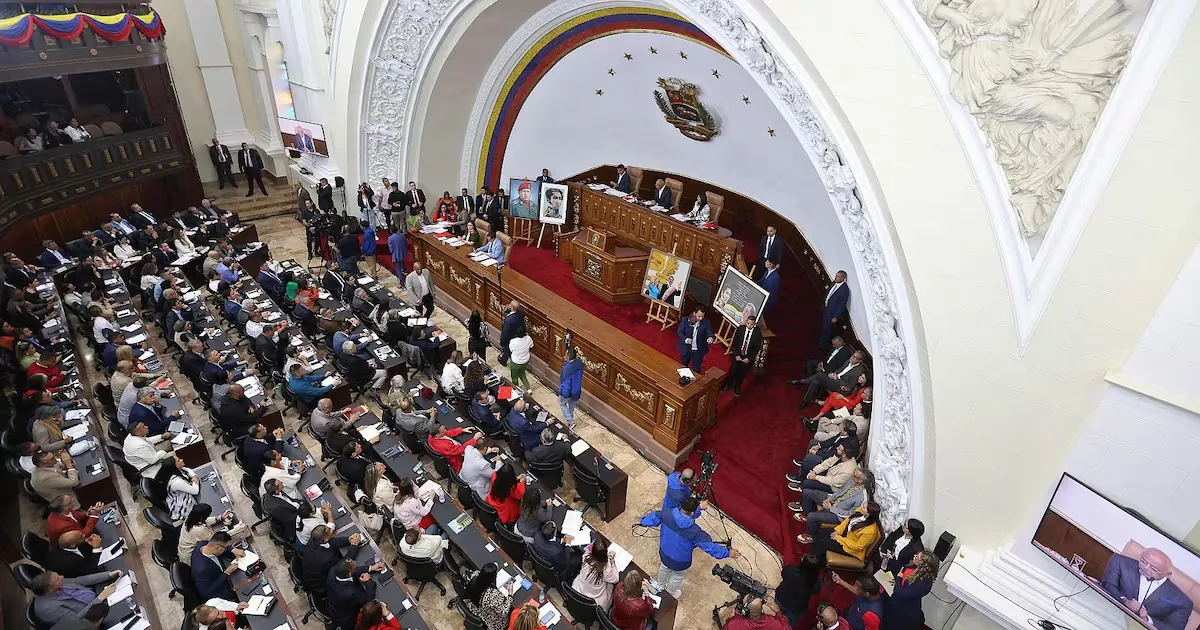
Phase 2 begins in August. Together with the opposition, this Tuesday the Venezuelan National Assembly announced a joint ‘roadmap’ with the opposition aimed at the reconstruction of the Latin American country after the double earthquake on June 24. This is part of a plan involving members of the parallel opposition Parliament established in 2015.
“Within the framework of the call for national unity to face together the consequences of the seismic doublet that mourns us, and for the strengthening of democracy, we announce the start of a joint working plan with former members of the 2015-2020 National Assembly starting next August 1,” stated the current Parliament, chaired by Jorge Rodríguez, in a communiqué.
According to this communiqué, the “unanimous international support” to the Venezuelan people and the Government “to face the tragedy” demonstrated that “only in unity” can progress be made “in reconstruction and in maintaining peace.”
From the 2015 opposition Parliament, which ran parallel to the chavista one, this joint work agenda was confirmed in a communiqué, seeking to “promote stability, democracy, and national recovery, constituting the beginning of the construction of a new stage that will lead to a Venezuela of progress and freedoms.”
In this regard, the communiqué notes that the support of countries like the United States shows that Venezuela “is not alone.” “We reaffirm our commitment to continue advancing on this roadmap through technical and institutional work to contribute to the country’s reconstruction,” it states.
Former opposition deputy Dinorah Figuera, who replaced Juan Guaidó as President of the opposition Assembly, affirmed on her social media that she assumes “the commitment and political will to promote a bilateral technical and political roadmap.” The idea, says the 2015 AN parliamentarian, is to support “a work agenda with concrete objectives and milestones that allows addressing the fundamental issues to consolidate the path towards the recovery of democracy in Venezuela.” “We raise the flags of faith and hope,” they say, without giving further details.
The announcement was reposted on X by Marco Rubio, the U.S. Secretary of State, and marks the entry into “phase 2” of the three phases in which Washington intends to carry out a democratic transition in Venezuela. Seven months after Nicolás Maduro’s capture, the chavismo “of the Rodríguez” and the opposition, although without María Corina Machado’s participation, will negotiate reforms for a fair and democratic transition.
This communiqué contrasts with what Jorge Rodríguez, head of the current AN, had been repeating amid the post-earthquake reconstruction process in the country. At that time, he assured that it was not the time to talk about elections or negotiations.
Now, shortly after opposition member Figueroa’s announcement, Rodríguez was forced to backtrack: “We announce the start of a joint working plan with former members of the 2015-2020 AN… The unanimous international support to our people and the national government to face the tragedy highlights that only in unity can we advance in reconstruction and maintaining peace.”
Former opposition deputy José Simón Calzadilla, secretary general of the Movement for Venezuela, values the initiative: “Positive, after the earthquake the disastrous institutional situation of the country and its immense weakness became evident. More than 6 months after January 3, real changes must begin to be seen that undoubtedly demonstrate that we are entering the stage of reinstitutionalization and recovery of the country.”
The two opposing readings contrast “the call for national unity” from chavismo, compared to the “agenda that will prioritize strengthening democratic institutions, the electoral system, and the restoration of guarantees for political participation,” seen by the opposition. The latter is supported by Marco Rubio.
At the center of the discussion is the election of a new Supreme Court of Justice (TSJ), which has been pursuing the opposition in recent years, and a new National Electoral Council (CNE), which would pave the way for an electoral schedule.
The 2015 National Assembly thanked the U.S. Embassy in Venezuela for its support to the Venezuelan people. This, considering that the roadmap is framed in the context of the double earthquake on June 24, which left more than 4,560 dead and 16,740 injured.
For his part, Calzadilla has faith in the process. “May the reinstitutionalization, recovery, and significant improvement of the country’s economic situation continue to progress progressively and steadily, as well as the effective solution for the victims and others affected by the earthquake,” he told La Tercera.
Read more Koke Núñez and Entremares ignite the scene with “A Besitos,” their new romantic northern cumbia