






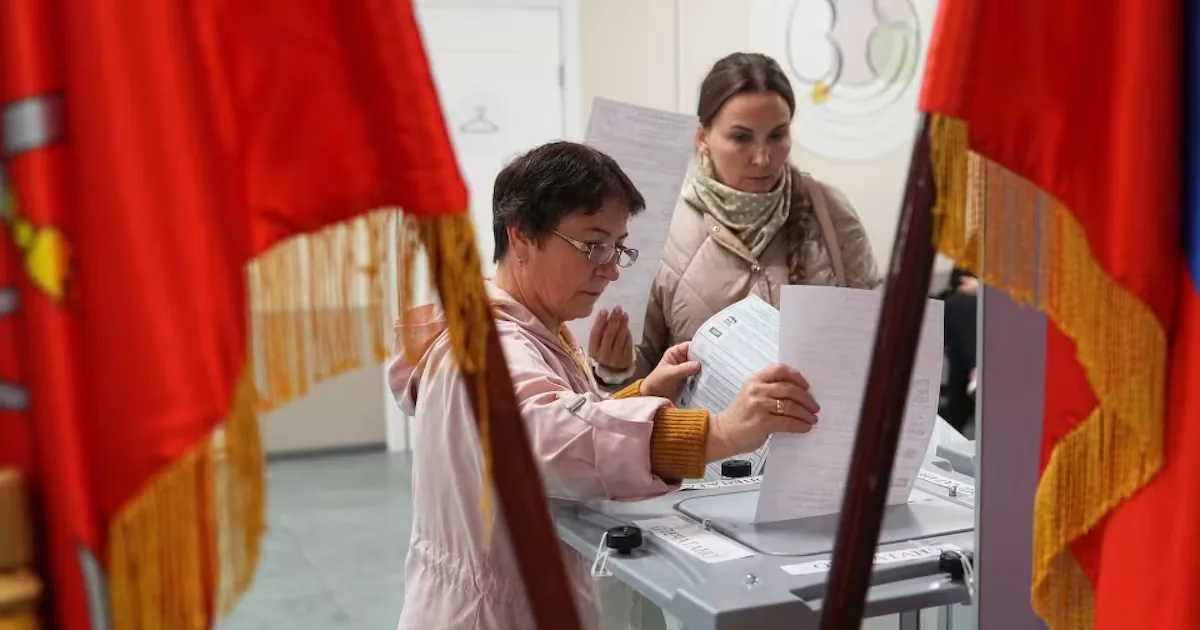
Russians began three days of voting on Friday in the country’s first parliamentary elections during wartime, which practically have no opposition and will almost certainly ensure the Kremlin’s political dominance.
Authorities extended the election period over the weekend, until Sunday, aiming to increase participation among the 111 million eligible voters, and even allowed electronic voting. According to the Central Election Commission, turnout was around 30% by Friday night, including online voting.
Voters cast two separate ballots, covering half of the 450 seats in the Duma by selecting political parties listed on the ballot. The rest are contested in single-member constituencies, where voters choose individual candidates.
This time, the presidential administration reduced to sixteen the number of districts that, in practice, will be ceded to the opposition within the system. These parties, in turn, have refrained from presenting some strong candidates who won in the 2021 elections. Considering the administrative resources at its disposal, United Russia is likely to win more than 200 single-member seats (it won 198 in 2021).
The Carnegie Center indicated that the rest of the seats United Russia needs can be won through the party list system; it would only need about 40% of the votes. The political bloc can achieve this by mobilizing voters who depend on the state for their livelihood.
The Kremlin intends for the parliamentary elections—the first since the start of the large-scale invasion of Ukraine in 2022—to reaffirm popular support for the war and give an appearance of legitimacy to its actions. To avoid any political risk, it has tried to suppress even the slightest hint of dissent.
“Your choice and determination will once again demonstrate that millions of people support our fighters, that we are a united people, bound by shared values, historical memory, and love for the homeland,” President Vladimir Putin told the country before the vote.
There is little doubt about the overall outcome of the elections, as the Kremlin has maintained tight control over the electoral campaign. The ruling United Russia party, which presents itself as Putin’s party, has no realistic prospects of losing the majority it has held in the State Duma for 23 years.
Five weeks before the vote, the country’s Supreme Court excluded Yabloko (which means apple in Russian), the only pacifist party, from the electoral list, mainly due to alleged copyright violations during the campaign. “Even in a matter as controlled and manipulated as Russian elections, the Kremlin clearly does not want to take risks,” said Alexandra Prokopenko, a researcher at the Carnegie Center, in a column published by The New York Times.
Read more Kylian Mbappé parts ways with Nike and signs for the brand of Roger Federer and Thierry Henry
“Nevertheless, the elections will serve as an indicator of public mood at a time when ordinary Russians increasingly feel the economic and social consequences of the war that Putin has been waging for years in Ukraine,” she added.
“Putin has outlawed the opposition, repressed dissent, and forced countless citizens into exile. For the elite, it has been a hard blow. While it is true that they had lost their ability to influence politics long before 2022, they still retained room to maneuver, the means to accumulate wealth, and fundamentally, the freedom to emigrate. Now, that room has practically disappeared. Putin has absolute control,” she warned.
The independent media outlet Meduza noted that Putin voted online on Friday. His personal reporter, Pavel Zarubin, showed him squinting at his monitor and then saying “Thank you” to his computer. The outlet (which operates from Latvia because it was declared a foreign agent) recalled that “Putin barely knows how to use the internet.” Meanwhile, social media users noticed that the Windows operating system on his computer was not activated, meaning it did not have a Microsoft license.
Meduza also indicated that public sector employees were being mass-driven to the District Election Commission, just as they were previously driven to polling stations. The Altai Regional Committee of the Communist Party of the Russian Federation has threatened to reject the results of online voting, alleging that people are being forced, under threat of dismissal, not only to participate in the elections but also to vote for specific candidates.
The elections were held after a summer marked by long-range drone attacks by Ukraine against oil refineries, which triggered a severe fuel crisis. Warehouses belonging to the popular e-commerce companies Wildberries and Ozon were also attacked. The damage worsened the problems of the Russian economy and brought the war closer to millions of people.
In Sochi, a Russian resort city on the Black Sea coast, polling stations were briefly closed due to the threat of a drone attack, according to local authorities. A polling station in the Krasnodar region had to be relocated after a drone broke the windows, said Ella Pamfilova, chairwoman of the Central Election Commission.
For the first time, parliamentary elections include residents of four Ukrainian regions occupied by Russia and not yet fully controlled. Voting is also taking place in Crimea, the Black Sea peninsula that Russia occupied in 2014.
In this regard, Meduza indicated that in Donetsk “supposedly 75% of its voters—over a million people—voted early.” “This sounds unrealistic, even considering that they had to vote under the threat of machine guns,” the portal said.