







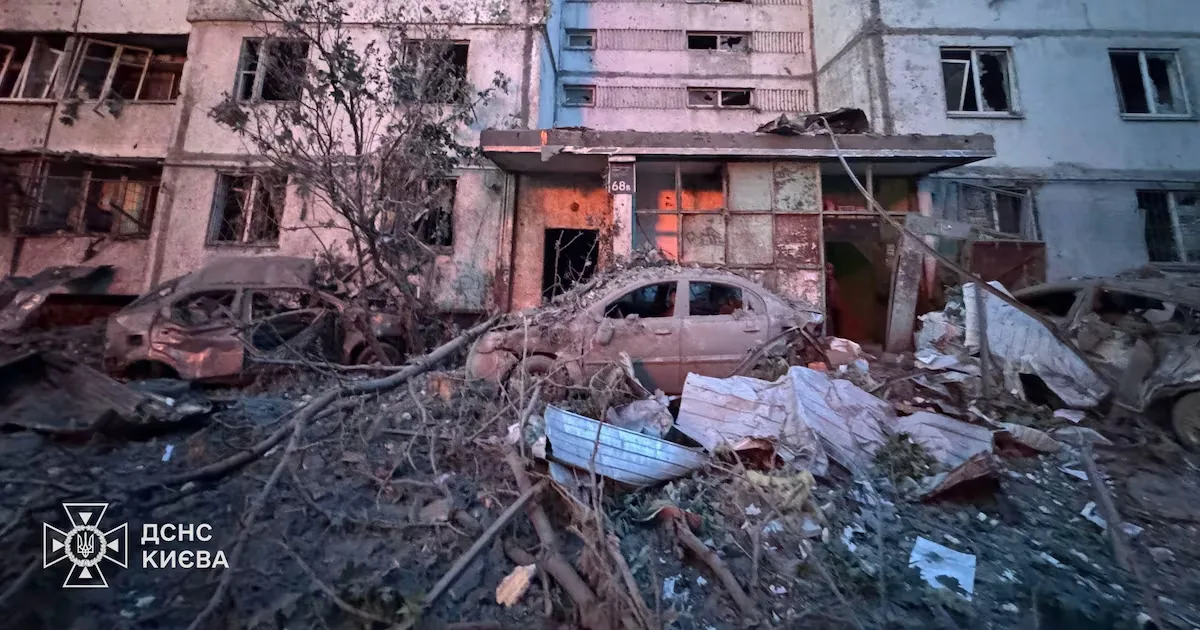
More than a week after Russia warned of an attack on Kyiv that would be so large that diplomats and other foreigners should flee, Moscow finally struck in the early hours of Tuesday. Its forces launched hundreds of drones and dozens of missiles against the capital and other cities in Ukraine, leaving at least 22 dead and more than a hundred injured, local authorities said.
“Sixteen people died (including two children) and 42 were injured. Search and rescue operations concluded in the residential neighborhood of Dnipro, attacked with Russian missiles during the night,” detailed the head of the Dnipropetrovsk Regional Military Administration, Oleksandr Ganzha, via Telegram, reported Ukrinform. Among the injured are four children. Three of them remain hospitalized, along with 21 adults.
Likewise, the consequences of the Russian night attack were confirmed in four districts of the Kyiv region, with the Bucha district suffering the most damage. Ukrinform reported six dead and 90 injured in Kyiv as a result of the massive attack carried out by Russia.
In total, 88 facilities across the region were damaged, including private houses, apartment buildings, warehouses, and logistics facilities, as well as around 50 vehicles. Additionally, 11 educational institutions in the Podilskyi, Solomianskyi, and Sviatoshynskyi districts of Kyiv were damaged.
“Since early morning, emergency services have been working at all affected sites. Inspections of the areas, damage assessments, and efforts to mitigate the consequences of the enemy attack continue. All necessary assistance is being provided to people whose property was damaged,” said the head of the Kyiv Regional Military Administration, Mykola Kalashnyk.
He also noted that during the latest attack, interceptor drone crews managed to destroy nearly 100 Russian drones near the region. Kyiv’s Armed Forces claim to have shot down 40 missiles.
In total, Russia launched 656 drones and 73 missiles—including 33 Iskander-M ballistic rockets—in the nighttime wave of attacks, according to the Ukrainian Air Force, which reported that 33 missiles hit their targets, impacting key civilian infrastructure.
Russia fired eight of its advanced Zircon hypersonic missiles at Ukraine, but none of them could be intercepted. Experts have previously told CNN that Zircon missiles are almost impossible to shoot down. Analysts said the Russian attacks were partly aimed at depleting Ukraine’s limited reserves of Patriot interceptor missiles, its only proven defense against Russian ballistic weapons. The main targets of the attack were Kyiv, Dnipro, Kharkiv, Zaporizhzhia, and Poltava, according to the Air Force statement.
In a statement released via Telegram, the Russian Ministry of Defense said its “massive attack” targeted Ukrainian defense, military, fuel, and transport facilities in several key regions, employing “long-range precision-guided weapons launched from air, land, and sea, including hypersonic aerobalistic missiles and unmanned aerial vehicles.”
“Russia once again demonstrates that its goal is to terrorize the civilian population,” said Ukraine’s Prime Minister, Yulia Svyrydenko. “These are deliberate attacks against residential areas, hospitals, schools, and critical and civilian infrastructure.”
“Intelligence alerts about Russian attacks remain in effect. A massive attack is possible,” warned Ukrainian President Volodymyr Zelensky the day before in a recorded speech.
In the northeastern Kharkiv region, Russian drones and missiles caused 10 injuries, including a child, according to Mayor Ihor Terekhov on Telegram. In the Chernihiv region, bordering Belarus, another minor was injured and an institute was hit, while in neighboring Sumy, in the northwest of the country, at least two people were injured, according to the Ukrainian Emergency Service.
In Kyiv alone, more than 41,000 residents sought shelter in underground stations, Kyiv Metro authorities reported. This figure marked the highest number of people seeking refuge in the metro during a nighttime air raid alert in recent years, reflecting the scale of the bombing campaign, CNN reported.
The bombing in Kyiv was similar in scale to two other attacks last month, The New York Times indicated. Moscow has continued its air campaign against the capital even as the Russian army goes through its worst period in years on the front line in terms of territory gained.
What seemed different in the latest attack on Kyiv was the psychological element. Last month, the Russian Foreign Ministry warned it would retaliate for what Russian officials said was a Ukrainian drone attack on a dormitory in the Luhansk region in eastern Ukraine, controlled by Russia, in which 21 students aged 18 to 23 died.
“Kyiv’s leadership has decided to open a new chapter in its crimes and add a new dimension to the conflict as a whole. Well, that is their decision,” Russian President Vladimir Putin said on Monday, trying to exploit that episode to continue his bloodbath in Ukraine. On one hand, appealing to emotion when speaking of “children” instead of young people. On the other, ignoring that his war is a greater tragedy, highlighted the newspaper El País.
On Tuesday, Moscow spokesman Dmitry Peskov insisted on the topic, warning that the recent Ukrainian attack on a university center in Starobilsk, in the occupied Luhansk province, “is a completely different paradigm” of this phase of the conflict, which has now lasted four and a half years.
Peskov pointed out that this “deliberate, inhuman terrorist attack against civilians” is a step further in the course of this war and emphasized that Ukraine was aware that those facilities were not a military target. “We are talking about a school that was never a military facility. It was never related to military matters. There were always young people, children, studying at that institution (…) the Ukrainian regime knew this very well,” Peskov denounced in statements to the media, according to Russian agencies.
After Russia threatened another large attack on Kyiv, even against “decision-making centers,” and asked foreigners to evacuate the country, Western envoys joined the Ukrainian government and said they would stay and not give in to intimidation tactics.
However, Moscow’s warnings and the long time before Russia actually attacked affected Kyiv residents. For days, Russia launched planes simulating a large attack, which triggered alarms and caused exhaustion among the population, according to The Times.
Many families ended up sleeping in the Kyiv metro and parking lots for several nights. On Tuesday morning, when the first Russian drones crossed the border into Ukraine, shelters were full, something less common than at the start of the war, as people had become accustomed to the threat of Russian attacks. Those who arrived in the middle of the night, after the first missile warnings, struggled to find a place to lie down, the newspaper detailed.
Mykhailo Samus, director of the independent New Geopolitics Research Network in Kyiv, said one of the most important aspects of this wave of Russian threats and attacks was “the cognitive component.” He added that this involves “changing the psychological state of Ukrainians and forcing them to take to the streets” to demand an end to the war.
Read more Government of Peru announces that Pope Leo XIV will visit three cities in the country in November
Ukrainian President Volodymyr Zelensky said one of the key targets for future Russian military, political, and propaganda attacks could be Ukrainian companies involved in missile technology development.
“Report from the head of Ukraine’s Defense Intelligence, Oleh Ivashchenko. It contains details about missile production in Russia: facilities, distances, quantities, supply routes for critical components and machinery, as well as information about people and companies from other countries helping Russia evade sanctions. We are preparing updates to our countermeasures, both Ukrainian and coordinated with our partners. It is essential that pressure on Russia continues to increase,” Zelensky wrote on his Telegram account.
“Russia considers this a strategic threat: Ukraine’s ability to develop its own ballistic system and produce local missile defense. We will respond,” he added.
According to CNN, Moscow launched the offensive in response to threats of increased aggression, citing a wave of almost daily Ukrainian attacks on Russian oil assets that have depleted fuel reserves and worsened economic difficulties. Last month, the Kremlin warned of “consistent and systematic attacks” on “specific sites” in Ukraine, leading Kyiv to reject “Russian blackmail and threats.”
Between January and May, Ukrainian troops attacked 15 Russian oil refineries, disabling 40% of Russia’s main refining capacity, President Zelensky said on Monday.
In fact, the Ilsky refinery, located in Russia’s Krasnodar region, suffered a fire on Tuesday due to a drone attack by the Ukrainian Army, local authorities confirmed, with no immediate reports of casualties or material damage.
The Russian Ministry of Defense specified that in recent hours, 148 Ukrainian drones have been shot down in the Belgorod, Bryansk, Volgograd, Kursk, Oryol, Rostov, Smolensk, and Krasnodar regions, as well as over the waters of the Sea of Azov and the Black Sea, and in the Crimean peninsula, annexed by Moscow in 2014.
Despite Tuesday’s massacre, Ukraine’s Foreign Minister Andrii Sybiha said the attack showed that “Moscow is losing on the battlefield. No number of missiles can change that.”
According to The New York Times, Ukraine has seemed to take the lead in the war in recent weeks, as peace talks have stalled. Ukrainian forces have increasingly attacked Russian oil facilities and even cities like Moscow with long-range drones. The front line remains largely frozen, as drones hinder movement on both sides, and Russia’s expected spring offensive has yet to materialize.
While Russia continues attacking Ukrainian cities from the air, U.S. Secretary of Defense Pete Hegseth told the press on Friday that the United States “will find a way” to help Ukraine defend itself but did not offer specific details.
Ukrainian analysts point out that Russia also has limitations on the number of weapons it can deploy. Moscow spaced its last three attacks on Kyiv about ten days apart, allowing for resupply. And despite Russian rhetoric, Tuesday’s attack was not larger than previous ones.
“At first glance, it is clear that Russia does not have enough missiles and drones to sustain massive attacks, at least in a short period,” said Vitalii Portnikov, a Ukrainian political analyst, in statements to The Times.
Lara Jakes, who covers defense and European diplomacy for the U.S. newspaper, wrote: “The show of force Russia deployed over Ukraine early Tuesday, with hundreds of drones and missiles, cannot hide Moscow’s growing signs of weakness in the war that has lasted four years.”
Russia’s advance in Ukraine has almost completely slowed. It has intensified forced mobilization in eastern Ukraine, occupied territory, after the failure of its internal recruitment efforts. Internal discontent is growing, and Europe is providing new support to Ukraine. U.S.-mediated peace talks have practically ended.
According to analysts, all this translates into a loss of momentum for Russia. “Ukraine’s position is much more formidable now than just a year ago,” said Franz-Stefan Gady, a Vienna-based military analyst, in an interview on Tuesday.
Some analysts believe Russia’s recent more intense attacks are an attempt to regain leverage in possible peace talks and to influence the Donald Trump administration, which has focused more on the Iran war than on Ukraine.
However, Ukraine’s advances on the battlefield have changed the course of the war, wrote Jack Watling, senior researcher at the Royal United Services Institute, a think tank based in London, this week.
“In Kyiv, optimism is growing that Ukraine can achieve a ceasefire with Russia,” Watling wrote in an analysis for Foreign Affairs. He added that while “drone attacks and bombings remain constant, Russia’s military performance is declining.”
And in another setback for Russia, Hungary has signaled it will abandon its long-standing opposition to Ukraine’s application to join the European Union, allowing it, along with Moldova, to begin formal negotiations to join the bloc in the coming days, four diplomats told the European edition of Politico.
The opening of the first negotiation group—a formal step on the path to accession—is scheduled for June 15 during an intergovernmental conference in Luxembourg, according to three of the diplomats. Kyiv and Chisinau applied for EU membership simultaneously, meaning Moldova’s application can only progress if Ukraine’s does as well.
Read more Let’s talk about love: the demands of school have me overwhelmed