





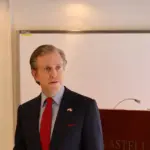




Vanessa Lista arrived in Santiago to speak this Thursday at the Cyber Defence, Technological Sovereignty & Resilience Summit 2026, organized by CiberLab, del Centro de Innovación UC. An Italian based in Denmark, she is Director of Alliances and Public Affairs at Digital Hub Denmark, the national-scale platform that connects the Danish public and private ecosystem with governments worldwide interested in its digitalization process.
Read more The death toll rises to 95 and 600 are missing due to floods in northern Nepal
The organization’s work is significant, as the UN has positioned Danish digitalization as the most advanced on the planet in terms of public administration. At the same time, it ranks among the top places on the list according to other institutions.
In an interview with La Tercera, before her participation in the event, Lista detailed how this system was built over nearly six decades and what lessons could be useful for Chile and the rest of Latin America.
What does the Danish digitalization process consist of?
Digital Hub Denmark is the national public-private alliance for digitalization. The Danish government has five such alliances, organized by industry: health, energy, agriculture, creative industries, and public administration digitalization.
Other areas – such as defense – do not yet have their own, but the latest government report, from June, shows a strong investment in the area, and our work is also moving towards digital defense and cybersecurity. That’s why, among other things, I am in Chile.
My role in the organization has two fronts. Connecting the Danish ecosystem, public and private, with foreign governments interested in our experience – we receive between 70 and 100 delegations a year – and working with 10 private Danish companies that are partners of the hub.
Denmark operates under a public-private logic in all its sectors, because we believe that innovation is driven by private enterprise. This does not mean “selling” our model, but rather helping other governments identify which parts of our digital journey can serve them. The UN ranked us as the number one country in the world for public administration digitalization.
How does this digitalization translate into the daily life of a Danish citizen?
We have access to 2,000 online services with the central person registry and the creation of the CPR, our social security number. Without it, one cannot exist as a citizen in Denmark.
Added to this is the digital identity, currently in its third version, and this year piloting its fourth version, which includes a digital wallet. With the CPR and digital identity, everything is accessible. From applying for benefits to paying public transport, carrying out banking transactions or requesting medical appointments, all centralized in a single portal.
Added to this is “digital mail”: physical communication between the State and citizens no longer exists. By the end of 2025, the national postal system ceased to operate as a public entity. Everything that the government, at all its levels, and banks need to communicate to us now arrives in a single digital inbox, connected to the CPR and digital identity. This is a topic we have discussed with interest, thinking about how it could be applied in Chile.
You have insisted that Denmark is not looking to “sell” its model. What is it looking for then?
We seek to inspire. We believe that if we all move in the same direction, it is better for everyone. Today, for example, we are working on a cross-border digital identity for all of Europe
That logic, thinking first about the benefit for people, has been at the core of the Danish process since the early 2000s, when different levels of government sat down to work together.
Of course, we are not naive. There is also a commercial interest, because the Ministry of Foreign Affairs supports the export of our companies. But in public digitalization, it is difficult for a foreign company to enter another country alone. What opens up is the opportunity for local firms to partner with Danish technology providers to build tailor-made solutions for each country.
What factors prompted the government to start this process at such an early stage?
It all started in 1968, with the central citizen registry and the CPR number. Once assigned, any transaction – an employment contract, a purchase, a bank change – is automatically linked to it.
Then, in the early 2000s, the Ministry of Finance created a working group that brought together the central government, regions, and municipalities. Digitalization was not done just for the sake of digitalizing, but to make life easier for people and for the State itself, something that the strong Danish welfare system helped to cushion when some public jobs disappeared due to this very reason.
Read more What to read by Roberto Merino, candidate for the National Literature Prize
From then on, milestones followed quickly. In 2001, the digital signature, the first digital identity, which avoided in-person procedures. In 2004, NemKonto (“easy account”), a bank account linked to the CPR through which all money with the State moves automatically. In 2007, MitID, our current digital identity, managed between a technology provider, municipalities, regions, the central government, and the Agency for Digital Government. In 2011, digital mail.
The next step is cross-border digital identity in Europe and, above all, cybersecurity, because digitalization is increasingly a geopolitical matter. Denmark was one of the first countries to realize this. In 2017, it created the figure of the “tech ambassador” in its Ministry of Foreign Affairs, a model that some 40 countries replicate today.
Is artificial intelligence being incorporated into public digital services? If so, how?
For the first time, the new government included its own chapter on artificial intelligence in its declaration of priorities, because the topic is no longer just about digitalization. Today it spans health, education, and defense.
The aim is to create an acceleration fund for AI, more computing capacity, a digital health assistant by 2028, and AI is expected to free up some 30,000 public jobs, a figure that does not cause alarm thanks to the strong welfare system. Digitalization in general already saves us about 300 million euros a year.
We use AI with caution. Only for simple and repetitive tasks, such as chatbots for scheduling municipal appointments, so that people can dedicate themselves to more strategic work. We are just beginning to discuss its use in trials, in very specific cases and without it making decisions. Estonia is already further along in that regard.
Regarding AI providers, for years we weren’t too concerned about their origin, but the turbulence of recent years has somewhat changed that perspective. We continue to work with all our allies – the major AI providers are still, for the most part, American – but together with Europe, we are moving towards developing sovereignty in this area.
There’s no need to change everything overnight: sovereignty and resilience are an opportunity for Europe to build more of its own solutions, always in collaboration with its allies.
What advice or lesson from this process could be applied in Chile or Latin America?
The most particular thing about Denmark, and perhaps also about the Nordic countries, is citizen trust. That is what has guided the Danish digital journey. It’s a difficult concept to understand if you don’t come from this region. I am Italian, and in Italy, citizens don’t trust the government much, nor does the government trust citizens much; I imagine something similar happens here.
What I suggest to international delegations is that they work on building that trust with their people, because you cannot ask citizens to adopt something like this out of nowhere: it is achieved by offering reliable services. If resolving a procedure takes two minutes from a phone instead of three hours in an office, people will prefer to use it.
However, digital inclusion is a priority on the Danish agenda. Although most services are mandatory today, there is a right not to use them – an elderly person can still go in person, and those with disabilities receive dedicated support from a “tutor”.
For a country like Chile, with a very different geography – Denmark is flat and has 97% 5G coverage – and with isolated areas, the starting point should be to provide a digital identity and advance gradually, offering in-person support to those who cannot yet join. I believe digital mail could also change many people’s lives. A single secure inbox reduces the burden on the State and saves citizens time.
What is at stake, in terms of cybersecurity, during a digitalization process?
The more digitalized a country is, the more exposed it is to risks. The most important things at stake are citizens’ data – one must be as close as possible to 100% sure that they are protected, although one can never be completely certain – and also digital and physical infrastructure.
Today, one of the most dangerous scenarios would be an attack on basic services such as water or energy, because the way war is waged has also changed. It may sound cliché, but in Denmark, the well-being of citizens is truly at the center of the conversation, even at a political level. In the end, I would say two things are at stake: data and trust.