




U.S. President Donald Trump has repeatedly threatened to bomb an Iranian nuclear facility under construction, buried deep within a mountain, as the two nations exchange attacks over the Strait of Hormuz.
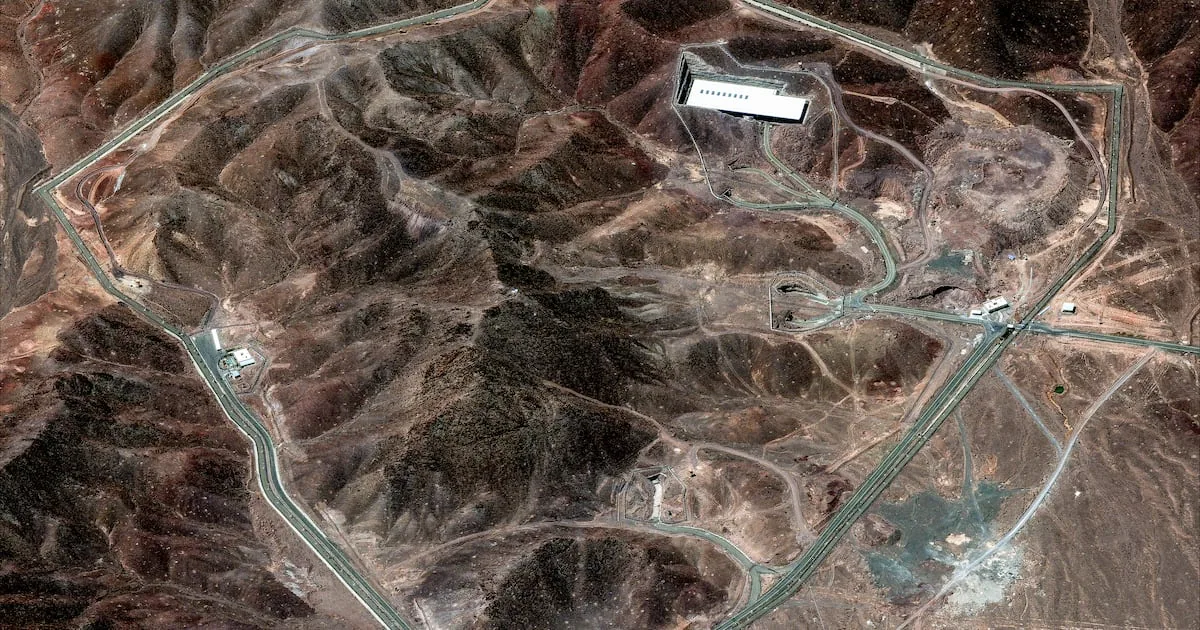
The site, known as Kuh-e Kolang Gaz La, or Pickaxe Mountain, is located on the southern slope of Iran’s Natanz nuclear enrichment center, which was bombed by the United States during Operation Midnight Hammer in the 12-day war between Iran and Israel in 2025. However, this mountain has remained untouched as Tehran continues to excavate the site.
“We have it in our sights and Pickaxe Mountain is a possible target for a good shot,” Trump told conservative host Hugh Hewitt. “Tell the Iranians to be prepared.”
Iran announced it would begin construction of the site in 2020, after a surface uranium enrichment plant in nearby Natanz was severely damaged in a possible act of sabotage. The following year, the then-head of Iran’s nuclear agency stated that it would be used to house “sensitive” equipment.
The Wall Street Journal noted that construction work at Pickaxe appears incomplete and it is unclear whether any activity, nuclear or otherwise, is taking place there. “During Israeli and U.S. airstrikes on Iran last year and this year, it was not deemed important enough to warrant bombing,” the newspaper said.
However, former U.S. and Israeli officials, who spoke to the newspaper, have indicated that the site, located under a mountain ridge more than 1,585 meters above sea level, could play a significant role in any future attempt by Tehran to revive and advance its nuclear program.
The Wall Street Journal reported last week that, according to U.S. officials, Trump is considering attacks on Pickaxe, as he leans towards expanding U.S. military operations in Iran after several days of briefings with his top advisors.
On Tuesday, Trump, in a conversation with reporters in the Oval Office, acknowledged the possibility that Iran may have moved centrifuges there, potentially to a depth that would test even the most powerful bombs in the U.S. arsenal.
“We are going to attack that area… probably very soon. And there’s nothing they can do about it,” Trump said.
Protected by anti-aircraft batteries, fences, and Iran’s paramilitary Revolutionary Guard, the facility spans 2.7 square kilometers on the country’s arid central plateau. It has multiple entrances visible in satellite images.
In 2023, an Associated Press article about the mountain included an analysis by experts from the James Martin Center for Nonproliferation Studies suggesting that Iran was likely building a facility at a depth of between 80 and 100 meters. Since then, excavations have continued at the site, with some experts suggesting it could be even deeper.
According to experts, the scale of the construction project indicates that Iran will likely be able to use the underground facility to enrich uranium, as well as to build centrifuges.
The Wall Street Journal noted that the site has been under U.S. and Israeli surveillance for years, but there are significant information gaps about it. Iran has refused to provide the International Atomic Energy Agency (IAEA) with information on the site’s design, and Rafael Grossi, the head of the United Nations agency, stated in March that inspectors should visit the site.
Read more Peru’s Justice extends Pedro Castillo’s preventive detention by one year for corruption case
Iran’s main nuclear facilities in Natanz and Fordow, where the country used large arrays of centrifuges to produce enriched uranium, a fissile material used in nuclear weapons, and in Isfahan, where Tehran manufactured uranium metal and converted uranium into the gaseous form in which it is enriched, have been heavily attacked by the United States and Israel in the last two years.</p
Some of the sites were bombed again this year, in part, analysts suggest, as an attempt to further bury fissile material believed to be at those locations.
Given that Washington has recently resumed military actions against Iran, U.S. officials are turning to new targets to weaken Tehran’s offensive capabilities and threats.
“Trump is concerned that the setbacks the 12-day war inflicted on Iran’s nuclear program could be reversed,” Dan Shapiro, who was a senior Pentagon official during the last year of Joe Biden’s administration, told The Wall Street Journal.
He commented that it might take some time for Iran to be able to begin enriching uranium and performing other work at the deep underground site, “but that makes the mountain a plausible target for an attack.”
Israeli intelligence believes Iran moved some of its enriched uranium stockpiles and advanced enrichment centrifuges to the Pickaxe Mountain facility after attacks last June, an Israeli source familiar with the matter told CNN.
The television network had previously reported that Iran had drastically intensified efforts to shield its near-weapons-grade uranium stockpile, deliberately collapsing tunnels and placing explosive booby traps at entrances.
When asked on Tuesday whether Iran had moved its advanced centrifuges to Pickaxe Mountain, Trump appeared to downplay the Israeli reports by stating: “We have no record of that.”
Andrea Stricker, a non-proliferation expert, told CNN that Trump should act to disable Pickaxe Mountain and thus prevent Iran from “restoring its enrichment capability or its option to develop nuclear weapons, and from accessing the thousands of centrifuges that constitute the remnants of its nuclear program.”
While a ground operation would be complex, the report by the Institute for Science and International Security (ISIS) noted several possible avenues for carrying out an attack.
Such a secret facility would require ventilation, heating, and cooling systems, as well as supply logistics, power supply, and personnel; all these elements present “vulnerabilities that, it appears, the United States and Israel could exploit,” according to the report.
However, attacks may not have the desired impact, as the main part of the facility is likely to be at great depth.
Read more Iran warns US military that they will commit war crimes if they attack bridges and power plants