









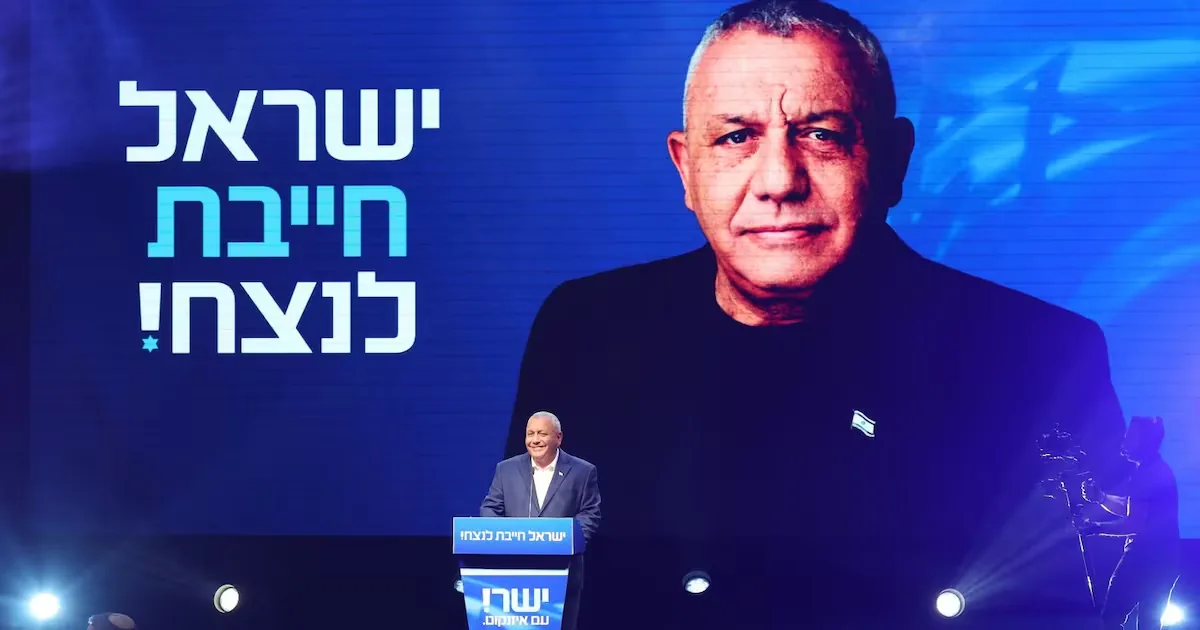
At 66 years old, Gadi Eisenkot has never led a ministry, is not very charismatic, and until a few months ago had never led a political party. Despite this, the former Chief of Staff of the Israel Defense Forces (IDF) surpasses Benjamin Netanyahu in several polls and is positioned as the main option to unseat the country’s longest-serving prime minister.
Read more The story of a Chilean nurse in the war in Ukraine
Israel will vote for its new Parliament on October 27, the last date allowed by law, after one of the most turbulent governments in its history due to corruption scandals, massive protests, and the start of the war against Hamas in 2023.
Netanyahu has defeated numerous rivals in three decades, but none are like Eisenkot. Other former generals reached the top before, although those who know him admit their surprise. Several describe him as the “anti-Netanyahu.” The military analyst for the Israeli newspaper Haaretz, Amos Harel, told the Financial Times that “he doesn’t give the typical image, he doesn’t possess overwhelming charisma, and he’s not one to deliver passionate speeches.”
The contrast starts from their origins. Netanyahu, of Ashkenazi descent, was born in Tel Aviv and educated in the United States. Eisenkot is the son of Moroccan immigrants and grew up in the working-class port of Eilat, in southern Israel. He belongs to the group of Mizrahi Jews – from North Africa and the Arab world – half of the Israeli Jewish majority, who have never had a prime minister. If elected, he would be the first of that origin.
Netanyahu and then-Defense Minister Moshe Ya’alon appointed him Chief of Staff in 2014 – making him the first military officer from a Mizrahi family in the position – and he left office in early 2019.
Eisenkot entered the Knesset – the Israeli unicameral Parliament – in 2022 on Benny Gantz’s list. But he separated from the former minister and, in September 2025, founded his own centrist party: Yashar, “Straight” in Hebrew.
In recent months, he led the polls for the first time. A survey by the public broadcaster Kan placed Yashar ahead of Likud by one seat, 24 to 23, in the 120-member Parliament, and gave Eisenkot 41% compared to Netanyahu’s 37% as best prime minister, according to the Financial Times.
Support for Eisenkot grew due to an episode almost all Israelis know. His son Gal, an IDF reservist, died in the occupation of Gaza in December 2023. At that time, Eisenkot was part of the war cabinet that Netanyahu formed after the Hamas attack on October 7, 2023, his only high-level governmental position to date.
Political analyst Dahlia Scheindlin linked that loss to the former general’s rise and the prestige of the Army, the most respected institution among Israeli Jews. “He paid the highest price for this war, which contrasts sharply with the current government,” she said, referring to Netanyahu’s attempt to exempt ultra-Orthodox Jews from compulsory military service, while his two sons have not joined the reserves.
Eisenkot’s military career includes episodes criticized by international justice. In 2006, as head of the Operations Directorate during the second Lebanon war, he created the Dahiya Doctrine, referring to the Beirut neighborhood where Hezbollah had its headquarters. The strategy involves razing civilian infrastructure and forcing population displacement to better counter armed groups.
He himself explained it in these terms to the Israeli newspaper Yedioth Ahronoth in 2008: “What happened in the Dahiya neighborhood in Beirut in 2006 will happen in every village from which fire is launched against Israel. We will use disproportionate force and cause immense damage and destruction there.”
Since October 7, the strategy has reappeared in both territories. Human rights organizations and governments have criticized its application in Gaza, with tens of thousands of civilians dead, and in Lebanon, with over a million displaced, according to Noon Post.
Read more Delcy Rodríguez announces a “master plan” for the “integral” reconstruction of Venezuela
In national security, Eisenkot differs from how Netanyahu has conducted offensives. He describes Iran as a “strategic threat” and refuses to call it an “existential danger” as long as it does not possess a nuclear weapon, and saw the 2015 nuclear deal as an opportunity to postpone confrontation. Recently, he accused the premier of exaggerating the Iranian nuclear threat for political and electoral reasons, and has shown openness to cooperating on security with Arab states against Tehran.
Eisenkot joined the war cabinet days after October 7 and supported the ground invasion of Gaza, but his distance from Netanyahu grew over the months. In January 2024, he called promises of “absolute defeat” of Hamas “unrealistic” and called for prioritizing a deal to recover the hostages.
He resigned from the cabinet in the middle of that year. “Once I understood that Netanyahu’s interests were no longer vital national security interests,” he told Channel 12 then.
He then added that “Netanyahu’s biggest problem is leadership. He doesn’t understand the word responsibility and doesn’t believe in setting an example.”
Like all candidates, Eisenkot demands the military and political elimination of Hamas. International Crisis Group senior analyst Amjad Iraqi anticipated to The New Arab that his government would try to maintain the pre-October 7 status quo in Gaza, Lebanon, and the West Bank, without drastic decisions.
On the Palestinian issue, he rejects the existence of a Palestinian state. “In my 66 years, I have never uttered the words ‘Palestinian state’,” he told the same broadcaster, but he also opposes the occupation of the West Bank and warned that “a reality in which we annex 2.8 million Palestinians to Israel will represent a serious threat to the Zionist project.”
Palestinian lawyer and analyst Diana Buttu described the October elections as “essentially a referendum against Netanyahu.”
“The main goal of all parties is to overthrow him,” she asserted. About the candidates, she was drastic. She pointed out that “they are all the same. They all want to attack the Palestinians.”
However, Eisenkot’s popularity would not guarantee a government. Polls place the opposition bloc a few seats short of the 61-seat majority in the Knesset. His commitment to compulsory and universal military service makes a pact with ultra-Orthodox Jewish parties and the religious right difficult.
Facing the threat, Netanyahu has sought to present Eisenkot as a defeatist, and analysts warn that his permanence should not be ruled out. Strategist Nadav Shtrauchler told the Financial Times: that the current prime minister “knows how to get by, as long as the flame is lit. I know many people who bet against him. And they usually lose.” Eisenkot, on the other hand, took on the task without seeking it, aware – according to Harel – of the “historic role” he had to play.
Read more Trump asserts freedom of speech at Correspondents’ Dinner postponed after shootings